
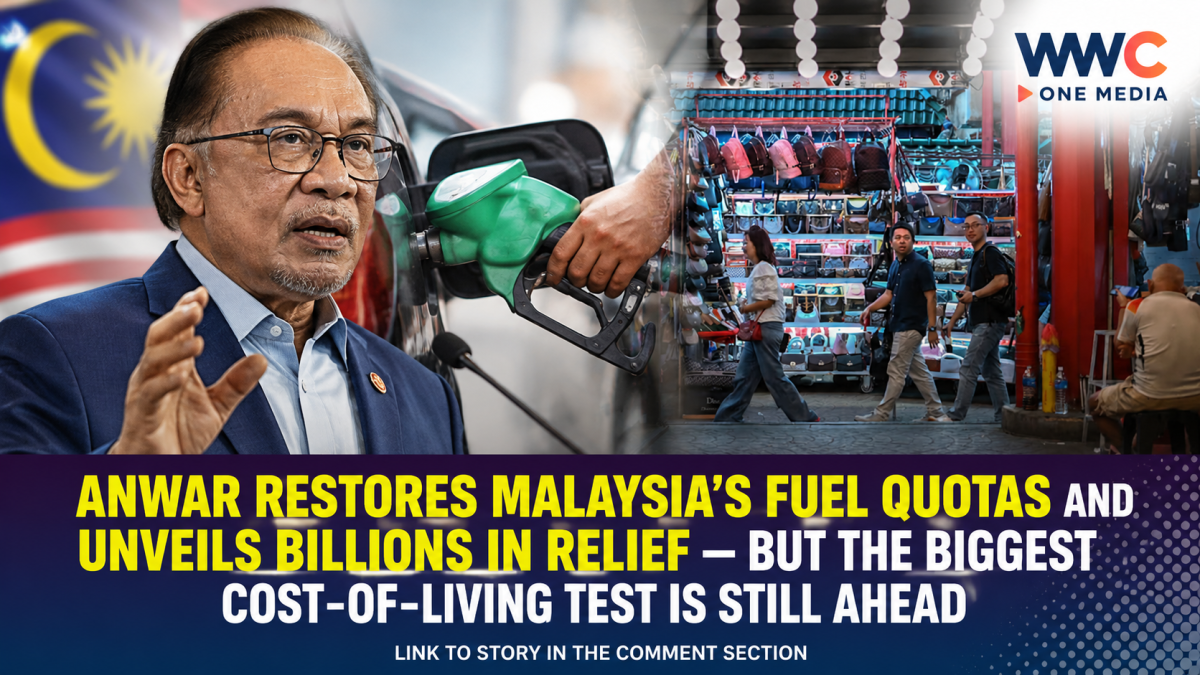
KUALA LUMPUR — Malaysian Prime Minister Anwar Ibrahim has unveiled a new package of measures aimed at easing cost-of-living pressure on households and giving smaller businesses more breathing room, including restoring higher subsidised fuel quotas, expanding microfinancing and reducing the number of companies required to adopt e-invoicing.
The measures, announced during Anwar’s National Day address on August 30, are due to begin taking effect from September 1, as his government tries to translate Malaysia’s surprisingly strong economic growth into benefits that ordinary households can feel more directly.
And that political challenge may be just as important as the economic one.
Malaysia’s economy expanded 6% year-on-year in the second quarter of 2026, accelerating from 5.4% in the previous quarter. But the strong headline number has not erased public concerns over everyday expenses, particularly food, housing and other recurring household costs.
Official data show headline inflation was 1.8% in July, while food and beverages inflation rose to 1.8% and housing, water, electricity, gas and other fuels also increased 1.8%. The relatively moderate inflation rate measures how quickly prices are rising — it does not mean prices that increased in previous years have returned to earlier levels.
That helps explain why Anwar is moving again on household assistance despite Malaysia’s strong economic performance.
Petrol Quota Goes Back Up to 300 Litres
For millions of Malaysian motorists, the most immediate change will come at the petrol station.
The government is restoring the monthly entitlement under the Budi Madani RON95, or BUDI95, programme from 200 litres to 300 litres per eligible user.
The government had cut the monthly quota from 300 litres to 200 litres beginning April 1 after soaring global oil prices increased subsidy costs.
The latest reversal means more than 16 million eligible users will again have access to as much as 300 litres of subsidised RON95 every month.
Eligible owners of diesel-powered pickup trucks and four-wheel-drive vehicles will also see their Budi Diesel entitlement rise to 400 litres per month, from 300 litres.
More than half a million eligible diesel vehicle owners are expected to benefit.
The move gives households that depend heavily on private vehicles some immediate protection from elevated global energy costs.
But fuel subsidies are only one part of the package.
Small Businesses Get a Major E-Invoicing Reprieve
Anwar also announced a significant change for smaller companies struggling with the cost and administrative burden of Malaysia’s expanding e-invoicing system.
Businesses with annual sales of RM3 million or less will now be exempt from mandatory e-invoicing, up from the previous RM1 million exemption threshold.
That effectively removes thousands of smaller companies from the immediate compliance requirement.
For micro and small businesses, the change could mean lower software, accounting and administrative costs at a time when many operators are dealing with higher wages, rent and input expenses.
The government is also adding RM1 billion in microfinancing facilities, bringing total available funding for 2026 from RM5 billion to RM6 billion.
A separate RM200 million Geran Sejahtera Madani programme will target hawkers, small traders, night-market vendors and mothers operating businesses from home.
Together, the measures show that Putrajaya is not treating the cost-of-living problem purely as a consumer issue. Supporting the small businesses that employ Malaysians and supply everyday goods is increasingly becoming part of the same strategy.
Schools Get a 50% Maintenance Boost
Another major announcement will affect Malaysia’s education system.
The government plans to increase funding for maintenance across all types of schools from RM1 billion to RM1.5 billion in 2027, a 50% increase.
The allocation covers national schools, Chinese and Tamil national-type schools, religious schools, tahfiz and pondok institutions and special-education facilities.
Anwar has instructed the Education Ministry to begin reviewing repair applications at district level so that maintenance work can start as early as January 2027.
Unlike the fuel and business measures, however, this part of the package is primarily a 2027 allocation rather than immediate September household relief.
RM1 Billion Push to Digitise Public Healthcare
Malaysia’s public healthcare system is also receiving a major technology injection.
The Malaysian Communications and Multimedia Commission will provide RM1 billion to improve digital infrastructure across the public health sector.
The funding is expected to support electronic medical records and better internet connectivity across 150 hospitals and more than 2,000 public health clinics.
The investment could eventually affect everything from patient records and referrals to appointment management and communication between healthcare facilities.
Anwar also said money legally seized or forfeited from corruption and other illegal activities would be redirected towards programmes benefiting the public, particularly education and healthcare.
That announcement carries an obvious political message: money recovered through enforcement actions should visibly return to public services.
Malaysia Is Also Betting on AI for Young People
One of the more unexpected measures targets Malaysians between 18 and 30 years old.
Under the expanded AI for the People programme, 100,000 young Malaysians who complete specified learning modules will be eligible for three months of free access to selected artificial-intelligence applications.
The applications named by the government include IlmuChat, Google’s Gemini Enterprise, Wonderclip and MuleRun.
Rather than functioning as traditional cost-of-living assistance, the initiative appears designed to improve digital skills and productivity among younger Malaysians as AI becomes increasingly important to employment and business creation.
The Bigger Question: Why Now?
The timing of the announcement matters.
Malaysia is producing economic numbers many governments would welcome.
GDP expanded 6% during the second quarter, supported by domestic demand and strong exports. Manufacturing grew 7.3%, while exports increased sharply during the period.
Yet economic growth and household confidence do not always move together.
Anwar acknowledged that Malaysians were still struggling with living costs, describing the latest measures as temporary relief rather than suggesting the problem had been solved.
There is also a growing political dimension.
Reuters reported that Anwar’s coalition has suffered defeats in three successive regional elections amid criticism over the pace of reforms and the government’s handling of several high-profile corruption controversies.
Those contests are being watched closely as indicators of voter sentiment before Malaysia’s next general election, which must be held by early 2028.
That makes the government’s ability to turn economic growth into visible improvements in household finances increasingly important.
And This May Not Be the Final Announcement
Perhaps the most significant part of Anwar’s address was what he said would come next.
The prime minister indicated that additional measures will be announced during Malaysia Day celebrations in Sarawak and through Budget 2027.
That means the September 1 package may be only the first stage of a broader attempt to reset the government’s economic message.
For Malaysian motorists, small traders and businesses, some benefits will arrive quickly.
But for Anwar, the larger question will take much longer to answer:
Can a government presiding over 6% economic growth convince Malaysians that the prosperity showing up in national statistics is finally reaching their wallets?




Leave a Reply