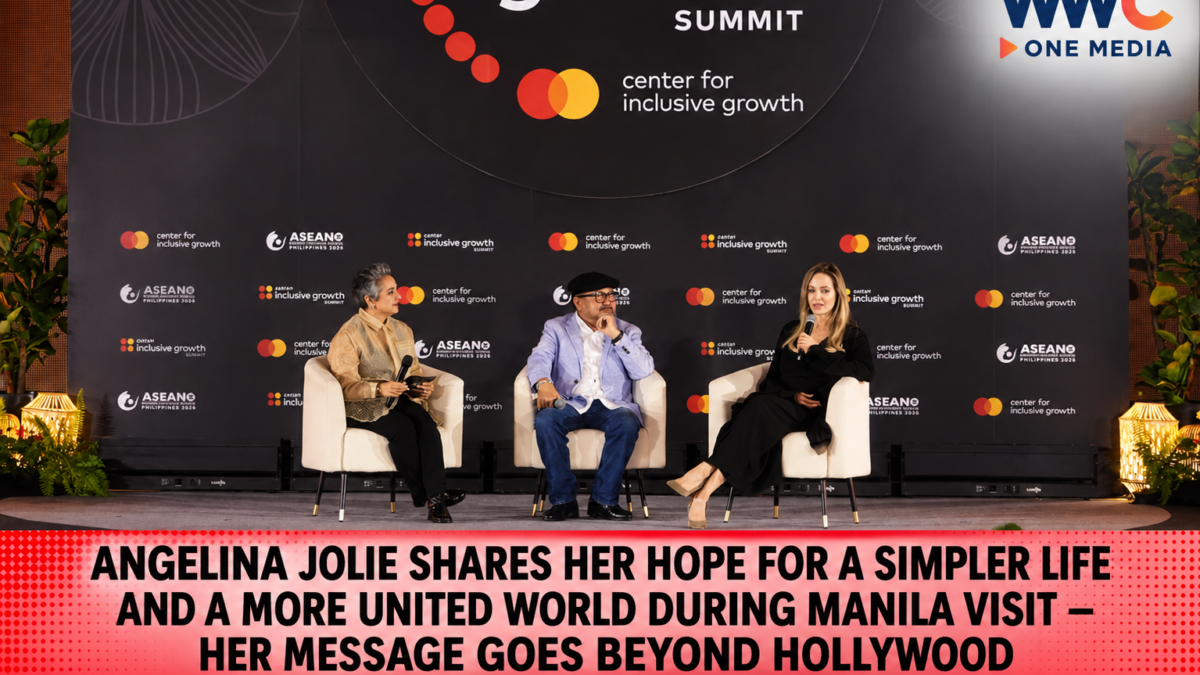
TAGUIG, Philippines — Angelina Jolie may be one of Hollywood’s most recognizable stars, but during her recent visit to the Philippines, the Oscar-winning actress and humanitarian offered a glimpse of a future that has little to do with fame, celebrity or the spotlight.
Speaking at the 2026 ASEAN Inclusive Growth Summit on November 11, Jolie reflected on motherhood, her decades-long relationship with Cambodia, the importance of humanitarian work and her hopes for the next generation.
Her message was personal but also carried a wider appeal: she wants a simpler, more peaceful life while continuing to help others — and hopes the world becomes more connected and united.
The 51-year-old actress shared these thoughts during a discussion titled “Cambodia, Courage, and the Power of Staying,” alongside Cambodian filmmaker Rithy Panh.
The conversation offered more than a celebrity appearance. It revealed how experiences that began with a film shoot more than two decades ago eventually shaped Jolie’s family life, humanitarian commitments and approach to helping communities become more independent.
Angelina Jolie Says Motherhood Changed Her Priorities
One of the most personal parts of Jolie’s Manila appearance was her reflection on being a mother.
The actress spoke about how her priorities have evolved over the years, emphasizing that her greatest hopes for the future are increasingly connected to her children and their well-being.
Jolie is the mother of six children: Maddox, Pax, Zahara, Shiloh, and twins Knox and Vivienne.
Philstar reported that she described motherhood as “the greatest gift” she has been allowed in her life, while also expressing gratitude for the countries and cultures that have welcomed her family.
When asked about her vision for the next decade, Jolie said she wanted to live more simply, spend meaningful time with her children and continue serving others.
Her message was not about abandoning her career. Rather, it reflected a desire to place greater value on peace, family, personal health and meaningful relationships.
The Philippine Daily Inquirer, through Asia News Network, also reported her hope for a more peaceful life and a world in which the next generation is more connected.
“It’s not a sacrifice to live a life for others, it’s a great joy,” Jolie said.
The statement became one of the defining messages of her Manila appearance.
How a Film Shoot in Cambodia Changed Angelina Jolie’s Life
Jolie’s connection to Cambodia began around 2000–2001, when she traveled to the country to film Lara Croft: Tomb Raider.
At the time, she knew about Cambodia’s painful history of conflict and displacement. However, she recalled being surprised by the warmth, openness and resilience of the people she encountered.
Rather than finding a community defined only by its difficult past, she met people whose strength and hospitality left a lasting impression.
That experience encouraged her to return.
In 2002, Jolie went back to Cambodia to volunteer at a school. During that visit, she eventually met Maddox, who was born in Cambodia and became her first adopted child.
Her connection to the country consequently became much more than a professional or humanitarian interest. Cambodia became part of her family story and a place she would continue to support through advocacy, community projects and filmmaking.
PhilSTAR Life reported that Jolie recalled having a clear feeling that her son was in Cambodia before she met Maddox.
Her experiences also influenced her decision to adapt Cambodian author Loung Ung’s memoir, First They Killed My Father, into a 2017 film.
The movie depicts Ung’s childhood during the Khmer Rouge regime and the devastating experiences endured by Cambodian families.
Jolie worked with Ung on the screenplay and collaborated with Cambodian filmmaker Rithy Panh, who joined her during the Manila summit discussion.
The project was significant because Jolie wanted the film to reflect Cambodian history and culture with the participation of people connected to the country.
Why Jolie Says Humanitarian Work Must Go Beyond Giving Aid
Another major theme of the summit discussion was the difference between providing short-term assistance and helping communities build lasting independence.
Jolie explained that meaningful humanitarian work requires people to spend time with the communities they hope to support.
For her, helping others should not be limited to arriving with a program, providing temporary assistance and leaving.
It also means listening, building relationships and understanding what people actually need.
She said she was happy to spend more time in places, develop friendships and become part of communities rather than simply observe their circumstances from a distance.
That approach has influenced her work in Cambodia.
Jolie recalled that the land around her Cambodian home was heavily affected by landmines when she first became involved in the area. In her conversation at the summit, she also discussed threats such as illegal gem mining, poaching and deforestation.
Vogue Philippines reported that Jolie recalled the discovery of 48 landmines during the early work to clear the area and make surrounding communities safer.
The work eventually expanded into conservation, livelihood development and support for local communities.
Jolie also discussed the importance of creating economic opportunities that do not destroy the environment or undermine the long-term well-being of residents.
Her goal, she explained, is to move from aid and relief toward investment that allows people to support themselves.
That means helping communities develop skills, protect their resources, preserve their traditions and create sustainable sources of income.
Angelina Jolie Wants Cambodia to Be Recognized for Its Culture and Potential
Jolie also challenged the way some countries are viewed in international discussions about development.
She argued that communities are often described primarily through poverty, conflict or dependence on foreign assistance, even when they possess rich cultures, talented people and valuable natural resources.
She emphasized that fair opportunities to trade, produce and develop local industries can help communities become more self-sufficient.
Her remarks placed particular importance on the need to support local creativity and economic participation.
Rather than treating humanitarian assistance as a permanent substitute for opportunity, she wants communities to have the resources and support needed to build their own futures.
This philosophy is also reflected in her creative initiative, Atelier Jolie, which aims to connect artists and makers with opportunities to share their work and reach wider audiences.
During the summit, Jolie discussed plans involving cultural restoration in Cambodia with Panh, including restoring historic buildings and theaters, supporting traditional practices and creating opportunities for artists.
She also expressed interest in establishing an artist residency where creative people could spend time, exchange ideas and work with local communities.
For Jolie, cultural preservation is not separate from economic development. It can help communities protect their identity while creating opportunities for future generations.
Her Message Also Raises Questions About Technology and the Next Generation
Jolie’s discussion in Manila was not limited to humanitarian work and family life.
She also reflected on how technology could reshape creativity, economics and politics over the next decade.
The actress emphasized the importance of preparing young people through education and training, particularly as new technologies change the way people work, create and communicate.
Her remarks come at a time when artificial intelligence is raising questions about creative ownership, employment, access to information and the concentration of economic power.
While she expressed hope that technology could help connect people across borders, she also stressed the importance of making thoughtful decisions about how future generations are educated.
The positive potential of technology, in her view, lies partly in allowing more people and countries to share their voices and creative work with the world.
Her hope is for a future in which greater connectivity leads to stronger understanding rather than deeper division.
Manila Summit Brought Together Angelina Jolie, Lea Salonga and Other Regional Figures
Jolie’s appearance was part of the 2026 ASEAN Inclusive Growth Summit, held in the Philippines on November 11.
The gathering brought together representatives from business, government, civil society and philanthropy to discuss opportunities for inclusive economic growth across Southeast Asia.
Other featured personalities included Filipino Broadway star Lea Salonga, former beauty queen and entrepreneur Kylie Verzosa, and fashion designer Rajo Laurel.
Business leaders and government representatives also participated in discussions about leadership, entrepreneurship, investment and regional development.
GMA News reported that Jolie joined Panh in discussing Cambodia’s history, resilience and long-term community development.
Her participation highlighted the importance of bringing cultural and humanitarian perspectives into conversations that often focus primarily on business and economic indicators.
The summit’s message was particularly relevant to Southeast Asia, where economic growth, environmental protection, cultural preservation and access to opportunity remain closely connected.
Public Figures Are Increasingly Using Their Platforms for Humanitarian Causes
Jolie’s remarks also reflect a broader conversation about the responsibilities and influence of public personalities.
Celebrities can use their visibility to draw attention to humanitarian issues, encourage public discussion and help audiences understand communities beyond their own borders.
But meaningful advocacy requires more than a public statement. It can involve long-term engagement, listening to affected communities and supporting initiatives that create lasting change.
WWC ONE MEDIA has previously covered this role through its report on Angel Guardian’s support for Gazini Ganados and her advocacy for Gaza, which examines how public figures can use their platforms to raise awareness of humanitarian concerns.
Another example is Michael J. Fox’s humanitarian recognition at the Emmy Awards, highlighting how an actor’s public influence can extend into long-term advocacy and support for people facing serious challenges.
Jolie’s own work has followed a similar long-term path, particularly through her involvement with refugee protection and displaced communities.
She served as a United Nations High Commissioner for Refugees (UNHCR) Goodwill Ambassador from 2001 to 2012 and later as Special Envoy from 2012 until 2022.
Her Manila appearance showed that her humanitarian interests remain closely connected to her public identity, even as she continues working as an actress and filmmaker.
Filipino and Asian Filmmakers Also Have a Role in Telling Their Own Stories
Jolie’s collaboration with Cambodian filmmaker Rithy Panh also highlights a wider issue in international cinema: the importance of allowing local artists and communities to help tell their own stories.
Her experience adapting First They Killed My Father demonstrated how filmmaking can become a way to preserve history and introduce audiences to experiences that might otherwise receive limited international attention.
The same question of representation is relevant to filmmakers across Asia.
WWC ONE MEDIA explored this creative journey in its coverage of Singapore filmmaker Ang Geck Geck Priscilla and her award-winning film Ah Girl, which examines how personal memories and local experiences can become stories with international appeal.
The growing international presence of Filipino performers is another part of this conversation. Read WWC ONE MEDIA’s report on Liza Soberano’s move beyond Philippine show business and her pursuit of Hollywood opportunities.
These stories are different from Jolie’s humanitarian work, but they share an important theme: artists can help bring local experiences, cultures and perspectives to wider audiences.
What Angelina Jolie Hopes the World Will Look Like in 10 Years
As the Manila discussion turned toward the future, Jolie returned to the personal values that have shaped her reflections.
She wants a simpler life, more time with her children and the opportunity to continue helping others.
She also hopes the next generation will be more connected than ever, with people and countries able to share their ideas, creativity and experiences across borders.
Her vision is not simply about technology making communication easier.
It is about building a world in which people listen to one another, recognize the value of different cultures and create opportunities that allow communities to become independent.
That message gives her Manila visit a significance beyond the appearance of a Hollywood celebrity at a regional summit.
It connects her experiences as a mother, filmmaker and humanitarian to a larger question about what progress should mean.
For Jolie, success is not measured only by recognition, wealth or professional achievements. It also involves the relationships people build, the communities they support and the opportunities they help create for others.
And perhaps that is the most memorable message she left in the Philippines: a simpler life does not necessarily mean doing less. It can mean focusing on what matters most.
As Angelina Jolie looks toward the next decade, her hope is clear: more meaningful connections, greater independence for communities and a world that is more united than divided.