
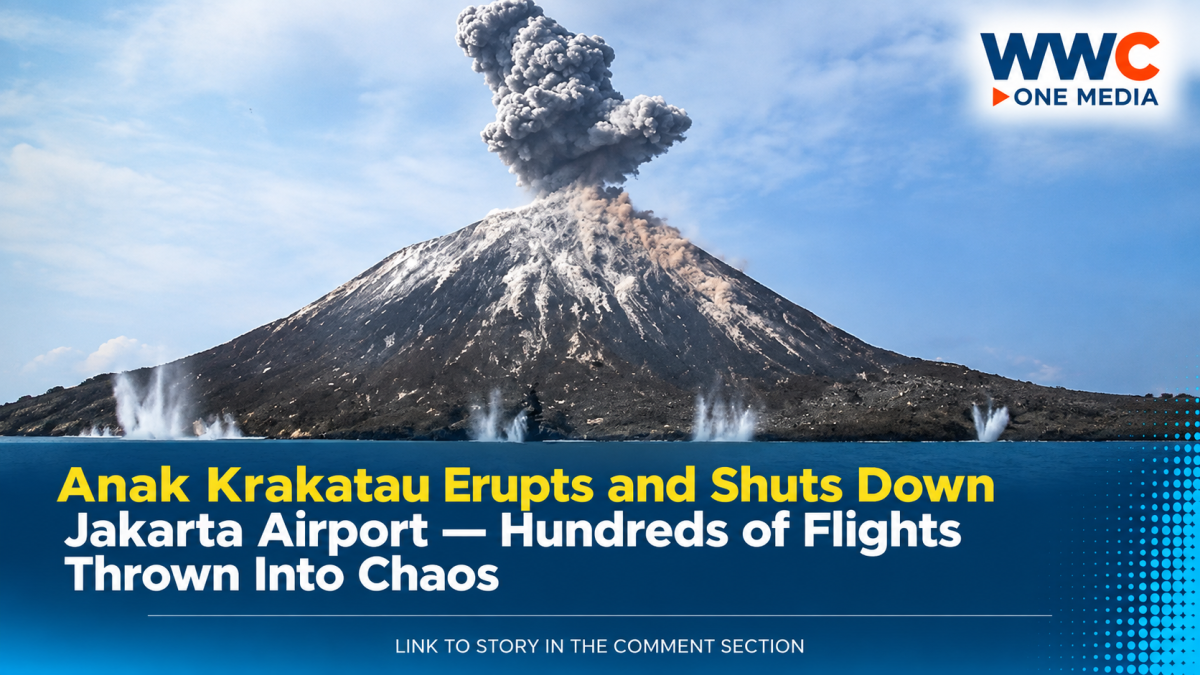
JAKARTA — Indonesia’s Anak Krakatau volcano has erupted, forcing authorities to temporarily suspend operations at Jakarta’s Soekarno-Hatta International Airport as volcanic ash spread across parts of western Indonesia and disrupted hundreds of flights.
The eruption sent ash high into the atmosphere, creating a major aviation hazard and prompting the closure of flight operations at Indonesia’s busiest airport early Sunday, Sept. 6.
The disruption affected both domestic and international passengers, with airlines cancelling and rescheduling services as authorities monitored the movement of the volcanic ash cloud.
Jakarta’s busiest airport temporarily suspends flights
Soekarno-Hatta International Airport initially suspended flight operations from 5.30am until 9.30am local time because of volcanic ash from the ongoing Anak Krakatau eruption.
Reuters reported that the disruption eventually affected 209 flights, including several international services, according to Indonesia’s Transportation Ministry.
Earlier official reports had cited a smaller number of affected flights, highlighting how rapidly the situation was changing as aviation authorities assessed the spread of ash.
Passengers at the airport faced cancelled departures, schedule changes and uncertainty over when normal operations would resume.
The closure was extended after volcanic ash was detected near the airport, demonstrating how quickly an eruption hundreds of kilometres away can affect one of Southeast Asia’s most important aviation hubs.
Why volcanic ash can shut down an airport
Volcanic ash is not ordinary smoke.
The tiny particles can cause serious problems for aircraft, including damage to engines and critical flight systems.
Ash can also reduce visibility and create dangerous conditions for pilots.
That is why aviation authorities may suspend flights even when the volcano itself is far from the airport.
AirAsia said the ongoing Anak Krakatau eruption had created extensive volcanic ash clouds affecting regional airspace, forcing some flights to and from Jakarta to be cancelled or rescheduled.
The situation remains fluid, with airlines monitoring flight paths and volcanic activity before determining whether normal services can safely resume.
Two enormous ash clouds were detected
Indonesia’s volcanology agency and the Darwin Volcanic Ash Advisory Centre detected two major ash clouds using satellite imagery.
One plume rose to approximately 20,000 feet, or about 6,100 metres, drifting northeast and affecting areas including Jakarta, Banten and West Java.
A second ash cloud climbed to approximately 50,000 feet, or more than 15,000 metres, moving westward and northwestward over parts of Banten, Lampung and Bengkulu, as well as sections of the Sunda Strait and the Indian Ocean.
The scale and direction of those ash clouds explain why aviation authorities were forced to take immediate action.
The volcano sits in the Sunda Strait between Java and Sumatra, but ash from an eruption can travel across a much wider area depending on wind conditions.
The eruption has been continuing since Friday
Reuters reported that Anak Krakatau had been erupting since late Friday, with authorities detecting volcanic ash at Jakarta’s airport early Sunday.
The Associated Press reported that the volcano showed signs of activity on Saturday before erupting for about 30 seconds at 3.53am on Sunday.
Authorities issued warnings for residents and visitors to keep away from the volcano’s active crater.
Despite the dramatic eruption and aviation disruption, there were no immediate reports of casualties, and no evacuation order was issued because the nearest settlement is more than 16 kilometres away.
Schools and fishing activities also disrupted
The impact of the eruption has extended beyond aviation.
Reuters reported that some schools cancelled activities on Saturday after residents and students experienced eye irritation from volcanic ash.
Some fishermen also cancelled fishing trips because of the eruption and ash conditions.
Indonesia’s disaster mitigation agency urged the public to remain calm but vigilant.
Residents affected by ashfall were advised to wear masks and eye protection, reduce outdoor activities, protect water sources and exercise caution while driving because volcanic ash can severely reduce visibility.
Is there a tsunami threat?
For many Indonesians, any major eruption involving Anak Krakatau immediately raises fears of another tsunami.
The volcano’s 2018 eruption triggered a devastating tsunami that killed at least 430 people and injured hundreds more on Java and Sumatra.
But Indonesian disaster authorities said there was no imminent tsunami threat from the current eruption.
That reassurance is significant given Anak Krakatau’s history.
The volcano emerged from the remnants of the legendary Krakatoa volcano, whose catastrophic 1883 eruption and resulting tsunamis killed more than 36,000 people.
Anak Krakatau’s very name means “Child of Krakatau.”
Airlines scramble as passengers face cancellations
Airlines operating in and out of Jakarta have been forced to make rapid adjustments.
AirAsia confirmed that some of its Jakarta services had been cancelled or rescheduled because volcanic ash posed a safety risk to aircraft operations.
Singapore Airlines services were also among flights affected by the wider disruption, according to Singapore media reporting.
Passengers travelling to or from Jakarta are being urged to check their flight status directly with their airline before leaving for the airport.
The disruption could continue to change depending on:
- Volcanic activity
- Ash cloud movement
- Wind direction
- Airspace safety assessments
- Airport operating conditions
Why Anak Krakatau is closely watched
Indonesia sits on the Pacific Ring of Fire, a highly active geological zone where earthquakes and volcanic eruptions are common.
The country has more than 120 active volcanoes.
But Anak Krakatau receives particular attention because of its history.
The current volcano emerged about a century ago in the area once occupied by Krakatoa, also known as Krakatau.
The original Krakatoa was destroyed during its catastrophic 1883 eruption, one of the most powerful volcanic events in recorded history.
More recently, the 2018 collapse of part of Anak Krakatau triggered a deadly tsunami, making every significant eruption a matter of national and international concern.
Authorities urge public to stay alert
Indonesia’s disaster mitigation agency has advised the public to remain calm while increasing vigilance.
Residents near areas affected by volcanic ash have been told to:
- Wear masks and eye protection
- Reduce unnecessary outdoor activities
- Protect water sources from ash contamination
- Drive carefully because visibility may be reduced
- Follow official warnings and evacuation instructions if conditions change
Authorities have also advised people to maintain a safe distance from Anak Krakatau’s active crater.
Hundreds of flights — and a volcano that is still being watched
The temporary closure of Soekarno-Hatta International Airport shows how quickly volcanic activity can disrupt everyday life in Indonesia.
One eruption has already affected hundreds of flights, disrupted schools and fishing activities and sent passengers scrambling for information.
For now, authorities say there is no immediate tsunami threat.
But the eruption and movement of volcanic ash remain under close watch.
Jakarta’s airport may have been temporarily shut down, but the bigger question is what Anak Krakatau does next.
Because for a volcano born from the ruins of Krakatoa, every new eruption carries a reminder of just how quickly nature can turn a regional event into a national emergency.
What travellers should do
Passengers travelling to or from Jakarta should:
- Check their flight status directly with their airline before going to the airport.
- Monitor airline alerts for cancellations or rescheduling.
- Allow additional time for rebooking and recovery arrangements.
- Avoid relying on previous flight schedules while volcanic activity continues.
- Follow official airport and aviation authority announcements.
AirAsia said affected passengers had been notified about their flight status and recovery options and urged travellers to check the latest information as conditions continue to change.
WWC ONE MEDIA J.M.D




Leave a Reply