
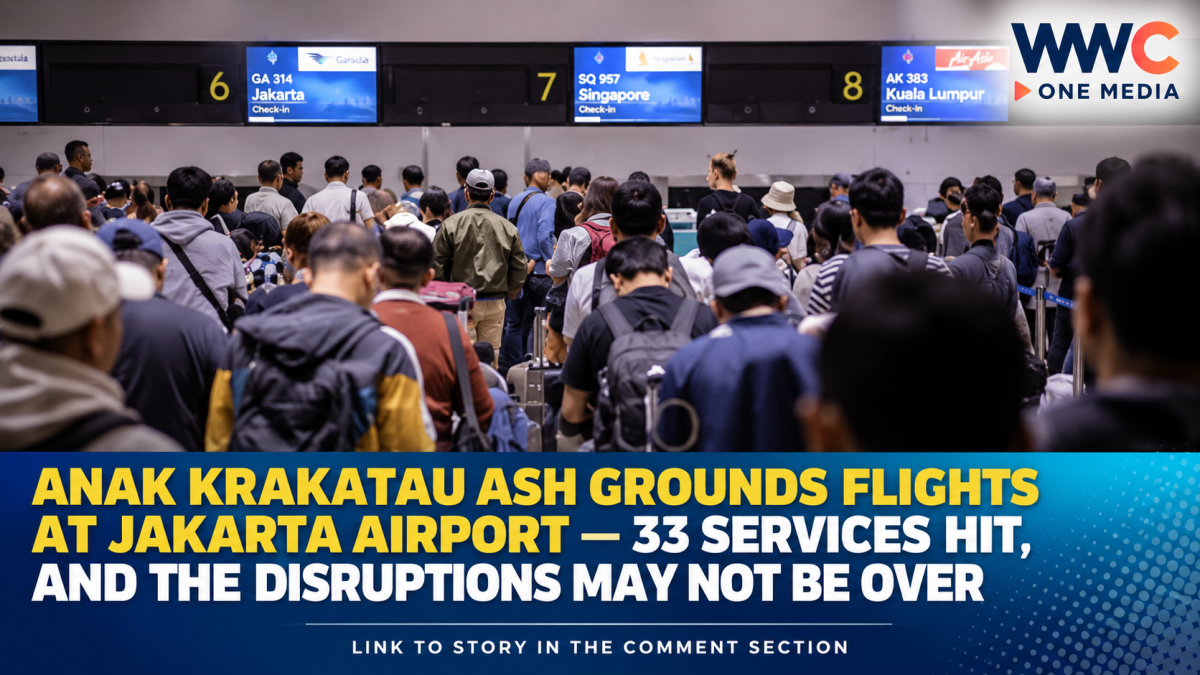
JAKARTA — Air travel through Indonesia’s main gateway was disrupted Sunday after volcanic ash from an ongoing eruption of Mount Anak Krakatau spread into the area of Soekarno-Hatta International Airport, forcing authorities to temporarily suspend operations and affecting dozens of flights.
The airport initially suspended operations from 1:30 a.m. to 5:30 a.m. local time on September 6, under a NOTAM issued by Indonesian aviation authorities. The suspension was subsequently extended until 9:30 a.m., according to the latest reporting. At least 33 flights were affected, including international services.
The disruption comes as Anak Krakatau continues an active eruptive phase in the Sunda Strait, with volcanic ash posing a serious aviation hazard.
33 flights affected
Indonesia’s Directorate General of Civil Aviation said monitoring data as of September 5 showed 33 flights affected at Soekarno-Hatta.
The international sector recorded:
- 16 cancellations
- 7 delays
- 5 rescheduled flights
Affected international routes included Singapore, Hong Kong, Sydney, Seoul/Incheon, Doha, Amsterdam and Kuala Lumpur.
Domestic operations were also affected, with four cancellations and one diverted flight involving routes to or from Lampung, Denpasar and Surabaya.
Authorities warned that the disruption could create a cascading effect involving aircraft rotations, available aircraft, connecting flights and terminal capacity as airlines attempt to recover their schedules.
Singapore Airlines cancels and reschedules Jakarta flights
The disruption has already affected Singapore Airlines.
SIA confirmed that it cancelled SQ966 from Singapore to Jakarta and SQ967 from Jakarta to Singapore on September 5.
It also rescheduled two additional services:
- SQ968 Singapore–Jakarta, originally scheduled for September 5, was moved to September 6.
- SQ951 Jakarta–Singapore, scheduled for September 6, was also retimed.
Singapore Airlines said the situation remains fluid and warned that other flights between Singapore and Indonesia could also be affected.
Passengers have been advised to check their individual flight status before heading to the airport.
AirAsia also reports disruptions
Singapore Airlines is not the only carrier dealing with the eruption.
AirAsia said the continuing eruption has produced volcanic ash clouds expected to affect regional airspace. The airline confirmed that a number of flights to and from Jakarta were cancelled or rescheduled, while some other services were adjusted because their flight paths could be affected.
AirAsia said affected passengers were being notified about their flight status and available recovery options.
Why volcanic ash is dangerous for aircraft
The airport closure was not simply a weather-related delay.
Volcanic ash can create serious hazards for aircraft, particularly because fine ash particles can enter jet engines, where they can melt and potentially disrupt engine operation. Ash can also reduce visibility and damage aircraft components.
That is why aviation authorities can halt or reroute flights even when an eruption is occurring many kilometers away from an airport.
In the Jakarta case, authorities said a paper test conducted shortly after midnight detected indications of volcanic ash at Soekarno-Hatta, prompting the temporary operational suspension.
Anak Krakatau remains on Alert Level III
The aviation disruption comes against a backdrop of heightened volcanic activity.
Indonesia’s Geological Agency said Anak Krakatau has been at Level III, or Siaga, since July 2, 2026.
The agency reported continuing Strombolian-type eruptions producing incandescent rocks and volcanic ash. On September 5, a continuing eruption accompanied by rumbling was observed, with the activity displaying characteristics of a lava-fountain eruption.
The eruption is occurring at the volcano in the Sunda Strait, between Java and Sumatra.
No current indication of a tsunami from a collapse
The volcano’s history makes the renewed activity particularly sensitive.
Anak Krakatau’s 2018 flank collapse triggered a devastating tsunami that struck coastal communities around the Sunda Strait.
However, authorities are not currently reporting an imminent tsunami threat from the present activity.
Indonesia’s Geological Agency said the portion of Anak Krakatau that has rebuilt since the 2018 disaster remains relatively small and, based on its latest assessment, does not currently have the scale of instability considered capable of producing a tsunami through collapse. Authorities are nevertheless continuing intensive monitoring of the volcano and its morphology.
That distinction is important: the absence of a current tsunami threat does not mean the eruption itself is harmless.
Officials continue to warn about lava, incandescent rock fragments and heavy ashfall.
Authorities impose a 3-kilometer exclusion zone
The Geological Agency is advising residents, visitors and tourists not to enter within 3 kilometers of the active crater.
The agency is also warning about possible hazards from lava flows, incandescent projectiles and heavy volcanic ash.
Indonesia’s disaster-management authorities are urging residents to rely on official information rather than unverified social-media reports, particularly concerning tsunami rumors.
Travelers across Southeast Asia should watch their flights
The immediate concern for travelers is less about the eruption’s distance and more about its impact on regional air traffic.
Soekarno-Hatta is a major international hub, meaning cancellations and aircraft repositioning can affect flights beyond Jakarta itself.
A delayed aircraft in Jakarta can also affect its next scheduled destination, potentially creating additional disruptions hours later.
That is why Indonesian aviation authorities are monitoring not only the ash itself but also the downstream effects on aircraft rotations, connecting flights and terminal capacity.
For passengers traveling through Jakarta, Singapore Airlines, AirAsia and other affected carriers are advising travelers to check their flight status directly before leaving for the airport.
What happens next?
The key variable is the movement and concentration of volcanic ash.
If ash continues to affect aviation corridors around Jakarta, airlines could face additional cancellations, delays and schedule changes. If conditions improve and aviation authorities determine that operations can safely resume, flights can gradually return — although the backlog may take longer to clear.
For now, the message from Indonesian authorities is clear: aviation safety takes priority over keeping the airport open.
And with Anak Krakatau’s eruption continuing, travelers across the region will be watching closely to see whether Sunday’s disruption remains a short-lived interruption — or becomes a much larger regional aviation headache.
WWC ONE MEDIA M.J.E




Leave a Reply