MANILA, PHILIPPINES — November 11, 2026 | WWC ONE MEDIA | Philippine Business, Renewable Energy, Investments and Financial Markets
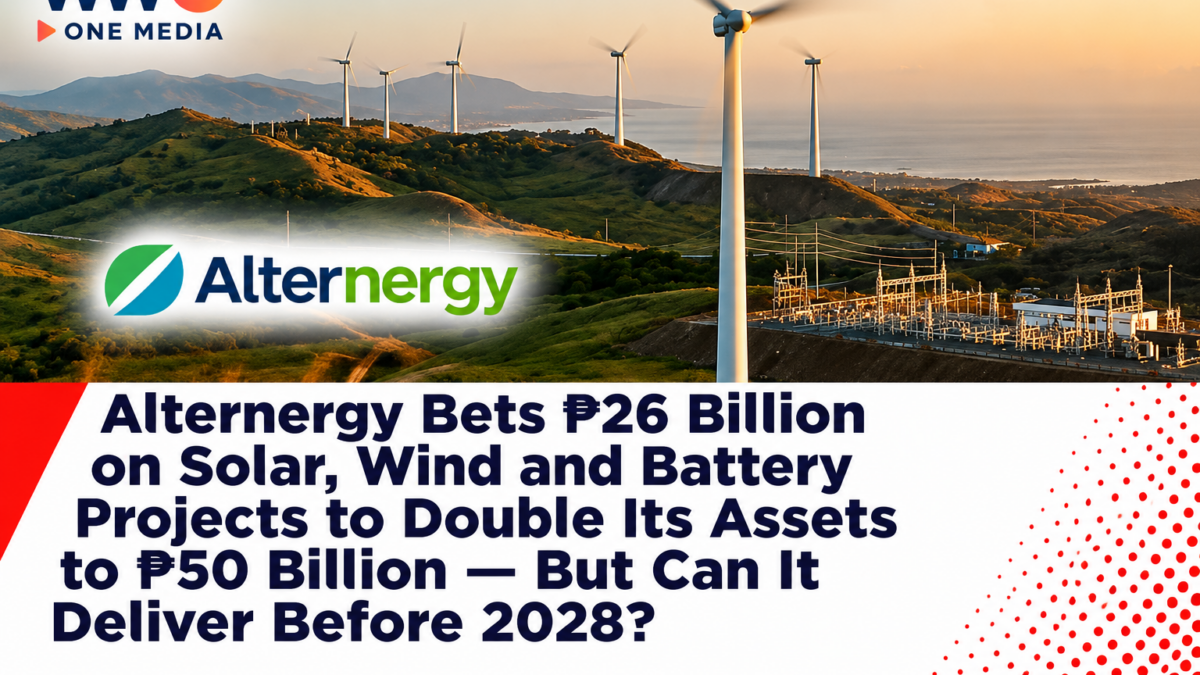
Philippine renewable energy developer Alternergy Holdings Corporation is preparing to double its asset base to approximately ₱50 billion within two years, backed by an ambitious ₱26-billion investment program involving solar power, wind farms and battery-supported energy projects.
The expansion marks a major growth push for the listed company chaired by former Energy Secretary Vince Perez, as it seeks to become a larger player in the country’s rapidly changing electricity industry.
During Alternergy’s annual stockholders’ meeting on November 10, Perez said the company, which currently has approximately ₱25 billion in assets, plans to develop three major renewable energy projects with a combined capacity of 320 megawatts (MW).
The projects will be located in Central Luzon, Mindanao and Cebu.
According to InsiderPH and BusinessMirror, Alternergy is seeking approximately ₱20 billion in project financing from banks, while the remaining ₱6 billion will form the equity portion of the planned funding structure.
The company is also preparing a ₱10-billion green bond program, with an initial offering of up to ₱4 billion targeted for the first quarter of 2027.
But doubling a balance sheet is not the same as doubling profits.
With billions of pesos in construction spending ahead, can Alternergy deliver its renewable energy projects on schedule and turn its growing asset base into stronger earnings—or will financing costs and development delays threaten its ambitious target?
Alternergy Wants to Grow From ₱25 Billion to ₱50 Billion in Assets
Alternergy’s latest announcement outlines one of its largest planned expansion programs.
Perez told investors that the company expects approximately ₱26 billion in additional project investment to significantly increase its current asset base.
The goal is to reach roughly ₱50 billion within two years, placing the target around 2028.
The company’s latest audited fiscal 2026 results showed total assets of approximately ₱24.6 billion as of June 30, an increase of 38% from the preceding year.
Management’s ₱25-billion figure is a rounded description of that asset base.
However, the ₱26-billion investment budget should not automatically be added to the current balance sheet as though every peso will become a net increase in reported assets.
Accounting treatment, ownership structures, financing arrangements and the timing of construction will affect the actual balance sheet.
The ₱50-billion figure is therefore a management target, not an already achieved financial result.
For investors, the key question is whether the larger asset portfolio will also generate sustainable revenue, earnings and operating cash flow.
Three Major Renewable Energy Projects Will Drive the Expansion
Alternergy’s new investment program focuses on three developments awarded under the Department of Energy’s fourth Green Energy Auction, known as GEA-4.
<escape> </escape>1. 140-MW Solar-on-Stilts Project — Central Luzon
The company plans to develop solar facilities above an existing fishpond.
The concept would allow the site to support electricity generation alongside aquaculture activities.
Such projects can potentially increase the productive use of land and water areas, but their commercial success depends on engineering, environmental requirements, construction costs and electricity sales.
2. 100-MW Solar and Battery Storage Project — Mindanao
The Mindanao development combines a solar farm with battery energy storage.
Battery systems can provide flexibility by storing energy for later use, subject to their capacity and operating design.
However, the project’s reported 100-MW size should not be interpreted as a separately confirmed 100-MW battery capacity. The detailed configuration of the storage system must be checked against project disclosures.
3. 80-MW Alegria Wind Farm — Cebu
Alternergy plans to develop a wind facility in Alegria, described by the company as Cebu’s first wind power development.
The project is intended to expand the company’s presence in the Visayas.
Combined, the three projects represent 320 MW of planned development capacity and approximately ₱26 billion in investment.
They form part of a larger 464-MW portfolio awarded to Alternergy under GEA-4.
Winning auction awards is an important commercial milestone, but the projects must still secure financing, complete construction and satisfy the relevant operating requirements.
Four Banks Compete to Finance ₱20 Billion in Projects
Alternergy’s management said it is in advanced discussions with four banks interested in financing the three developments.
The proposed funding structure includes approximately ₱20 billion in project-level financing and ₱6 billion in equity requirements.
Project financing is commonly used for large infrastructure developments because the expected future cash flows of an asset can help support borrowing.
However, lenders generally examine project economics, contracts, construction arrangements, risk allocation and the financial position of participating companies.
Perez said the initial green bond issuance would help support Alternergy’s equity requirements.
The company has not publicly identified the four competing banks in the coverage reviewed.
Nor has it confirmed that every financing agreement has been signed or that the entire ₱20 billion has been disbursed.
Until binding arrangements are finalized, the financing should be described as planned or under negotiation.
Alternergy’s ₱10-Billion Green Bond Program Is Central to the Strategy
On November 10, Alternergy’s board approved a proposed shelf registration of up to ₱10 billion in fixed-rate green bonds.
The company intends to issue the bonds in stages over five years rather than borrowing the full amount immediately.
Its initial transaction would consist of a ₱3-billion base offering, with an option to raise another ₱1 billion if demand and approvals permit.
Alternergy is targeting a listing on the Philippine Dealing & Exchange Corporation during the first quarter of 2027.
In related reporting, WWC ONE MEDIA examined Alternergy’s ₱10-billion green bond proposal, the planned ₱50,000 minimum retail investment and the risks investors should understand before participating.
The offering could widen Alternergy’s access to capital by attracting individual as well as institutional investors.
However, regulatory registration and final terms remain pending.
The interest rate, maturity and other conditions have not been finalized publicly.
A green bond is still a debt investment. Its environmental purpose does not remove credit, liquidity or interest-rate risk.
Why Alternergy Changed Its Preferred Share Financing Plans
The proposed green bonds replace an earlier financing plan involving perpetual preferred shares.
Alternergy has deferred that previous proposal indefinitely.
The change matters because the two instruments have different financial characteristics.
Corporate bonds generally create contractual debt obligations involving interest and principal repayment.
Preferred shares are equity securities with terms governing dividends and other shareholder rights.
Management’s decision indicates a shift toward debt-market financing for the next stage of development.
The company previously demonstrated access to credit markets through a ₱2-billion issue of fixed-rate enrolled corporate notes in September 2026.
Those notes carried a 7.75% annual interest rate.
However, investors should not assume the proposed 2027 bonds will carry the same coupon as the September notes.
The final rate has not yet been announced.
Alternergy’s Existing Solar and Hydro Projects Are Already Operating
The new investment plan comes as Alternergy begins receiving contributions from projects developed in earlier years.
Its 28-MWp Balsik Solar Farm in Bataan began commercial operations in February 2026.
The Dupinga run-of-river hydropower project in Nueva Ecija followed in March.
These facilities have moved beyond the construction stage and are now part of the company’s operating portfolio.
Two larger wind developments are also advancing.
The 64-MW Alabat Wind Farm and 128-MW Tanay Wind Farm have started generating electricity and recognizing commissioning-related revenue.
Full commercial operations are targeted for December 2026 and January 2027, respectively.
These dates remain management targets.
Electricity generated during commissioning does not necessarily mean the entire facility has reached full commercial operation.
In related coverage, WWC ONE MEDIA reported on Alternergy’s approximately ₱40-million common-share dividend and the progress of its wind, solar and hydropower projects.
The importance of these milestones is financial as well as operational.
Projects that begin commercial operation can start generating recurring electricity revenue under their applicable commercial arrangements.
For Alternergy, converting development assets into income-producing facilities is essential to funding further growth.
Alternergy’s Revenue Climbs 31%, but Net Income Barely Grows
The company’s latest audited results show that the transition toward operating assets is producing stronger revenue, although profit growth remains modest.
For the fiscal year ended June 30, 2026, Alternergy reported:
- Consolidated revenue of ₱471.8 million, an increase of 31%.
- EBITDA of ₱553.8 million, up 39%.
- Gross profit of ₱272.6 million, up 44%.
- Consolidated net income of ₱168.2 million, compared with ₱165 million a year earlier.
- Total assets of approximately ₱24.6 billion, up 38%.
Balsik Solar contributed approximately ₱96.4 million in revenue, while existing solar and wind facilities also supported the results.
The figures reveal the central challenge facing the company.
Revenue and operating earnings are growing more quickly than bottom-line net income.
That is not unusual for infrastructure developers undertaking significant construction and financing commitments.
But it reinforces the need to monitor borrowing costs, depreciation and the actual cash flows generated by newly completed projects.
A much larger asset base will only create lasting shareholder value if the underlying projects produce adequate returns.
Can Alternergy Achieve Its 1-GW Renewable Energy Ambition by 2030?
Alternergy has outlined a longer-term ambition of reaching one gigawatt of renewable energy capacity by 2030.
The proposed 320-MW GEA-4 program could be an important step toward that goal.
But the company must first deliver several overlapping development commitments.
Its Tanay and Alabat wind projects are approaching targeted commercial operation.
Its new projects will require financing and construction over the next two years.
And additional development opportunities may emerge through government energy auctions or private-sector arrangements.
The company describes its portfolio approach as a combination of solar, wind and run-of-river hydropower.
This diversification may help reduce reliance on one source of renewable generation.
However, each technology carries different risks.
Solar output depends on sunlight.
Wind output depends on weather conditions.
Run-of-river hydroelectric plants depend on available water flows.
Having several technologies can broaden the generation mix, but it cannot eliminate intermittency or guarantee continuous electricity production.
The Philippine Power Grid Could Become a Major Bottleneck
Renewable energy development depends not only on building power plants but also on connecting them to the electricity grid.
Solar farms, wind installations and battery systems require the necessary transmission or distribution arrangements before they can deliver electricity commercially.
The scale of the country’s proposed energy pipeline is substantial.
Those endorsements are preliminary milestones, not proof that the projects have secured final connections or begun operating.
For Alternergy, grid availability, equipment procurement, environmental approvals and construction schedules could influence when new facilities generate revenue.
Any significant delay could also increase financing costs.
That makes project execution just as important as raising money.
Green Financing Is Growing, but Debt Creates Obligations
Alternergy’s financing strategy reflects a wider trend in which renewable developers use corporate bonds and bank loans to fund energy infrastructure.
Banks and investment institutions are increasingly offering financing products linked to environmental projects.
For Alternergy, borrowing can allow major projects to be built without requiring the entire investment from existing shareholders immediately.
But debt also introduces repayment obligations.
The company must eventually generate enough cash to cover operating expenses, interest payments, required principal repayments and further investment.
The financing mix may change as bank negotiations progress and the green bond program moves through regulatory review.
Investors should therefore evaluate the company’s overall debt structure rather than focusing only on its planned increase in total assets.
What Alternergy’s Expansion Means for Filipino Consumers
Additional renewable projects could help diversify the country’s electricity generation mix.
Solar and wind facilities do not require the ongoing purchase of fossil fuels to generate electricity.
Battery storage may also help manage changes in renewable output and electricity demand, depending on how the systems are designed and operated.
However, new renewable capacity does not automatically translate into cheaper electricity for households.
Retail rates depend on generation contracts, grid costs, distribution charges, taxes and other factors.
The financial terms of a project’s power supply arrangements also matter.
For consumers, the most important long-term outcome would be additional reliable electricity at competitive costs.
For communities hosting the projects, potential benefits include construction activity, employment and local economic opportunities.
Actual employment numbers and community benefits will depend on the final project plans.
Five Major Challenges Alternergy Must Overcome
1. Securing the full financing package
The proposed ₱20 billion in bank financing and ₱6 billion equity requirement must translate into workable financing agreements.
2. Completing construction on schedule
Delays could postpone electricity revenue and increase project costs.
3. Managing debt and borrowing costs
New financing may accelerate growth, but it also creates long-term financial obligations.
4. Obtaining timely grid connections
Power projects must satisfy technical requirements before delivering electricity commercially.
5. Turning assets into sustainable profits
The ultimate test is not the size of the balance sheet but the returns and cash flows generated by the new portfolio.
The Bottom Line: Alternergy’s ₱50-Billion Ambition Faces a Two-Year Test
Alternergy is entering an ambitious new stage of development.
With approximately ₱25 billion in assets today, the company plans to invest another ₱26 billion in three renewable energy projects that could lift its asset base toward ₱50 billion by 2028.
The program includes 140 MW of solar capacity in Central Luzon, 100 MW of solar and battery-supported development in Mindanao, and an 80-MW wind project in Cebu.
To fund the expansion, Alternergy is pursuing ₱20 billion in project loans and ₱6 billion in equity-related financing, supported partly by its proposed green bond program.
Its existing operations are making progress, with Balsik Solar and Dupinga Hydro already commercially operational and two major wind developments approaching completion.
But the company’s earnings still need to catch up with its rapidly expanding asset portfolio.
Investors will be watching whether management can secure financing, finish projects on time and convert new capacity into dependable earnings.
Alternergy is preparing to transform itself into a roughly ₱50-billion renewable energy company within just two years. But with ₱26 billion in new investments, major bank financing still being negotiated and 320 MW of power projects waiting to be built, can the company deliver its biggest expansion yet—or will the race to grow test the limits of its finances?