
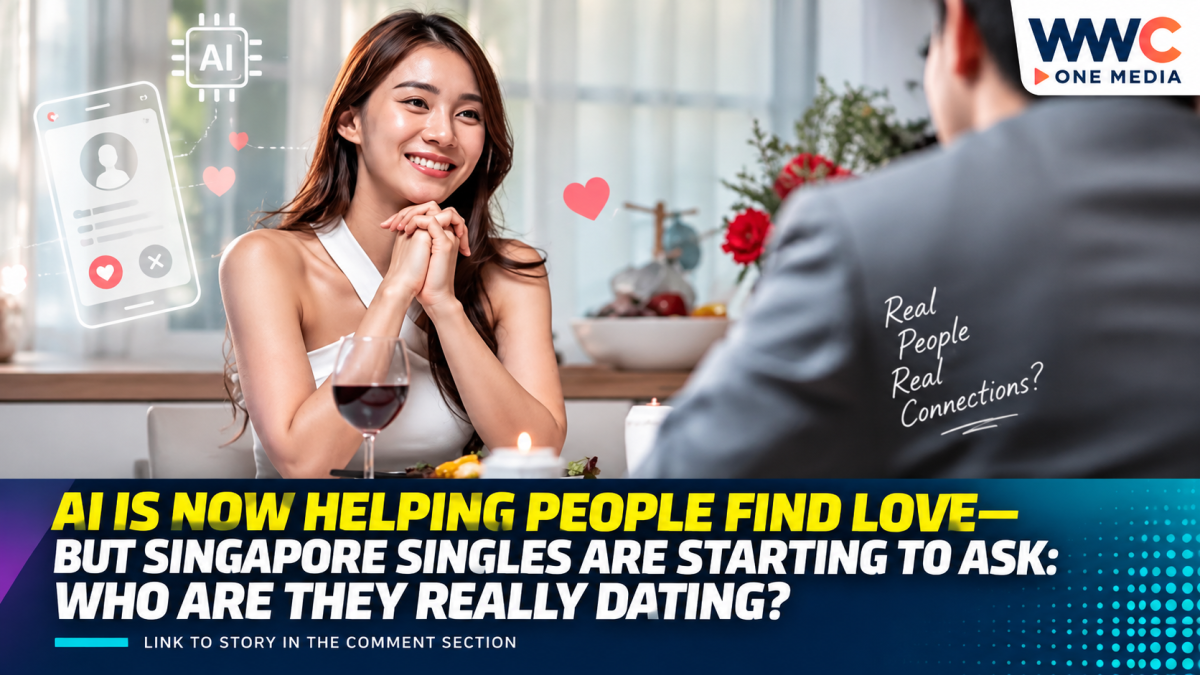
SINGAPORE — Artificial intelligence is quietly becoming a third party in modern dating, helping people write profiles, craft messages, plan dates and even interpret what a potential partner means. But as AI becomes more involved in the search for love, a bigger question is emerging: when technology helps create the impression, are people still getting to know the real person?
The issue was highlighted in a recent CNA TODAY report, which found that Singapore singles are increasingly encountering AI-generated profiles, AI-assisted messages and even synthetic intimate images while navigating dating apps. At the same time, other users say AI can be useful when it helps them overcome nervousness or find better ways to express themselves.
The result is a new dating dilemma: AI can make online romance easier—but it may also make authenticity harder to judge.
When the perfect message isn’t actually theirs
For some users, the warning signs are surprisingly subtle.
CNA spoke to a Singaporean woman who matched with a man on OkCupid whose polished biography and unusually formal messages initially impressed her. After they moved their conversation to Telegram, however, she noticed that his messages had distinctive formatting and wording that made her suspect AI was involved.
Eventually, he admitted that he had been using AI because he was “lazy” to text.
For her, the issue wasn’t simply that he had used a chatbot.
It was that she had believed she was getting to know his communication style when she was actually seeing something partly generated by a machine.
That distinction is becoming increasingly important as generative AI gets better at mimicking natural conversation.
AI isn’t necessarily the villain
Not everyone sees AI-assisted dating as deceptive.
One Singaporean man interviewed by CNA said he used ChatGPT to polish messages when he first matched with his now-girlfriend because he was nervous about texting. He said the messages remained his own thoughts, but AI helped him express them more effectively.
Another user said she uses AI for a second opinion when crafting messages or trying to understand what a match might be saying.
Dating experts interviewed by CNA similarly argued that the technology itself isn’t necessarily the problem.
The dividing line is how much of the interaction is actually coming from the person.
AI can help someone organise their thoughts, suggest a date idea or make a difficult message clearer. But using it to manufacture a personality—or effectively outsource emotional communication—creates a very different situation.
Singapore’s singles are already tired of swiping
The AI debate comes at a time when dating apps are already facing another problem: dating fatigue.
CNA reported earlier this year that some Singapore singles feel overwhelmed by the sheer number of potential matches available through apps.
Instead of creating more opportunities for meaningful relationships, an endless stream of profiles can produce what users describe as choice overload—the feeling that there is always another, potentially better option just one swipe away.
Industry players have responded by experimenting with more curated matching.
Coffee Meets Bagel, for example, limits the number of curated matches users receive each day and encourages conversations to move into the real world rather than continuing indefinitely inside the app.
That creates an interesting contradiction.
Dating technology was supposed to make finding someone easier. Yet some users now say the abundance of technology is making genuine connection harder.
Dating apps are turning to AI anyway
Despite those concerns, the dating industry is moving deeper into artificial intelligence.
Reuters reported in August that Bumble abandoned its long-standing women-first messaging rule, allowing either person in a match to initiate contact. The move came as dating companies grapple with user fatigue and slowing growth, while experimenting with new features and AI-powered tools.
The Guardian similarly reported that major dating platforms are increasingly looking toward AI as they try to move beyond the traditional swipe-and-match model.
Among the approaches being explored are AI-assisted matchmaking, conversation tools and systems designed to reduce the exhausting process of endlessly browsing profiles.
But that creates a difficult question for the industry:
Can AI solve dating-app fatigue without making dating feel even less human?
The fake-profile problem is getting harder
Authenticity is not merely a philosophical concern.
Dating platforms are also confronting increasingly sophisticated fake profiles, scams and AI-generated content.
Recent reporting has highlighted the growing use of AI-generated identities and other deceptive techniques, prompting dating platforms to introduce stronger verification systems.
That creates an unusual paradox.
The more convincing AI becomes, the more dating platforms may need technology to prove that users are actually human.
And that could mean asking users for increasingly intrusive forms of verification.
The emerging industry response includes facial recognition, video-selfie checks and other identity technologies. But privacy experts have warned that proving someone is human is not necessarily the same as proving that the person is trustworthy.
The danger goes beyond awkward messages
Singapore’s authorities are also dealing with the darker side of AI-generated intimate content.
From 17 August 2026, amendments to Singapore’s Penal Code explicitly extended the definition of intimate images to cover synthetic AI-generated material and introduced an offence for producing intimate images without consent. The offence can carry up to two years’ imprisonment, a fine, or both.
And the issue is not theoretical.
On September 3, the Singapore Police Force warned of a rise in cyber-extortion scams involving intimate images and sexually explicit video calls. Since August 2026, police had received at least 52 reports involving losses of at least S$134,000. Victims were commonly approached through dating apps or social media before being moved to messaging platforms.
Police advised people not to send intimate photographs or participate in sexually explicit video calls with people they have only recently met online, and warned that paying extortionists does not guarantee that material will be deleted.
So, can AI actually help people fall in love?
Possibly.
But experts cited by CNA argue that AI should remain a tool rather than a substitute for authenticity.
That could mean using AI to overcome writer’s block, organise thoughts or suggest conversation topics—while ensuring the actual feelings, intentions and values remain the user’s own.
There is also a practical argument for using AI responsibly.
For someone who struggles with anxiety or doesn’t know how to start a conversation, a little assistance could help them get past the first hurdle.
But there is a line.
If AI writes every message, prepares every response, analyses every interaction and constructs the perfect dating profile, the eventual first meeting could become a test of whether the real person can live up to the AI-assisted version presented online.
The dating-app paradox
Singapore’s dating scene may therefore be entering an unusual new phase.
People have more ways to meet than ever.
They have algorithms to recommend matches.
AI can help write messages.
Platforms can suggest conversation starters.
Verification systems can attempt to establish that someone is real.
And yet many singles are increasingly looking for something technology cannot manufacture: a genuine connection.
CNA’s earlier reporting found some Singapore singles turning toward offline events, curated matchmaking and face-to-face encounters amid frustration with swiping, ghosting and online dating fatigue.
The technology may continue getting smarter.
But the question facing modern daters may become surprisingly simple:
When you finally meet someone you connected with online, how much of the person you’re meeting was actually you—and how much was AI?
That may be the hardest match of all.
WWC ONE MEDIA M.J.E


Leave a Reply