
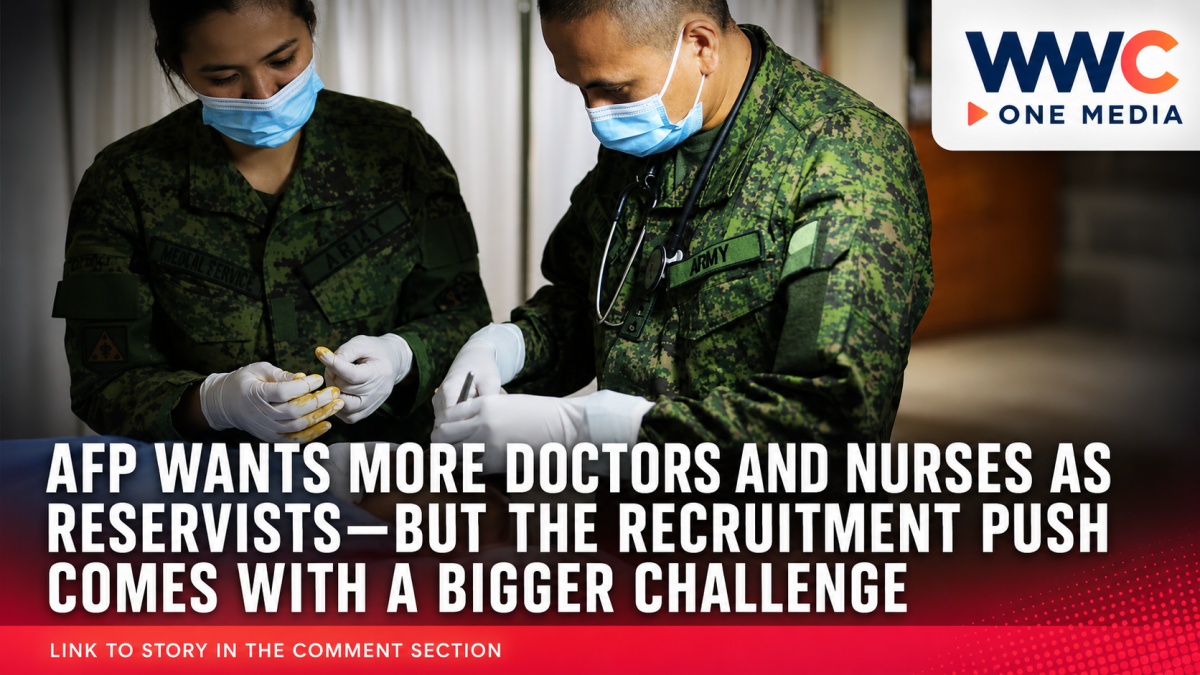
MANILA, Philippines — The Armed Forces of the Philippines is looking beyond traditional soldiers as it strengthens its reserve force, putting a growing premium on doctors, nurses and other licensed professionals whose civilian expertise could become critical when disasters, national emergencies or security crises strike.
The AFP Reserve Command, or AFPRESCOM, is stepping up efforts to bring more medical and other professionals into the military reserve system, according to a September 2 report by Manila Standard. The initiative is part of a wider effort to build a reserve force that can provide specialized capabilities—not simply additional manpower—when the country needs them.
And the push has already gone beyond public appeals.
AFP Turns to PRC to Find Licensed Professionals
In June, AFPRESCOM officials met with Professional Regulation Commission Assistant Commissioner Louis P. Valera to explore ways of encouraging licensed Filipino professionals to join the AFP Reserve Force.
Under the proposed cooperation, the PRC expressed support for placing an AFP reservist recruitment link on its website and allowing recruitment booths during oath-taking ceremonies for newly licensed professionals, subject to the submission of formal documents and a proposed memorandum of understanding.
That could potentially give the military a direct recruitment channel to thousands of newly licensed doctors, nurses and other professionals instead of relying primarily on conventional military recruitment campaigns.
The idea fits the structure of the AFP itself.
Philippine law recognizes specialized technical services within the military, including the Medical Corps, Dental Service, Nurse Corps and Veterinary Corps, while AFPRESCOM says its reserve ranks already include licensed physicians, dentists, nurses and pharmacists alongside lawyers, educators and other professionals.
For the AFP, that expertise can be particularly valuable because reservists are expected to do far more than prepare for conventional warfare.
Why Medical Reservists Matter
Under the country’s reserve-force framework, reservists may support the expansion of the Armed Forces during war, invasion or rebellion, but their mission also includes relief and rescue operations during disasters and calamities, socioeconomic activities and support for essential public services.
AFPRESCOM distinguishes between Ready Reservists, who maintain physical fitness and training and can be mobilized when ordered, and Standby Reservists, who provide a broader pool for expansion and augmentation when required.
That disaster-response role is hardly theoretical in a country repeatedly hit by typhoons, flooding, earthquakes and other emergencies.
On September 1, the AFP said it had deployed personnel, military vehicles and other humanitarian-assistance and disaster-response assets to Tarlac, Pampanga and Bataan as communities dealt with flooding linked to the southwest monsoon and Tropical Cyclone Pilandok.
The military said the deployments were meant to support local governments and disaster-response agencies in rescue operations as well as the transportation and distribution of relief supplies.
Medical reservists can add another layer to that response—from emergency medicine and nursing to medical evacuation, community health operations and support for overwhelmed facilities.
There is already a working model.
Civilian Hospitals Are Already Being Linked to the Reserve System
In July 2025, the Armed Forces and the Amai Pakpak Medical Center formalized the hospital’s affiliation with the AFP Reserve Program as a Reserve Military Treatment Facility.
Under that partnership, participating hospital personnel were expected to undergo military orientation and learn AFP organizational procedures to improve coordination during joint missions, disasters and other emergencies.
AFPRESCOM commander Brig. Gen. Ferdinand Geminic Ramirez described the partnership as extending the role of healthcare professionals beyond their hospitals by preparing them to support public welfare during national emergencies and calamities.
The arrangement illustrates what the military’s expanded professional-reservist strategy could eventually look like nationwide: civilian expertise remaining rooted in civilian institutions but organized and trained so it can be rapidly integrated into a larger national response.
But Expansion Comes as AFP Tightens Scrutiny of Reservists
There is another dimension to the recruitment drive.
The AFP announced in August that it was reviewing policies governing the recruitment, promotion and awarding of decorations to reservists, following controversy over military ranks, medals and qualifications involving members of the reserve force.
The military said it remains committed to meritocracy and that verified irregularities would be dealt with under existing regulations.
That review does not negate the drive to recruit doctors, nurses and other specialists. Instead, it highlights the challenge facing the AFP as it tries to expand the reserve system: how to attract highly qualified civilian professionals while ensuring military ranks, promotions and recognition remain tied to clear standards and genuine service.
That distinction may become increasingly important.
A highly trained trauma surgeon, nurse, pharmacist, engineer or communications specialist may offer the military capabilities that cannot simply be created through basic military training. But professional credentials alone do not eliminate the need for proper screening, military orientation, readiness requirements and accountability.
A Different Kind of National Defense
The AFP’s search for medical professionals reflects a broader evolution in what national defense now requires.
Modern emergencies are not limited to armed conflict. Typhoons can isolate entire towns. Earthquakes can overwhelm hospitals. Disease outbreaks can stretch medical systems. Large-scale evacuations can require logistics, communications, engineering and healthcare specialists at the same time.
A reserve force capable of drawing on civilian expertise could therefore become one of the government’s most flexible emergency assets—provided the professionals are properly trained, organized and deployed.
The Philippines already has doctors and nurses serving their communities every day.
The AFP’s bigger bet is that some of them may also be willing to answer another call when the country faces its next major crisis.
And as recruitment expands, the more difficult question will not simply be how many professionals the military can bring into the reserve force—but how effectively it can turn their civilian expertise into a disciplined, credible and rapidly deployable national capability.
WWC ONE MEDIA MJE




Leave a Reply