
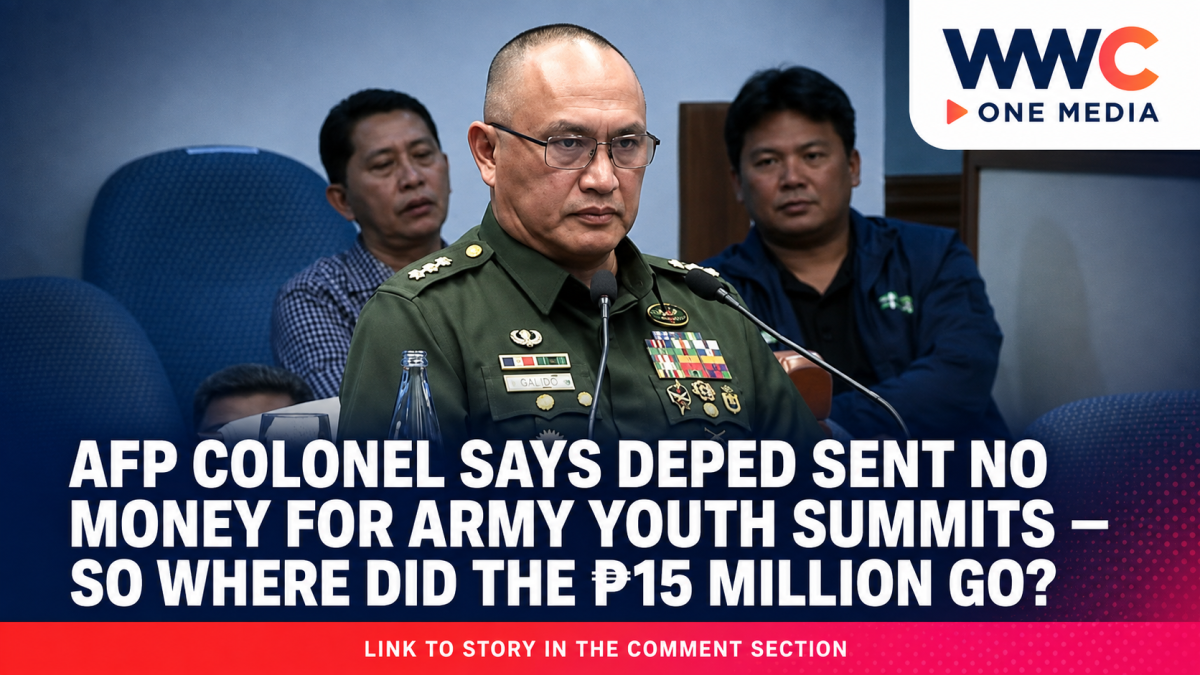
MANILA, Philippines — A military officer’s testimony has opened another crucial front in Vice President Sara Duterte’s impeachment trial after he told the Senate impeachment court that his Army division received no funding from the Department of Education for youth leadership activities in 2023 — despite military certifications later becoming part of the documentation connected to DepEd’s confidential-fund spending.
Retired Army Col. Manaros Boransing II took the witness stand on Tuesday, September 1, as the prosecution’s eighth witness under Article I of the impeachment case against Duterte. Article I centers on allegations involving the handling and liquidation of confidential funds of the Office of the Vice President and DepEd.
And the central question raised by his testimony is increasingly difficult to ignore:
If the Army did not receive the money, what exactly was the roughly ₱15 million in DepEd confidential funds spent on?
Boransing: No DepEd Money Reached the Army Unit
Under questioning by prosecution lawyer Reynaldo Robles, Boransing testified that the Philippine Army’s 1st Infantry “Tabak” Division did not receive funding from DepEd for its Youth Leadership Summit or Information Education Communication activities in 2023.
He also said the unit did not receive funding for those programs from the Office of the Vice President or the Vice Presidential Security and Protection Group.
According to Boransing, the Army used its own resources, while local government units provided support for participating local partners.
His testimony therefore reinforces an account he gave during a House investigation in October 2024: the military activities cited in the controversy were not financed using DepEd confidential funds.
That distinction matters because the military certifications became connected to documents submitted after the Commission on Audit questioned DepEd’s confidential-fund expenditures.
The ₱15-Million Question
The controversy goes back to DepEd’s ₱112.5 million in confidential funds in 2023, when Duterte was serving concurrently as vice president and education secretary.
During previous congressional proceedings, then-DepEd spokesperson and official Michael Poa said he asked then-Education Undersecretary and retired Maj. Gen. Nolasco Mempin to obtain certifications from military units.
Those certifications were subsequently connected to the liquidation of roughly ₱15 million reportedly spent as rewards for informants.
But the military officers who signed the certifications told lawmakers that they were not aware their documents would be used for that purpose. GMA News reported during the 2024 House inquiry that the certifications were associated with about ₱15.54 million in confidential-fund expenditures.
That creates the contradiction prosecutors are now trying to place before the senator-judges:
The military confirms the Youth Leadership Summits happened.
Military officers issued certifications concerning those activities.
But the Army officers say their units did not receive DepEd confidential funds to conduct them.
Meanwhile, the certifications became part of DepEd’s supporting documentation surrounding confidential-fund spending.
The impeachment court will ultimately have to determine what that chain of events proves — and, equally important, what it does not.
Military Officers Previously Said They Did Not Know the Certifications’ Purpose
Boransing’s testimony is not emerging for the first time.
During the October 2024 House inquiry, Boransing and other military officers acknowledged issuing certifications requested through DepEd but said they were unaware those documents would later be used in connection with the liquidation of confidential funds.
Philstar reported that the officers said the Youth Leadership Summits were financed mainly through military and local-government resources, not through DepEd confidential funds.
Former Education Undersecretary Mempin also previously said DepEd had not released money to the military units for the Youth Leadership Summits.
That prompted lawmakers at the time to ask the question now resurfacing in the impeachment trial: if the confidential money did not finance the Army program cited in the supporting documents, where did the money actually go?
Why Boransing’s Testimony Matters to Article I
Article I covers allegations surrounding a combined ₱612.5 million in confidential funds — ₱500 million associated with the Office of the Vice President and ₱112.5 million allocated to DepEd.
Prosecutors are attempting to establish that irregularities occurred not only in withdrawing and distributing the funds but also in documenting and liquidating how the money was supposedly spent.
Boransing’s testimony is potentially important because it gives the impeachment court a witness with direct knowledge of the Army unit and the programs named in the disputed certifications.
But his statement alone does not automatically prove that Duterte personally misappropriated the money.
Prosecutors still have to connect Boransing’s account with the audit records, DepEd documents, acknowledgment receipts, testimony from other officials and, ultimately, evidence concerning Duterte’s responsibility for the transactions.
The defense, meanwhile, will have the opportunity to cross-examine witnesses and challenge the prosecution’s interpretation of the documents and testimony.
Defense spokesperson Michael Poa has previously urged both sides to avoid terminology that could prejudge the controversy before the Senate impeachment court has evaluated the evidence.
Another AFP Officer Is Expected to Testify
Boransing is not expected to be the prosecution’s final military witness.
The Senate impeachment court also issued a revised subpoena for Col. Magtangol Panopio, another officer linked to military certifications used in connection with DepEd’s confidential-fund records. GMA News reported that Panopio was expected to testify after Boransing.
Michael Poa could also eventually become a prosecution witness. Poa served as a senior DepEd official and spokesperson during Duterte’s tenure at the department and is now part of her impeachment defense team.
Presiding Officer Sen. Francis Escudero previously said Poa could be called without a subpoena because he had indicated willingness to testify if necessary.
His testimony could become particularly significant because of his previous acknowledgment that he requested assistance in securing the military certifications later associated with DepEd’s confidential-fund liquidation.
The Bigger Question Has Yet to Be Answered
Boransing’s appearance may have answered one part of the controversy: his Army unit says it did not receive DepEd money for the Youth Leadership Summits.
But that answer leads directly to another question.
If DepEd’s confidential funds were reported as being spent on informants, while military certifications concerning separately funded Army programs were submitted in connection with the expenditure, prosecutors will now have to demonstrate exactly how those documents entered the liquidation process — who requested them, who approved their use, and where the confidential money ultimately went.
For the senator-judges deciding Duterte’s fate, the issue is no longer merely whether the Youth Leadership Summits happened.
The potentially decisive question is whether the paperwork presented to account for millions in confidential public funds accurately reflected what those funds were actually used for.
And after Boransing’s testimony, that ₱15-million question is far from settled.




Leave a Reply