
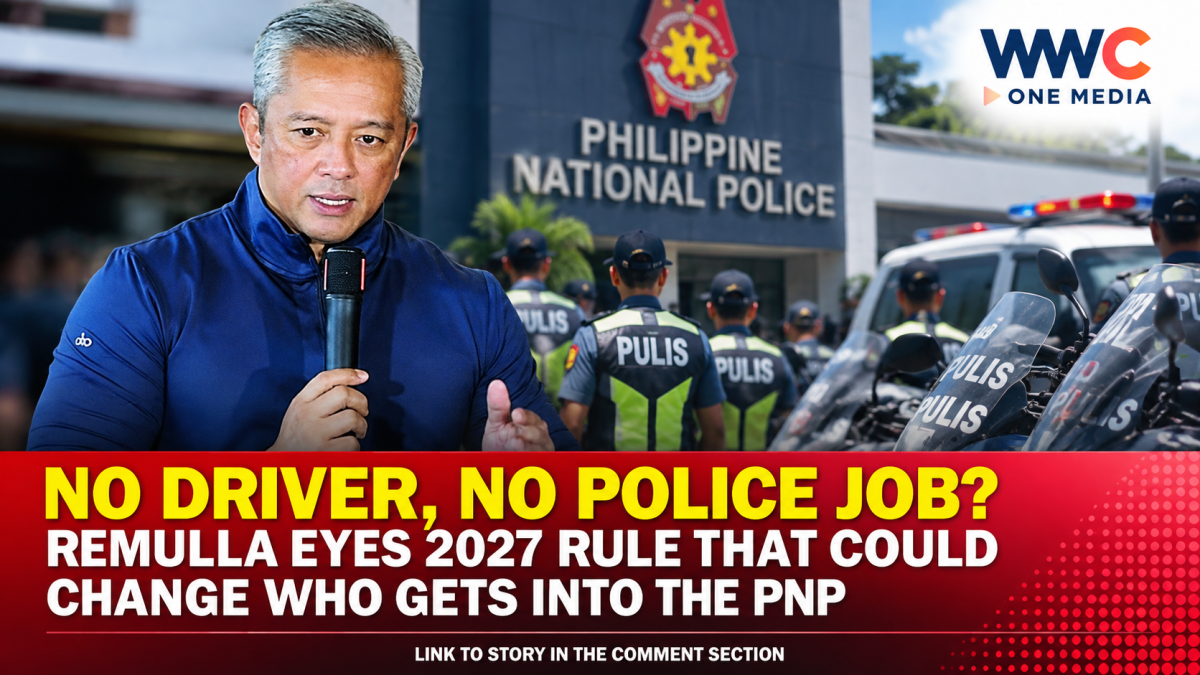
ILOILO CITY — A major change could be coming to the Philippine National Police, with Interior Secretary Jonvic Remulla saying the government is preparing a policy that would require police personnel—particularly new recruits—to know how to operate both motorcycles and four-wheel vehicles.
Remulla disclosed the plan on Wednesday, September 9, during the turnover of 20 Unified 911 emergency-response motorcycles to police units in Western Visayas.
The proposed requirement is aimed at addressing a practical problem inside the police force: vehicles are only useful if officers assigned to them can actually operate them.
“POLICE OFFICERS SHOULD KNOW HOW TO DRIVE”
According to Panay News, Remulla said the DILG plans to issue a memorandum circular in 2027 requiring police personnel to be capable of driving both motorcycles and four-wheel vehicles.
“Not only motorcycles, but four-wheel vehicles as well,” Remulla said, stressing that police officers should have the skills needed to use government-provided mobility assets.
The Philippine News Agency reported the proposal somewhat differently, saying the DILG is planning a memorandum circular before 2027 requiring new police recruits to know how to drive motorcycles and four-wheel vehicles.
The key point: the requirement is still a planned policy, not yet a nationwide rule already in force.
WHY THE DILG WANTS THE CHANGE
Remulla pointed to his experience as governor of Cavite, where the provincial government supplied hundreds of vehicles to police but found that a significant number of officers could not drive.
He recalled that about 800 vehicles were provided for roughly 2,000 policemen, but only around 800 officers knew how to drive.
That created a serious operational problem, particularly at night, when available vehicles could remain unused because there was no qualified officer available to operate them. Police personnel were subsequently trained to drive.
For Remulla, the lesson is straightforward:
Giving police more vehicles without ensuring enough trained drivers does not necessarily translate into faster emergency response.
20 NEW MOTORCYCLES FOR WESTERN VISAYAS
The proposed driving requirement comes as the DILG continues expanding police mobility under the Unified 911 emergency-response system.
Twenty Honda PCX160 emergency-response motorcycles were turned over to police units serving Iloilo City and Aklan. The motorcycles are intended to improve response times, particularly in areas where narrow streets and heavy traffic can make larger vehicles less practical.
The motorcycles are expected to be deployed to tourist police units and strategic locations, including areas under the Iloilo City Police Office and Aklan Police Provincial Office.
The Western Visayas deployment is part of a much broader national push.
Earlier in August, the DILG turned over 20 emergency-response motorcycles in Bicol, while 50 more motorcycles were deployed to Tourist Police Units in Eastern Visayas.
THE DRIVING SKILLS GAP INSIDE THE PNP
The numbers cited by Remulla underline why the proposed policy could become significant.
According to PNA, around 80% of the PNP’s approximately 230,000 personnel know how to ride a scooter, but fewer than half can drive a four-wheel vehicle.
That difference becomes particularly important as the government increases the number of motorcycles and vehicles available to police units.
The DILG’s argument is essentially that mobility equipment and personnel capability have to grow together.
UNIFIED 911 RAISES THE PRESSURE
The issue is also tied directly to the government’s expanding Unified 911 emergency-response system.
With emergency calls being routed through a unified system, expectations for police, fire and other responders are increasing.
Remulla said the public should expect faster and more capable emergency services, while emphasizing the need for police and other responders to be able to reach people quickly once a call comes in.
The DILG has been distributing emergency-response motorcycles in several regions specifically to improve mobility and shorten response times.
The Philippine Information Agency has described the broader rollout as part of the government’s effort to strengthen Unified 911 response capabilities across the country.
THIS COULD CHANGE POLICE RECRUITMENT
If the proposed policy is implemented, driving proficiency could become another practical competency expected of aspiring police officers.
That would represent a significant shift in emphasis: being physically and academically qualified to join the police force may not be enough if a recruit cannot operate the vehicles increasingly used for patrol and emergency response.
However, the final details—including exactly who will be covered, when the requirement will take effect, what type of driving qualification will be required, and whether existing personnel will be subject to the same standard—still have to be established by the DILG.
For now, Remulla’s announcement should therefore be understood as a planned policy direction rather than an immediately enforceable PNP recruitment rule.
THE BIGGER QUESTION
The government’s growing investment in emergency vehicles raises a simple question:
What happens when help is available—but there is nobody qualified to drive it?
That is the problem Remulla says the DILG wants to eliminate.
And if the proposed 2027 policy moves forward, knowing how to drive may become more than a useful skill for aspiring police officers.
It could become part of the job.




Leave a Reply