
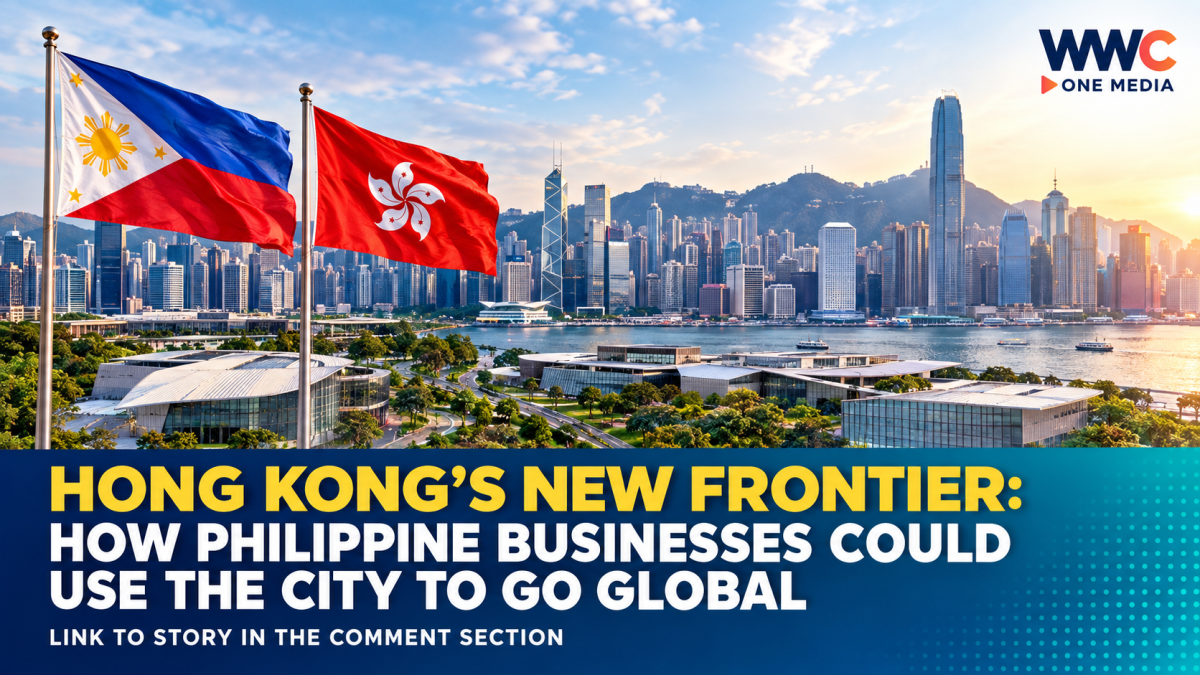
MANILA — Philippine companies looking to expand beyond the domestic market could find a new strategic gateway in Hong Kong, as the city accelerates development of its Northern Metropolis and strengthens its role as a bridge between Southeast Asian businesses, mainland China and international capital.
The opportunity is particularly relevant to the Philippines, which has developed major strengths in electronics manufacturing, business-process outsourcing, digital services and other export-oriented industries.
The emerging question is no longer simply how Filipino companies can compete overseas.
It is where they can build the connections, financing and technology needed to move further up the global value chain.
Hong Kong Wants to Become More Than a Financial Hub
Hong Kong has traditionally been known as an international financial centre and gateway to mainland China.
But the city’s development strategy is increasingly focused on technology, innovation, logistics and advanced industries.
At the centre of that strategy is the Northern Metropolis, a large development zone along Hong Kong’s border with Shenzhen.
The project is designed to combine innovation and technology activities in the north with Hong Kong’s established financial and professional-services strengths in the south.
Hong Kong authorities describe the Northern Metropolis as an important part of the city’s effort to deepen connections with the Guangdong-Hong Kong-Macao Greater Bay Area.
The Greater Bay Area itself represents a huge economic ecosystem linking Hong Kong, Macau and major mainland cities including Shenzhen and Guangzhou.
Why the Philippines Is Part of the Opportunity
The Philippines already has an established position in several global supply chains.
Its electronics industry exports components and other products to international markets, while its large English-speaking workforce has helped make the country a major global centre for business-process outsourcing and knowledge services.
The next stage is potentially more ambitious: moving into higher-value activities such as product development, engineering, technology and regional management.
Hong Kong’s proposition is that Philippine companies can maintain manufacturing, engineering or service operations in the Philippines while using Hong Kong for functions such as regional headquarters, financing, research and development and international business connections.
That could give companies access to markets and resources that are difficult to build independently.
Northern Metropolis Puts Innovation at the Centre
The Northern Metropolis is planned as a major innovation and technology cluster.
One key component is the San Tin Technopole, which is designed to support research and development and new industrialisation in areas including life sciences, artificial intelligence, robotics and green technology.
The Hong Kong-Shenzhen Innovation and Technology Park is another important component, providing infrastructure intended to facilitate cross-border movement of talent, capital, data and goods.
Plans also include expanded data-centre and logistics infrastructure.
That combination could be particularly significant for businesses that need both advanced technology and access to international financial services.
A Direct Link to the Greater Bay Area
One of Hong Kong’s biggest advantages is geography.
The city sits immediately next to Shenzhen, one of China’s major technology and manufacturing centres.
That proximity gives businesses based in Hong Kong access to a much larger industrial and consumer ecosystem while retaining Hong Kong’s international financial infrastructure and legal and professional-services environment.
Hong Kong officials have increasingly promoted this “hub-to-hub” model, in which companies and economies use Hong Kong as a connecting point between mainland China, ASEAN and global markets.
At the 2026 Belt and Road Summit, Hong Kong officials again emphasized the city’s role as a gateway linking Belt and Road economies with mainland China and international markets. The Sept. 9 summit brought together more than 6,000 participants, with more than 60 memoranda of understanding expected to be witnessed.
ASEAN Is Becoming More Important
The Philippines is also entering this conversation as part of a wider ASEAN growth story.
Hong Kong’s Financial Secretary Paul Chan said at the 2026 Belt and Road Summit that ASEAN has consistently outpaced the global economy and is becoming increasingly important in technology and industrial upgrading.
He also highlighted the region’s young population, growing middle class and expanding technology sector as important long-term growth drivers.
Hong Kong’s strategy is therefore not solely about attracting individual Philippine companies.
It is about positioning the city within a broader network connecting ASEAN production and consumption with Chinese manufacturing, technology and global capital.
The Philippines Already Has a Trade Connection With Hong Kong
The economic relationship is not starting from zero.
Trade between the Philippines and Hong Kong has long benefited from the ASEAN-Hong Kong Free Trade Agreement, which entered into force for the Philippines and Hong Kong in 2019.
Hong Kong has also historically served as an important commercial and financial centre for Philippine companies operating across Asia.
The new opportunity is to move beyond traditional trade and use the relationship for investment, innovation and international expansion.
The Bigger Opportunity: Moving Up the Value Chain
For Philippine businesses, the most important issue may not be simply gaining another export market.
It is increasing the value of what the country produces.
A company that begins with manufacturing, outsourcing or commodity-linked activity can potentially expand into product design, research, technology development, branding, financing and international distribution.
That transition is difficult.
It requires capital, skilled workers, technology and connections with international customers.
Hong Kong’s pitch is that its financial system and proximity to the Greater Bay Area can help provide some of those ingredients.
But Philippine companies would still need competitive products, strong management and sustainable business models. A Hong Kong base alone would not guarantee global success.
A New Asian Business Map Is Emerging
The shift also reflects a broader transformation taking place across Asia.
Companies are increasingly spreading production and business functions across multiple economies rather than relying on a single location.
ASEAN countries are competing for manufacturing, technology and investment, while cities such as Hong Kong and Singapore are positioning themselves as regional headquarters and financial centres.
At the same time, major economic corridors such as the Greater Bay Area and the Johor-Singapore Special Economic Zone are being developed to connect production, infrastructure, technology and capital more efficiently.
The competition is therefore no longer simply between individual countries.
It is increasingly between regional economic ecosystems.
Why This Matters for Philippine Companies
For Filipino entrepreneurs, the opportunity is potentially significant.
A company can remain anchored in the Philippines while using Hong Kong to reach international investors, professional services and markets in mainland China and elsewhere in Asia.
The model could be particularly relevant for technology companies, advanced manufacturers, exporters, logistics businesses and firms seeking international capital.
But there is also a strategic challenge.
The Philippines must ensure that the value created by international expansion continues to benefit its domestic economy through jobs, investment, technology transfer and stronger local supply chains.
Hong Kong’s Next Test
Hong Kong is betting that the Northern Metropolis can help transform its economic role.
Instead of functioning primarily as a financial gateway, the city wants to become a value-adding platform connecting finance, technology, manufacturing and global business.
For Philippine companies, that could create a new route from Southeast Asian operations to international markets.
The opportunity is real, but so is the competition.
As Asian economies race to attract the next generation of manufacturers, technology companies and investors, the companies that benefit most will likely be those able to combine Philippine talent and production strengths with regional capital, technology and market access.
And that is where Hong Kong’s new frontier could become particularly important.
The question now is not whether Philippine companies can go global. It is whether they can move quickly enough to capture the new Asian growth corridors taking shape around them.
WWC ONE MEDIA G.A



Leave a Reply