
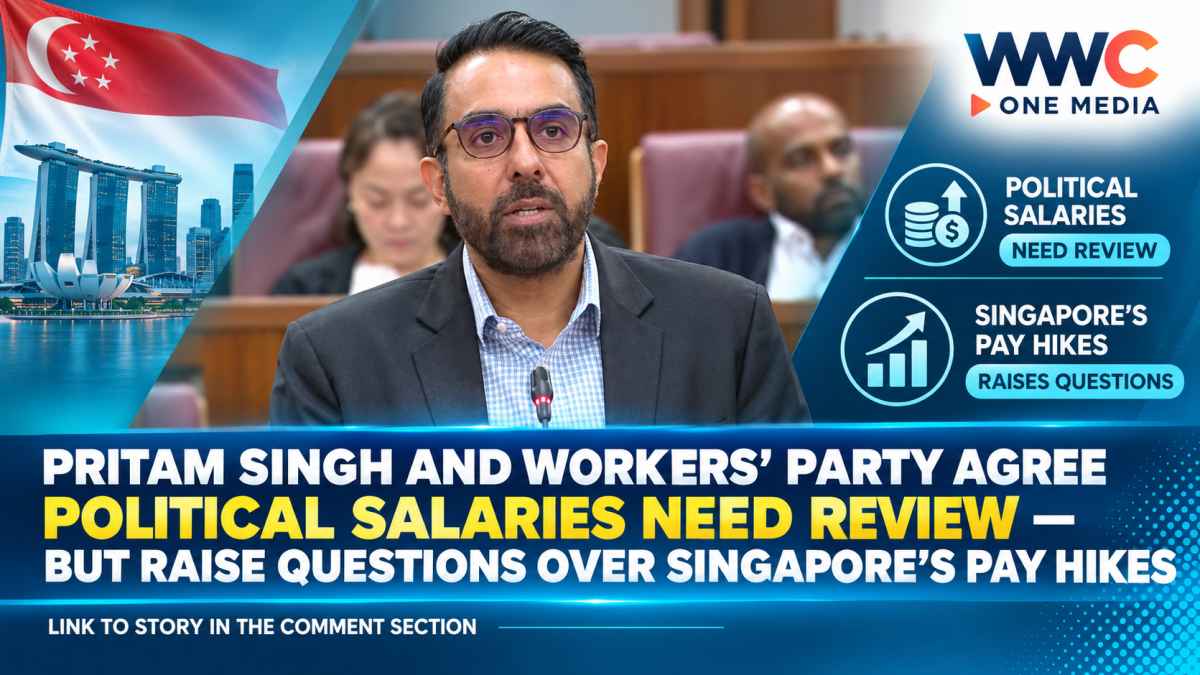
SINGAPORE — Singapore’s debate over higher political salaries took an interesting turn as Workers’ Party (WP) chief Pritam Singh and the opposition party signalled that they agree with a key principle behind the Government’s latest pay review: political leaders must be paid enough to attract capable people into public service.
But agreement on the principle does not necessarily mean agreement on every detail.
The debate comes after Prime Minister Lawrence Wong’s Government accepted recommendations from an independent committee to update Singapore’s political salary framework — including higher salary benchmarks for ministers and increased monthly allowances for Members of Parliament (MPs).
Ministers and MPs Set for Higher Pay
Under the revised framework, the benchmark salary for a minister at the entry-level MR4 grade will rise from S$1.1 million to S$1.8 million a year.
However, existing ministers will not immediately receive the full S$1.8 million benchmark.
Instead, current political office holders will receive a one-off salary adjustment of up to 9 per cent from October 15, depending on individual circumstances, including performance and when their salaries were last adjusted.
An MR4 minister currently earning the S$1.1 million reference salary could therefore see annual pay rise to around S$1.2 million with the maximum adjustment.
MPs will also see their monthly allowance increase from S$13,750 to S$18,500, effective October 15.
Pritam Singh and WP Find Common Ground on Principle
The political salary issue has long been contentious in Singapore, but there has also been significant agreement across the political divide on some fundamental principles.
Prime Minister Wong noted that during Singapore’s previous major political salary debate, there was considerable convergence between MPs from the ruling People’s Action Party and the Workers’ Party.
That included the view that political salaries should be:
- Transparent
- Free from hidden perks and privileges
- Competitive enough to attract capable individuals
- Subject to a meaningful discount to reflect the ethos of public service
The Government’s current framework was built around these principles, with ministerial salaries benchmarked against private-sector earnings and discounted to reflect the public-service nature of political office.
Why the Government Says the Increase Is Necessary
PM Wong acknowledged that political salaries are a difficult and emotionally charged issue.
But he argued that Singapore could not indefinitely maintain a salary framework in principle while repeatedly postponing adjustments in practice.
Political salaries have remained largely unchanged for about 15 years, while pay in the private sector, civil service and other parts of Singapore’s economy has continued to move.
The Government argues that competitive remuneration is necessary to ensure future prime ministers can continue attracting capable Singaporeans from the public service, private sector and other fields.
PM Wong said he had personally approached senior business leaders before the last General Election but found that none was prepared to make the move into politics.
He stressed that salary is only one factor, alongside family pressures, public scrutiny and career sacrifices.
The Opposition’s Bigger Question
The debate is therefore not simply about whether Singapore’s political leaders should ever receive higher pay.
The more difficult questions involve:
How much should they earn?
How should increases be calculated?
Should politicians’ pay rise in the same way as private-sector salaries?
And perhaps most importantly:
How can Singapore balance the need to attract talented leaders with public expectations of sacrifice and service?
These questions have placed the Government and opposition on some common ground over broad principles while leaving room for significant differences over the final structure and implementation of the revised framework.
PM Wong Pledges to Donate His Salary Increase
Amid public sensitivity over the issue, PM Wong announced that he would donate the full increase in his own salary to suitable charitable causes for the next five years, assuming he remains prime minister.
Under the revised framework, the prime minister’s salary is pegged at twice the MR4 benchmark.
The Government will continue paying the prime minister according to the framework, but Wong said he would personally donate the increase.
He also made clear that this was his own decision and that he did not expect other political office holders to follow suit.
Why Singapore’s Political Salary Debate Matters
Singapore has long defended its approach of paying political leaders competitively.
Supporters argue that high but transparent salaries help attract capable leaders and reduce the temptation for corruption.
Critics, however, question whether politicians need to be paid at such high levels and whether large salary increases are appropriate when ordinary Singaporeans continue facing concerns about living costs and economic uncertainty.
The latest review has once again brought that debate to the forefront.
And while the Government and Workers’ Party may share some common principles, the political arguments over how Singapore should translate those principles into actual salaries are far from over.
The Bottom Line
Singapore’s latest political salary debate has revealed an important point of agreement: even across party lines, there is recognition that the country must be able to attract capable people into politics.
But the real debate is now about the numbers.
With ministerial benchmarks rising from S$1.1 million to S$1.8 million, existing office holders receiving adjustments of up to 9 per cent, and MP allowances increasing from S$13,750 to S$18,500 a month, Singaporeans are once again asking how much political leadership should cost.
Pritam Singh and the Workers’ Party may agree that political salaries cannot simply be ignored forever — but whether they agree with the Government on exactly how the increases should work is where the real political battle begins.
WWC ONE MEDIA J.M.D



Leave a Reply