
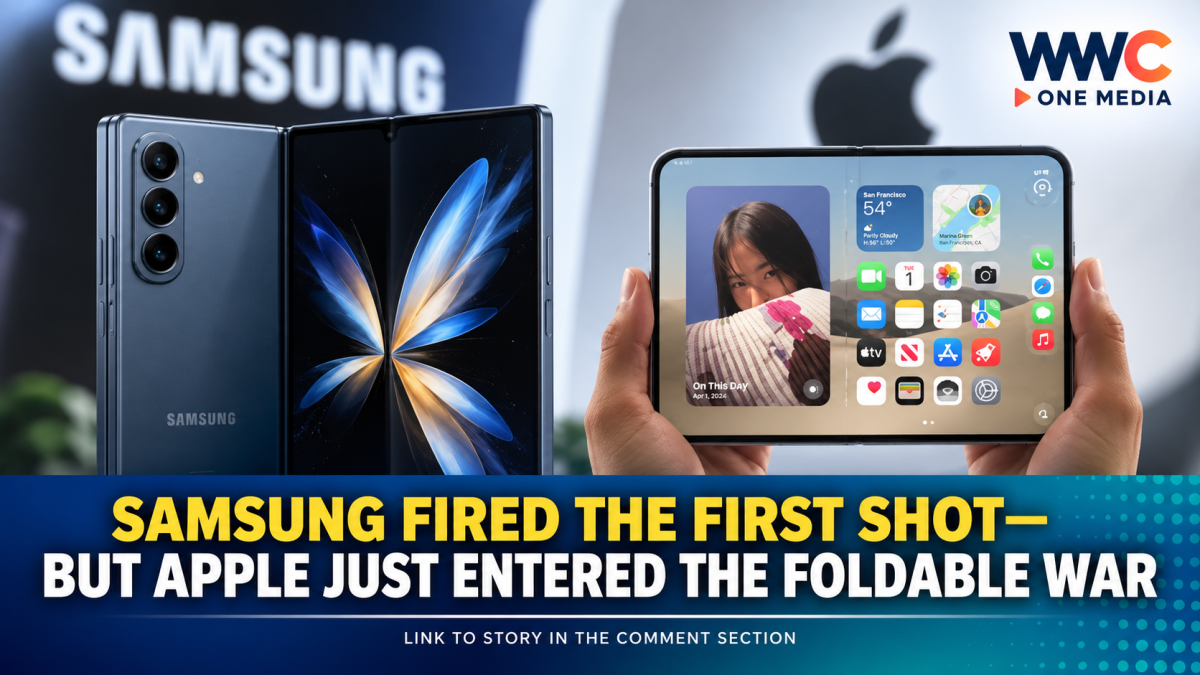
Samsung spent years building the foldable-phone market. Now, the company faces the one rival capable of turning the niche category into a mainstream phenomenon: Apple.
Apple has officially entered the foldable smartphone market with the $1,999 iPhone Duo, unveiled on September 9, immediately putting pressure on Samsung, which has dominated the category since the first-generation Galaxy Fold arrived in 2019.
And Samsung isn’t waiting quietly.
The South Korean electronics giant has launched a highly visible marketing campaign promoting its experience with foldable devices, including billboards in cities such as Seoul, Tokyo and London carrying messages such as “Welcome to Foldables.” Samsung has also used social media to take pointed shots at Apple’s new entry.
The message is clear: Samsung believes Apple may be late to the foldable party.
But Apple may have arrived at exactly the right moment.
Apple’s $1,999 gamble
The iPhone Duo starts at $1,999, placing it only about $100 above Samsung’s Galaxy Z Fold8, which starts at $1,899.
The Duo features a 5.4-inch outer display and opens into a 7.6-inch inner screen in a passport-like design. Apple says it is the thinnest iPhone when unfolded. The device also supports Apple Pencil, two-app multitasking and is powered by Apple’s A20 Pro chip.
Apple will begin taking preorders on October 16, with the phone scheduled to go on sale October 23.
That price could prove crucial.
Counterpoint analyst Liz Lee told Reuters that Apple’s decision to keep the device just below $2,000 was notable because it puts the company’s first foldable directly into competition with Samsung’s premium Fold lineup rather than positioning it as an ultra-luxury experiment.
Samsung has the experience—but Apple has the ecosystem
Samsung has a substantial head start.
The company launched its first mass-market foldable in 2019 and has now gone through eight generations of foldable phones, giving it years of experience refining hinges, displays, durability, software and overall design.
That experience could be Samsung’s biggest advantage.
The company also has an enormous global distribution network and an established Galaxy ecosystem.
But Apple brings something Samsung cannot easily replicate: the enormous installed base and brand loyalty of the iPhone ecosystem.
That is why analysts expect Apple’s arrival to have an impact far beyond the number of phones it sells.
Counterpoint expects Apple to capture roughly 25% of the foldable-phone market this year, compared with approximately 38% for Samsung, according to Reuters.
Other estimates are even more aggressive. CNA reported that IDC expects Apple could secure about 40% of the foldable market by the end of next year, reflecting expectations that Apple will sell essentially every unit it can manufacture.
Apple could make foldables mainstream
The biggest opportunity for Apple may not simply be stealing Samsung customers.
It could be expanding the entire market.
Foldables have remained a relatively small portion of global smartphone sales despite years of development by Samsung, Huawei, Google and other manufacturers.
CNA reported that foldables accounted for only around 1.6% of smartphone sales in 2025, while IDC expects foldable shipments to grow substantially faster than the broader smartphone market.
Apple’s history suggests why competitors are nervous.
The company has repeatedly entered established categories later than rivals, then used its ecosystem, marketing and software integration to push those products into the mainstream.
The iPhone itself is the obvious example.
Now Samsung is effectively asking whether Apple can repeat that playbook with foldable phones.
The irony: Apple is using technology from Samsung’s ecosystem
There’s another twist to the battle.
Apple is entering a market that Samsung helped create—and Apple is reportedly using parts of the same supply chain.
Reuters reported that Apple’s foldable device uses foldable displays supplied by Samsung Display, Samsung Electronics’ display unit.
In other words, Samsung may be competing against an iPhone that partially relies on technology from the very ecosystem Samsung helped build.
That’s an unusual position for the Korean tech giant.
Samsung’s response: experience versus hype
Samsung’s marketing campaign is therefore more than ordinary product advertising.
The company is emphasizing its years of foldable development, thinner designs and engineering improvements while taking subtle—and sometimes not-so-subtle—jabs at Apple.
Samsung’s social-media posts following Apple’s announcement included sarcastic references to Apple allegedly “reheating” existing ideas.
Apple, meanwhile, is selling the Duo as a major reinvention of the iPhone.
The company’s new CEO, John Ternus, made the foldable launch particularly significant because it is his first major iPhone-era product presentation after taking over from Tim Cook on September 1.
That makes the Duo more than another product launch.
It is also an early test of Ternus’ leadership.
The real battle hasn’t started yet
Samsung may have invented the modern foldable-phone category, but Apple doesn’t need to invent it.
It only needs to make people want one.
That distinction could be the biggest threat Samsung faces.
Samsung has spent years convincing consumers that foldable phones are useful. Apple now has the opportunity to take that established category and attach it to the world’s most recognizable smartphone brand.
If Apple succeeds, foldables could finally move beyond tech enthusiasts and become a major premium-phone category.
And if that happens, Samsung’s years of experience may not be enough to keep Apple from taking a huge slice of the market.
The foldable-phone war has officially begun—and Samsung’s biggest advantage may now be the one thing Apple has never needed: a head start.




Leave a Reply