
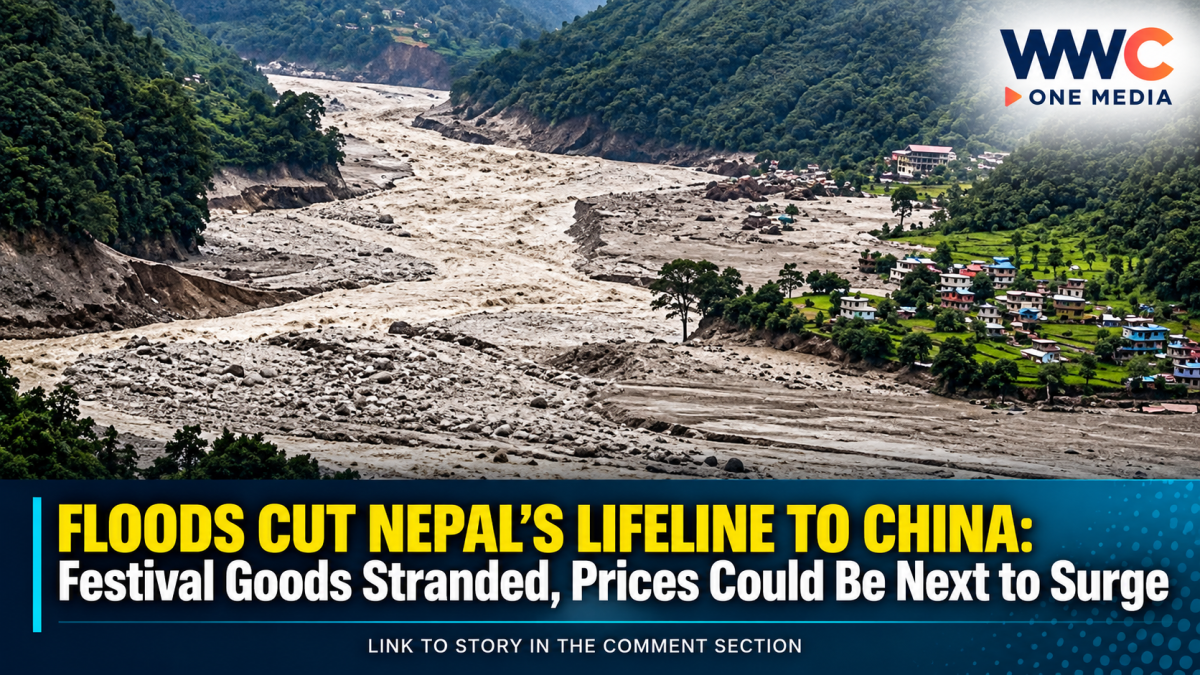
KATHMANDU — Nepal is facing a major supply-chain crisis after devastating floods and landslides damaged key trade routes linking the country to China, threatening the timely arrival of Chinese goods just as demand is expected to surge for the coming festival season.
The disaster struck the Bhotekoshi River and the Rasuwa region on August 26, destroying roads, bridges and critical infrastructure around the Rasuwagadhi–Kerung border crossing, one of Nepal’s most important overland trade gateways with China.
The destruction has left traders scrambling for alternative routes while hundreds of cargo containers carrying clothing, footwear, electronics, household goods, decorations and other merchandise remain stranded or have been lost.
And the timing could hardly be worse.
Nepal is approaching major festivals including Dashain, Tihar and Chhath, when consumer demand traditionally rises sharply.
Hundreds of Chinese containers caught in the disaster
According to traders cited in reports from Nepal, more than 500 to 600 Chinese containers carrying merchandise intended for the festival season were moving toward Kerung when the border infrastructure was devastated.
More than 200 Nepali containers were reportedly swept away, with traders estimating losses of at least 2 billion Nepalese rupees.
The damage goes far beyond lost cargo.
The flood destroyed the Rasuwagadhi customs and dry-port infrastructure, while the connecting road network was badly damaged. CNA reported that the area around Rasuwagadhi, once a busy commercial hub handling goods from Tibet, was effectively severed from the rest of Nepal.
Nepal forced to take the long way around
With Rasuwagadhi severely damaged, traders have been forced to divert cargo through Korala in Mustang.
But Korala is not an easy replacement.
Traders say the mountainous route is slower, more expensive and lacks the capacity and infrastructure of Rasuwagadhi. Around 176 cargo trucks had already been diverted toward Korala, according to reports.
Transporting cargo through the alternative route can take 10 to 12 days, while the cost of moving a cargo vehicle from Korala to Kathmandu has climbed to roughly 450,000–500,000 Nepalese rupees, an estimated 10% to 15% increase in transportation costs.
For businesses operating on tight margins, that additional cost could eventually reach consumers.
It isn’t just Rasuwagadhi
Nepal’s supply problem is being compounded by trouble at another major China trade gateway: Tatopani.
Landslides have disrupted the Tatopani crossing, leaving Nepal’s two major northern trade corridors operating far below normal capacity.
That has effectively pushed more pressure onto Korala and even the southern border with India.
The Kathmandu Post reported that some Chinese imports are already being rerouted through Birgunj, Nepal’s major southern trading gateway with India, with goods arriving through the Sirsiya dry port.
Why consumers should pay attention
The problem is no longer confined to customs yards and trucking companies.
Chinese imports make up a substantial portion of the merchandise sold in Nepal during the festival period, including:
- Clothing and footwear
- Electronics and electrical goods
- Household products
- Toys
- Festival decorations
- Other consumer merchandise
If these goods arrive late or have to travel through substantially more expensive routes, traders could face higher costs—and those costs may eventually be reflected in retail prices.
Nepalese economists and business representatives have therefore warned that the disruption could contribute to shortages and inflation if alternative supply routes cannot handle the increased demand.
A disaster far bigger than a trade disruption
The trade crisis is only one consequence of the catastrophe.
The August 26 disaster triggered a devastating torrent of water, ice, mud and debris through northern and central Nepal. The flood destroyed communities, roads, bridges and hydropower infrastructure.
By September 9, reports were putting the combined death toll in Nepal and China’s Tibet region at more than 1,300, with more than 5,000 people still missing. Reuters also reported that more than 12 hydropower plants and major transportation infrastructure were swept away.
Reuters reported separately that Nepal’s government is seeking roughly $5 billion in international assistance for initial rebuilding following the disaster.
The China connection is strategically important
Rasuwagadhi is not simply another border checkpoint.
It has become one of Nepal’s principal overland connections with China and an important channel for Chinese merchandise entering the Nepalese market.
The destruction also affects travel and tourism because the wider corridor connects Nepal with Tibet, including routes used by pilgrims traveling toward Mount Kailash. The devastation at the nearby Gyirong crossing on the Chinese side underscores the scale of the cross-border impact.
The bigger warning
Nepal’s immediate challenge is getting goods moving again.
But the disaster has exposed a much deeper vulnerability: too much of the country’s China-bound supply chain depends on mountain corridors that are highly exposed to floods, landslides and other climate-related disasters.
The government is now working to rebuild early-warning capabilities along vulnerable sections of the China border, including planned seismic sensors, cameras and satellite communications. Reuters reported that authorities may have only a few minutes to warn downstream communities when another landslide-triggered flood occurs.
For now, however, the race is against the clock.
Nepal’s festival season is approaching, warehouses need supplies, traders are already absorbing heavy losses—and the country’s main northern supply routes remain badly damaged.
The question now isn’t simply when Nepal’s trade routes will reopen. It’s whether the supply disruption will reach the pockets of ordinary consumers before the celebrations even begin.Alert me if Nepal-China trade routes reopen or prices worsen




Leave a Reply