
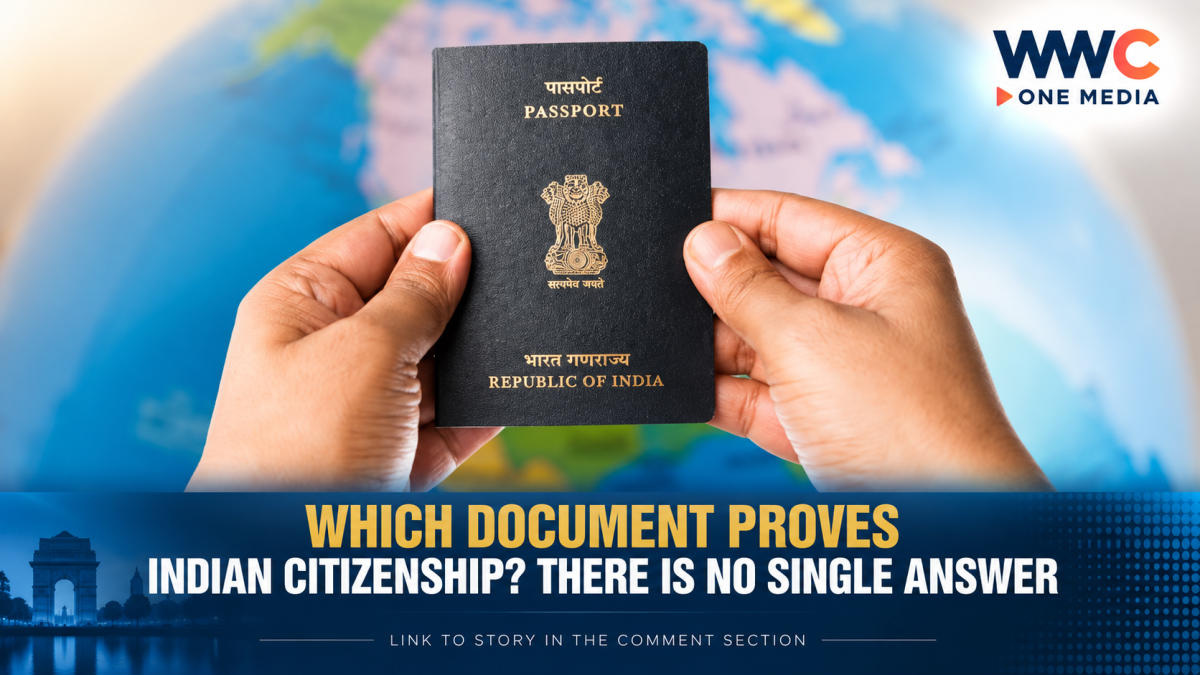
NEW DELHI — What document proves that a person is an Indian citizen?
The answer is more complicated than a birth certificate, Aadhaar card, voter ID or passport.
India’s citizenship framework does not designate one universal document as the sole proof of citizenship. Instead, citizenship is determined under the Citizenship Act, 1955, and the relevant evidence can depend on whether citizenship was acquired by birth, descent, registration, naturalisation or incorporation of territory.
That distinction has taken on renewed importance as questions over citizenship verification, immigration and documentation have become increasingly prominent in India’s political debate.
No single “citizenship card”
The Indian government has previously addressed the question directly in Parliament.
In a 2020 Rajya Sabha response concerning documents legally valid for proving citizenship, the Ministry of Home Affairs said acquisition of Indian citizenship is governed by the Citizenship Act and its rules. It identified five routes through which citizenship can be acquired: birth, descent, registration, naturalisation and incorporation of territory.
In another parliamentary response, the government was asked specifically whether Aadhaar, passports, voter IDs, PAN cards and birth certificates could be treated as proof of citizenship.
The government’s answer again pointed back to the Citizenship Act rather than naming one document as a universal citizenship certificate.
Aadhaar is not proof of citizenship
One point is considerably clearer.
An Aadhaar number does not, by itself, establish Indian citizenship.
Section 9 of the Aadhaar Act explicitly states that an Aadhaar number or its authentication does not confer, or by itself constitute proof of, citizenship or domicile.
That is important because Aadhaar is primarily an identity and residency-linked identification system, while citizenship is a separate legal status.
In other words, possessing Aadhaar should not automatically be interpreted as establishing that a person is legally an Indian citizen.
So what documents can matter?
The answer depends on the individual’s circumstances.
For someone claiming citizenship by birth, records such as a birth certificate can be important evidence, but the legal rules governing citizenship by birth also depend on the person’s date of birth and, in some circumstances, the citizenship status of their parents.
For citizenship by descent, records establishing parentage and the relevant citizenship history can become important.
People who obtained citizenship through registration or naturalisation may have a formal certificate documenting that status.
The Citizenship Rules also prescribe documentary requirements for particular citizenship applications. Those requirements can include birth records, parents’ passports, citizenship certificates and other supporting documents depending on the application route.
Why the debate has become politically sensitive
The issue has become especially contentious because citizenship verification can intersect with questions surrounding undocumented migration, voter rolls, population registers and the National Register of Citizens (NRC).
India has already experienced a large-scale citizenship documentation exercise in Assam. In 2019, the final NRC included more than 3.11 crore people, while about 19.06 lakh people were excluded from the final list, according to figures cited by the Union government in Parliament.
That experience demonstrated how complicated citizenship documentation can become when authorities examine large populations using multiple records and legal criteria.
It also helps explain why the question of “which document proves citizenship?” can generate significant public anxiety.
Citizenship and identity are not the same thing
A major source of confusion is the tendency to treat identity documents and citizenship documents as interchangeable.
They are not necessarily the same.
An identity document can establish who a person is or provide evidence of residence, while citizenship is a legal relationship between an individual and the Indian state.
That distinction is reflected in Indian law. The Aadhaar Act, for example, expressly separates Aadhaar from proof of citizenship.
Similarly, the government’s citizenship framework focuses on the legal basis through which citizenship was acquired rather than simply asking whether someone possesses a particular everyday identity document.
What this means for Indians facing verification
For anyone asked to establish citizenship, the safest approach is not to assume that one commonly used identity document will automatically settle the question.
The relevant evidence can depend on how and when citizenship was acquired, family records, place and date of birth, and whether citizenship was obtained through registration or naturalisation.
India’s Ministry of Home Affairs currently maintains the Citizenship Act, Citizenship Rules and subsequent amendments on its official website, underscoring that citizenship determination remains governed by a legal framework rather than a single standalone identification card.
The bigger question
The debate over citizenship documents is therefore about more than paperwork.
It raises a fundamental question about how a country determines who legally belongs to its citizenry—and what evidence ordinary people can reasonably be expected to produce when that status is questioned.
The key fact is straightforward: there is no single document that universally serves as India’s one-and-only proof of citizenship.
Instead, citizenship is established under the law and through evidence relevant to the particular route by which citizenship was acquired.
And as India’s citizenship and immigration policies continue to evolve, that distinction could become even more important.
WWC ONE MEDIA G.A




Leave a Reply