
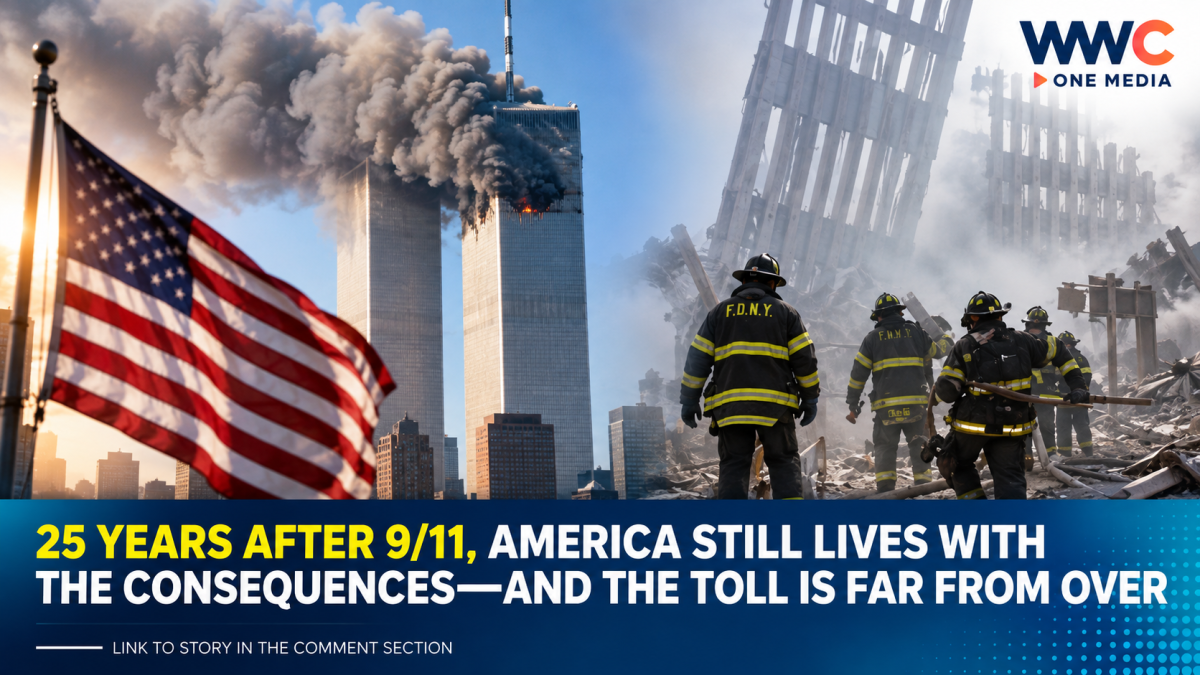
NEW YORK — Twenty-five years after the September 11 attacks changed America and stunned the world, the devastation is still unfolding.
The Twin Towers are gone. The smoke has long cleared from Ground Zero. A new skyline has risen over Lower Manhattan.
But for thousands of families, survivors and first responders, 9/11 is not simply history.
It remains a daily reality.
As the United States prepares to mark the 25th anniversary of the September 11, 2001 attacks, the focus is increasingly shifting beyond the nearly 3,000 people killed that morning—to the generations still living with its medical, emotional, political and global consequences.
And perhaps the most haunting reality is this: for some, the death toll from 9/11 has never truly stopped.
Nearly 3,000 Died in Hours. Thousands More Have Suffered Since.
On September 11, 2001, al-Qaida hijackers used four commercial aircraft in coordinated attacks on the United States.
Two planes struck New York’s World Trade Center. Another hit the Pentagon. A fourth, United Flight 93, crashed in Pennsylvania after passengers fought back against the hijackers.
Nearly 3,000 people were killed in the attacks, including 343 members of the New York City Fire Department who rushed toward the burning towers as others fled.
But the immediate deaths were only the beginning.
Reuters reported this week that the federally funded World Trade Center Health Program now serves more than 150,000 responders and survivors affected by 9/11-related illnesses. More than 9,000 people tracked by the program have died since the attacks, although officials caution that determining the precise role 9/11 exposure played in every death can be difficult.
The program has recorded tens of thousands of certified health conditions, including respiratory diseases, cancers and other illnesses associated with the toxic environment surrounding the recovery effort.
The latest official program data also shows the enormous long-term scale of care required for people affected by the attacks and their aftermath.
The First Responders Who Survived Are Still Paying the Price
For many Americans, images of firefighters, police officers and rescue workers rushing into danger remain among the defining memories of 9/11.
Twenty-five years later, many of those who survived are still battling the consequences.
The collapse of the Twin Towers sent enormous clouds of toxic dust across Lower Manhattan. Rescue and recovery workers spent months searching through the wreckage, often under hazardous conditions.
Reuters reported that cancers and other serious illnesses linked to the toxic aftermath continue to affect members of the 9/11 community, underscoring how the attacks remain a public health crisis long after the destruction itself ended.
That means the anniversary carries a painful contradiction.
America is remembering those who died on one day—but also those whose lives have been permanently altered in the quarter-century since.
A New Generation Carries the Memory Forward
The passage of time has created another challenge: millions of Americans are now too young to remember September 11 firsthand.
Some were not yet born.
That is why the National September 11 Memorial & Museum has increasingly focused on education and preserving firsthand accounts for future generations.
The organization will hold its 25th anniversary commemoration ceremony on September 11, 2026, with family members reading the names of those killed in the 2001 attacks and the 1993 World Trade Center bombing.
The ceremony will also include seven moments of silence marking the attacks on the World Trade Center and Pentagon, the crash of Flight 93, and those who later died from 9/11-related illness and injury.
The symbolism is significant.
The official act of remembrance now acknowledges not only what happened on September 11, 2001—but what has continued to happen ever since.
The Children of Fallen Firefighters Are Now Firefighters Themselves
One of the most powerful reminders of 9/11’s generational impact can be found inside New York firehouses.
Reuters recently highlighted the story of Scott Larsen, whose father, an FDNY firefighter, was killed in the World Trade Center collapse.
Larsen was just four years old when his father died.
He later joined the FDNY and secured an assignment to the same Woodside firehouse where his father had served.
He is not alone.
According to data cited by Reuters, 58 children of FDNY firefighters killed on 9/11 have followed their parents into the profession.
A quarter-century later, some families are still carrying the legacy of that day directly into their work, their identities and their futures.
9/11 Didn’t Just Change New York. It Changed the World.
The physical scars of Ground Zero may have transformed into a memorial and a rebuilt Lower Manhattan.
The geopolitical consequences, however, spread across the world.
The attacks triggered the U.S.-led war in Afghanistan and helped reshape American foreign policy for decades. The wider conflicts that followed in Afghanistan and Iraq resulted in enormous human, political and financial costs.
Reuters noted that the wars associated with the post-9/11 era led to more than 900,000 deaths, primarily in Iraq and Afghanistan, while the attacks also fundamentally transformed U.S. national security policy.
A recent Financial Times analysis argued that young Americans have effectively grown up in a political and foreign-policy environment shaped by decisions made after 9/11—from expanded executive powers and military interventions to an enduring national security infrastructure.
That raises one of the biggest questions surrounding the 25th anniversary:
Has America fully understood what 9/11 changed—or has the country simply learned to live with those changes?
The New York Skyline Recovered. The Memories Never Did.
Lower Manhattan looks dramatically different today.
One World Trade Center now dominates the skyline, while the footprints of the original Twin Towers have been transformed into reflecting pools at the National September 11 Memorial.
The Financial Times recently examined how 9/11 permanently reshaped Manhattan’s architecture, redevelopment and identity.
The rebuilding process transformed the former World Trade Center site into a space of remembrance, tourism and commerce—but debates over architecture, memory and the meaning of Ground Zero have continued for decades.
New York survived.
It rebuilt.
But rebuilding was never the same as forgetting.
America Prepares to Mark the 25th Anniversary
Commemorations are being held across the United States as the country approaches one of the most significant milestones since the attacks.
At the National September 11 Memorial in New York, the anniversary ceremony will begin in the morning and focus on family members reading the names of those killed.
The ceremony is private and not open to the general public, although it will be streamed.
President Donald Trump is scheduled to observe the anniversary at the Pentagon, while Vice President JD Vance is expected to attend the memorial in New York, according to the Associated Press.
Washington is also holding exhibitions and remembrance events featuring artifacts, eyewitness accounts and artistic performances connected to the attacks and their aftermath.
The Most Difficult Part of 9/11’s Legacy May Be What Can’t Be Measured
There are numbers that define September 11.
Nearly 3,000 killed.
Four hijacked planes.
343 FDNY members lost.
More than 150,000 people served by the World Trade Center Health Program.
Thousands of deaths among people tracked by the program in the years since.
But some consequences cannot be measured.
The child who grew up without a parent.
The first responder who developed cancer years later.
The survivor who still remembers the sound of the towers collapsing.
The generation that inherited a world transformed by wars, surveillance and security policies born from a single morning.
Twenty-five years later, 9/11 remains one of those rare events where history and the present continue to overlap.
The Bottom Line: 9/11 Is Still Not Over
The 25th anniversary is not simply about looking back at September 11, 2001.
It is about recognizing everything that followed.
The health crisis.
The wars.
The security changes.
The political consequences.
The families who never stopped grieving.
And the younger generation now tasked with remembering something they never experienced.
The Twin Towers disappeared in a matter of hours.
But 25 years later, the consequences of their destruction are still being written.
And as America pauses to remember the lives lost, one uncomfortable truth remains:
September 11 may be a date in history—but for thousands of people, its aftermath is still happening today.




Leave a Reply