
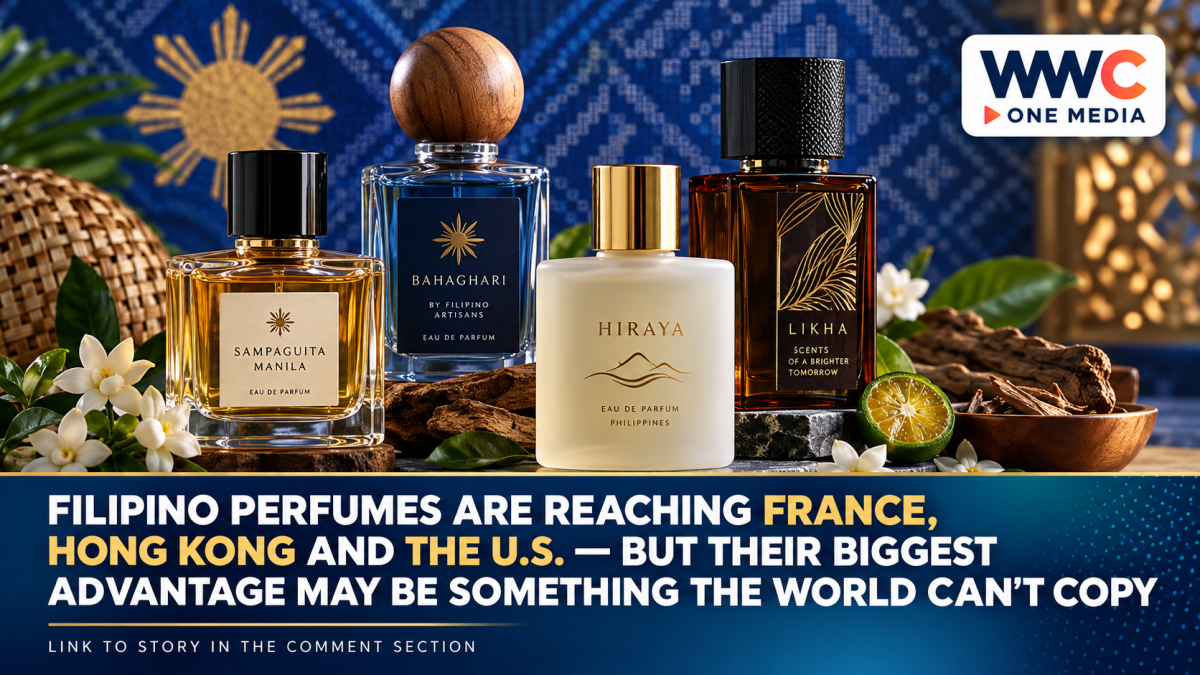
MANILA, Philippines — For generations, the language of prestige perfume has largely been associated with places such as Paris, Grasse and the great fragrance houses of Europe and the Middle East.
Now a new group of Filipino perfumers is trying to add another destination to that map.
Their raw material is not simply perfume oil.
It is Philippine memory.
Sampaguita after the rain. Calamansi cut open in a kitchen. Pandan steaming beside freshly cooked rice. Mango and charcoal-grilled tupig. Ube. Davao coffee. Ylang-ylang. Even the smell of landscapes, food and rituals that Filipinos may have known since childhood.
A growing generation of Philippine niche fragrance houses is turning those intensely local references into sophisticated perfumes—and some are beginning to earn recognition overseas. CNA Lifestyle highlighted Tadhana, Wren Atelier, Oscar Mejia III, Olfaction and Orca Parfums as five labels helping define the emerging movement.
And there is increasing evidence that this is becoming bigger than a handful of boutique brands.
At a local fragrance gathering in San Juan in August, more than 30 Philippine perfume brands from areas including Mindanao, Batangas and northern parts of Luzon participated, according to Manila Bulletin. The publication described a domestic fragrance scene increasingly built around original compositions rather than merely interpretations of foreign perfumes.
The result is the beginning of something the Philippines has rarely had before:
A recognizable olfactory identity of its own.
The world is starting to smell the Philippines
One of the strongest symbols of that shift came thousands of kilometers away from Manila.
In 2025, Filipino fragrance house Tadhana participated in the inaugural Grasse Perfume Week in France—Grasse being one of the historic centers of global perfumery. The organizers described the 2025 event as the first edition of a new international gathering devoted to perfume and olfactory culture.
Vogue Philippines subsequently reported that Tadhana showcased its collections at both Grasse Perfume Week and ScentXplore in New York, introducing international visitors to ingredients including calamansi and sampaguita within fragrances conceived from a Filipino perspective.
Tadhana later announced U.S. retail distribution through niche fragrance retailer Scent Grade in March 2026. The company describes the move as making it the first Filipino fragrance house retailed in the United States, a claim also reported by Tatler Asia.
That does not suddenly make Philippine perfumery a rival to France.
But it does show that Filipino perfume is beginning to enter spaces where niche-fragrance buyers, distributors and industry professionals from around the world actually discover new houses.
And that distinction matters.
Tadhana wants Philippine ingredients to be the main character
Tadhana founder and perfumer Shale Albao came to fragrance with an unusual combination of science and nostalgia.
A chemical engineer by training, Albao later studied perfumery at France’s ISIPCA. Vogue Philippines reported that her ambition was not simply to manufacture perfume locally but to use Philippine ingredients and memories as the foundation of a distinct fragrance identity.
That difference becomes clear in the ingredients.
Tadhana’s catalog has featured materials and references including calamansi, sampaguita, Philippine elemi, almaciga resin, muscovado sugar, Davao coffee, Bohol’s asin tibuok, mango and dalandan.
Its fragrance Hello, Silence, highlighted by CNA, uses almaciga alongside black tea, leather, juniper berry and lemon.
Almaciga is a conifer associated with Philippine forests, giving the fragrance a connection to the landscape rather than simply borrowing the tropical imagery commonly used by overseas luxury brands.
That appears to be one of the larger ambitions of the new Filipino perfume movement.
Local ingredients are no longer merely decorative references on packaging.
The goal is increasingly to make them part of the actual creative language of the perfume.
Wren Atelier turned tupig into an international award winner
Then there is Wren Atelier, founded in 2020 by Filipino perfumer Renato Lopena Jr., who trained at the Grasse Institute of Perfumery.
His fragrances draw on Philippine culture in ways that would have sounded highly unconventional in traditional Western luxury perfumery.
One composition takes inspiration from sinigang.
Another references Batok, the traditional tattooing practice associated with Kalinga.
But perhaps the most internationally significant so far is Smoky Gourmand.
The fragrance combines inspiration from Philippine mango and tupig, the sticky-rice delicacy traditionally wrapped and grilled over charcoal.
That unusual combination won Wren Atelier an Emerging Perfume Brand Award at the 2025 Asia Perfume Awards in Hong Kong.
The Asia Perfume Foundation confirms that Wren Atelier was among the Philippine, Vietnamese and Japanese winners of its 2025 brand awards.
Preview also reported the victory following the November 2025 awards ceremony at Cosmoprof Asia.
Wren received another domestic endorsement when its Batuk Parfum was named Best Filipino Fragrance in the 2025 MEGA Beauty Awards.
Those awards matter because they suggest Philippine perfumery is beginning to be evaluated not only as a local curiosity but on craftsmanship, composition and storytelling alongside other Asian fragrance houses.
One perfumer’s story begins on a Davao flower farm
The local movement is not centered only in Metro Manila.
Oscar Mejia III, for example, traces his relationship with fragrance to a childhood spent around a cut-flower farm in Davao City.
His namesake perfume house works with Philippine-linked botanicals and essential oils, according to CNA.
One fragrance, Handumanan, takes its name from a Cebuano word associated with memory or remembrance.
At its center is ylang-ylang, surrounded by lemon and gardenia before moving into sandalwood and cedar.
Mejia’s work has been part of the Philippine fragrance conversation for years. Manila Bulletin previously interviewed him alongside Albao and Lopena while examining the growth of homegrown perfumery and the increased use of Philippine ingredients.
The significance is easy to miss.
The Philippines has long produced or grown aromatic materials.
The newer ambition is to capture more value by turning those ingredients into finished creative products carrying Filipino authorship, rather than allowing the country’s role to end at raw materials.
Olfaction bottled the smell of newly cooked rice
Perhaps the clearest example of how far Filipino perfumers are willing to push memory is Olfaction.
Founded by cosmetic scientist and perfumer Claire Mavreen, the brand frequently turns food and everyday experiences into fragrance concepts.
One of the most striking is Samyo Ng Bagong Kanin—essentially, the aroma of freshly cooked rice.
According to CNA, the perfume opens with rice and steam, with pandan and clove creating warmth before cedarwood, white musk and mimosa appear later in the composition.
It is a revealing creative choice.
European perfume traditions have long transformed flowers, leather, tobacco, woods, vanilla and spices into luxury objects.
Filipino perfumers are asking why the smell of rice steaming in a family kitchen cannot carry the same emotional weight.
Olfaction also makes fragrances inspired by ube and other familiar references. Manila Bulletin recently placed it among the local perfume houses helping grow the Philippine niche scene and noted Mavreen’s background in cosmetic chemistry.
The idea is not that a customer should literally smell like dinner.
The more sophisticated concept is to reproduce the emotional association surrounding the smell.
Home.
Childhood.
Comfort.
A particular person.
A place remembered decades later.
That may be where Philippine perfumery has one of its strongest advantages.
Orca is taking the opposite route: futurism
Not every local perfumer is trying to reconstruct nostalgia.
Orca Parfums, created by Gib Osbert Ang, approaches perfume from another direction.
Ang revisits classical fragrance structures—including styles such as chypres—but combines them with modern synthetic aroma molecules and formulations designed to perform in tropical heat and humidity.
Its Steel Petals juxtaposes pear and bergamot with jasmine sambac, metallic and mineral effects.
The composition is Philippine-linked without depending on the obvious visual vocabulary of beaches, coconuts and tropical sunsets.
That matters.
A mature Philippine perfume industry cannot survive on one definition of what “Filipino” is supposed to smell like.
The country is too culturally varied for that.
Some houses may focus on indigenous botanicals.
Others may use food.
Others may work with urban life, memory, science, abstraction or completely invented scent worlds.
Manila Bulletin’s August survey illustrates how broad the scene is already becoming, featuring everything from fragrance inspired by Filipino desserts to a perfume called Yosi Break, based on the familiar idea of stepping outside for a cigarette break.
There are already far more than five Filipino fragrance brands
CNA’s five brands are best understood as examples—not a complete inventory of the Philippine perfume scene.
Preview was already highlighting a substantially longer roster of locally made fragrance houses in late 2024, including Domus Emeterius, Ilum Studios, Home Studio Scents, The Boar Grooming Co., Imperfect Scents and Parfums Astraux, alongside Wren Atelier.
New names have continued to appear.
Preview covered the launch of Anino in late 2025, while Manila Bulletin profiled other niche houses such as Valor Extrait de Parfum, Dilettante Perfumery and Imahenacion in August 2026.
More than 30 brands participating in a single local fragrance event this August provides another indication that the category is moving beyond a tiny enthusiast circle.
What remains uncertain is how large the Philippine niche-fragrance market actually is.
Reliable public sales data specifically isolating Filipino independent perfume houses is scarce, so claims describing the sector as a multibillion-peso Philippine industry or assigning it a precise growth rate would currently go beyond the available evidence.
What can be documented is the increase in brands, retail visibility, media coverage, enthusiast events and international recognition.
Asia is building its own fragrance language
The Philippine movement is also part of something bigger.
Asian perfume houses are increasingly rejecting the idea that luxury fragrance must tell European stories using European reference points.
CNA points to China’s To Summer, which has built its identity around ingredients and imagery tied to Chinese culture, plants, teas and landscapes.
The Asia Perfume Foundation has similarly described the Asia-Pacific fragrance market as expanding while acknowledging that Asian brands remain comparatively underrepresented globally. Its awards specifically evaluate how perfumes represent the region through scent as well as their technical execution and storytelling.
That creates an opportunity for Filipino perfume houses.
They do not necessarily have to out-French the French.
They can compete by bringing something different.
Tropical weather may actually become part of the innovation
The Philippine climate creates another challenge—and potentially another point of differentiation.
A perfume developed for cool European weather can behave differently in Manila’s heat and humidity.
High temperatures can accelerate evaporation and make certain compositions project aggressively or disappear rapidly.
Some Filipino perfumers are therefore consciously designing fragrances around tropical conditions.
Orca, for example, uses modern aroma molecules partly with performance in heat and humidity in mind, according to CNA. Tadhana has also positioned some of its formulations around tropical wear.
If that expertise becomes more developed, Philippine houses could eventually offer something relevant not just to Filipino consumers but to customers across Southeast Asia, South Asia, the Middle East and other warm-weather markets.
That would turn the climate from a formulation problem into a commercial advantage.
The biggest opportunity isn’t sampaguita
Sampaguita will inevitably become one of the symbols of Philippine perfumery.
It is instantly recognizable, culturally meaningful and already respected internationally as jasmine sambac.
But the long-term opportunity for Filipino fragrance is bigger than one flower.
The real competitive advantage is the enormous archive of smells and memories that Philippine culture has barely begun translating into fine fragrance.
Rice steaming in a kitchen.
Muscovado from Negros.
Coffee from Davao.
Tupig grilling over charcoal.
Calamansi peel.
Pandan leaves.
Rain on warm pavement.
Old churches and wooden houses.
Salt air.
Forest resins.
Mangoes.
Markets.
Flowers associated with childhood, funerals, fiestas or courtship.
Those memories cannot simply be reproduced by importing a formula.
They require context.
That is where Filipino perfumers may have something much more difficult for established international houses to copy convincingly: authorship.
Vogue quoted Albao describing the goal as telling Philippine stories not through an outside European interpretation but from the perspective of the people who actually lived them.
That may ultimately decide whether this current wave becomes a lasting perfume industry rather than another beauty trend.
Filipino fragrance does not need to smell like Paris.
Its biggest opportunity may come when the world decides it wants to know what the Philippines smells like instead.




Leave a Reply