
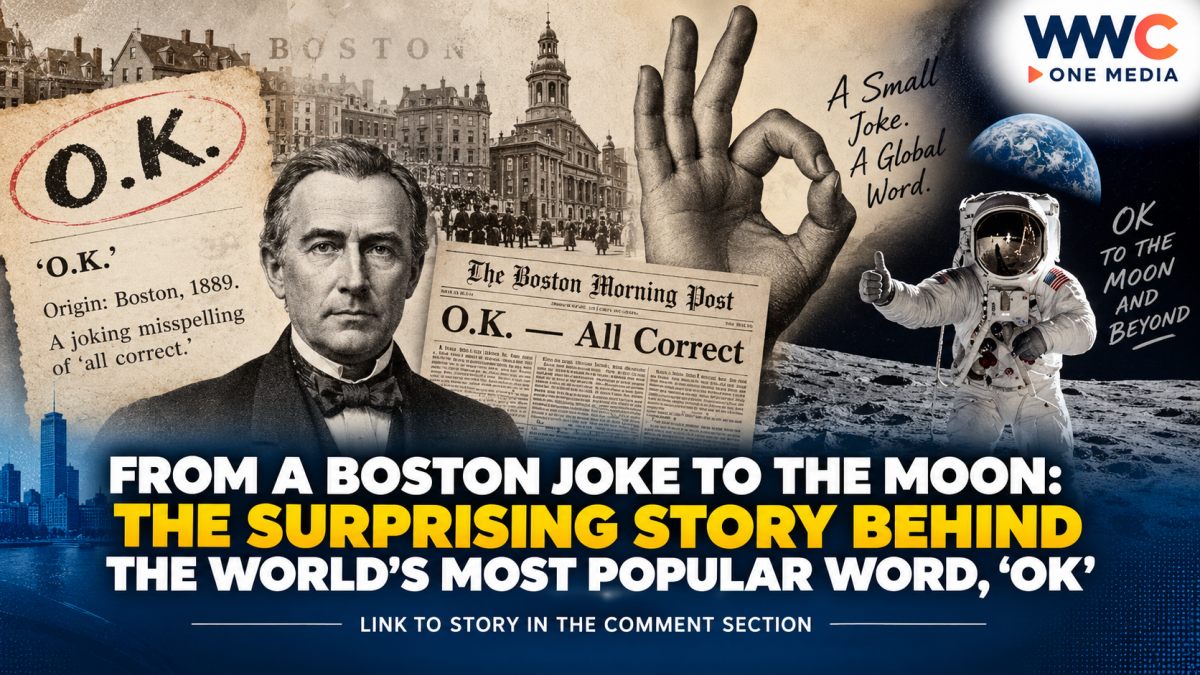
BOSTON, United States — It is one of the most commonly used words on the planet. People say it in text messages, business meetings, casual conversations and countless languages around the world.
But the story behind “OK” is far stranger than most people realize.
The tiny word that now signals agreement, approval or simple acknowledgment reportedly began as a joke in a Boston newspaper newsroom nearly two centuries ago — before a US presidential election, telegraph operators and even the Moon helped turn it into a global phenomenon.
It All Started With a Joke
The story dates back to 1839, when creative abbreviations became fashionable among educated circles in New England.
Newspaper editors experimented with humorous shortcuts and deliberately misspelled phrases. Most of those expressions disappeared almost as quickly as they appeared.
One survived.
On March 23, 1839, Boston Morning Post editor Charles Gordon Greene reportedly used “OK” as a playful abbreviation for “oll korrect” — a deliberately misspelled version of “all correct.”
What started as a newsroom joke would eventually become one of the most recognizable expressions in human language.
A Presidential Election Helped Make ‘OK’ Famous
The expression received an unexpected boost during the 1840 US presidential election.
President Martin Van Buren was known by the nickname “Old Kinderhook,” a reference to his hometown of Kinderhook, New York.
Supporters embraced the initials OK, creating campaign slogans and OK Clubs across the country.
Van Buren ultimately lost the election, but the expression survived.
In the years that followed, telegraph operators adopted “OK” as a quick and efficient confirmation signal, helping spread the term even further across the United States.
Why ‘OK’ Works Almost Everywhere
Part of the secret behind “OK” may be its remarkable flexibility.
It can mean:
Yes.
I understand.
I agree.
That’s acceptable.
Or simply:
I heard you.
Unlike words such as “fantastic” or “wonderful,” which clearly express enthusiasm, “OK” can remain almost completely neutral.
That flexibility has helped it cross cultural and linguistic boundaries, becoming familiar in hundreds of languages around the world.
From a Boston Newsroom to the Moon
Perhaps the most extraordinary chapter in the story of “OK” came more than a century after its creation.
When astronaut Buzz Aldrin landed on the Moon in 1969, one of his early transmissions included the words:
“OK, engine stop.”
A humorous abbreviation born in a 19th-century Boston newsroom had officially made its way beyond Earth.
The Bottom Line
“OK” began as a joke — but it became one of the world’s most powerful words.
From a deliberately misspelled phrase in a Boston newspaper in 1839, the expression was boosted by a presidential campaign, adopted by telegraph operators and eventually carried to the Moon.
Nearly 200 years later, people around the world still use it every day without thinking twice.
Not bad for a joke that was only supposed to make a few newspaper editors laugh.
WWC ONE MEDIA J.M.D




Leave a Reply