
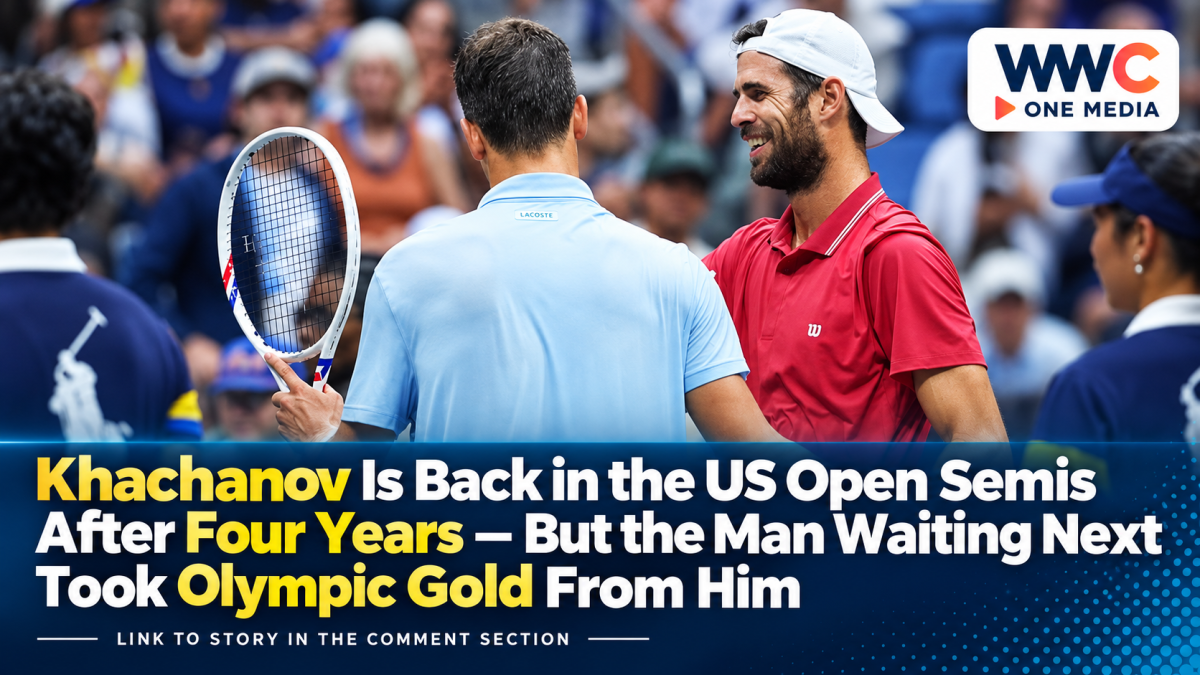
NEW YORK — Karen Khachanov is back in the US Open semifinals for the first time in four years, but the way he arrived there was anything but celebratory.
The 30-year-old Russian advanced when Belgian breakthrough star Alexander Blockx was forced to retire injured while trailing 6-2, 7-5, 3-2 in their quarterfinal at Flushing Meadows.
Khachanov had controlled much of the contest, but Blockx’s physical condition steadily deteriorated before he finally stopped after roughly an hour and 38 minutes of play. The 21-year-old entered the match already dealing with a rib problem and competed with his right thigh wrapped and ankle supported.
For Khachanov, the result sends him into his second US Open semifinal and third Grand Slam semifinal overall.
But his next opponent gives the story a much bigger twist.
Waiting on the other side of the net will be top seed Alexander Zverev — the same player who denied Khachanov Olympic gold in Tokyo five years ago.
Blockx’s remarkable US Open run ends in pain
Blockx had been one of the unexpected stories of the 2026 tournament.
The Belgian entered the US Open as the No. 28 seed and stunned fifth seed Flavio Cobolli in the third round, winning 6-7(4), 6-3, 6-0, 6-3. He then defeated Francisco Cerundolo in four sets to reach his first Grand Slam quarterfinal.
That achievement also made Blockx the first Belgian man to reach the US Open men’s singles quarterfinals.
But there had already been warning signs.
During his fourth-round victory over Cerundolo, Blockx experienced sharp rib pain and later admitted he had come close to retiring. The US Open reported that medication allowed him to continue that match, but the physical problems carried into his quarterfinal against Khachanov.
Against Khachanov, the Belgian needed treatment for his right foot, struggled with his back and hip and was visibly wincing between points.
He eventually retired shortly after losing serve in the third set.
Khachanov acknowledged the awkward circumstances afterward, saying it was difficult to maintain competitive intensity while watching his opponent struggle physically. He wished Blockx a speedy recovery while expressing satisfaction at returning to the final four.
Khachanov’s comeback run has been much harder than his ranking suggests
Khachanov arrived in New York ranked No. 50 in the world, far below his career high of No. 8 and at his lowest ranking entering a Grand Slam in nearly a decade.
Yet his US Open run has included several impressive victories.
He eliminated third seed Felix Auger-Aliassime in the second round, coming back after losing the opening set, before beating Benjamin Bonzi in straight sets.
Khachanov then survived one of his toughest matches of the tournament against No. 14 seed Learner Tien, recovering from two sets to one down to win 7-5, 4-6, 6-7(6), 6-1, 6-4 and reach the quarterfinals.
That five-set victory was another indication that Khachanov’s ranking may not accurately reflect the level he has produced in New York.
First US Open semifinal since 2022
Khachanov’s last trip this deep at Flushing Meadows came in 2022.
That year, he defeated Nick Kyrgios in a dramatic five-set quarterfinal before losing to Casper Ruud 7-6(5), 6-2, 5-7, 6-2 in the semifinals.
He followed that run by reaching the 2023 Australian Open semifinals, where Stefanos Tsitsipas stopped him in four sets.
Until this week, Khachanov had not returned to the last four of a Grand Slam since that Melbourne run.
Now he is one victory away from reaching the first Grand Slam singles final of his career.
But the player blocking his path carries some painful history.
Zverev stands between Khachanov and his first major final
Zverev booked his place in the semifinal by defeating Botic van de Zandschulp in straight sets.
The German won 6-2, 7-5, 6-1, reaching his third US Open semifinal while continuing his pursuit of another major title.
The matchup immediately brings back memories of the Tokyo Olympics in 2021.
Khachanov reached the men’s singles gold-medal match there, only for Zverev to overwhelm him 6-3, 6-1 in just 79 minutes, leaving Khachanov with silver.
Five years later, the stakes are different but once again enormous.
According to the official US Open, Khachanov trails Zverev 3-6 in their overall rivalry, although all three of Khachanov’s victories have come on hard courts — the same surface being used in New York.
That gives Khachanov at least one reason for optimism.
So does their more recent history: he has shown that he can challenge Zverev on hard courts, making the semifinal more complicated than the rankings alone might suggest.
Zverev is finding his best tennis at the right time
Zverev’s tournament has followed almost the opposite trajectory.
The German struggled badly during the opening rounds and needed more than four hours to survive Quentin Halys in a five-set battle.
But his performances have become progressively more convincing as the tournament has continued.
Against Van de Zandschulp, Zverev endured an erratic opening stretch that included five double faults before taking control.
His victory also gave him 23 Grand Slam match wins in 2026, surpassing Boris Becker’s previous German men’s record of 22 major-match victories in a single season, set in 1989.
That makes Khachanov’s next challenge considerably greater than the quarterfinal he just escaped.
One player’s breakthrough ended. Another player’s biggest opportunity is beginning.
Blockx leaves New York disappointed, but his run may still represent a breakthrough moment in his young career.
Before this US Open, the Belgian had never gone beyond the second round of a Grand Slam. He leaves after beating a top-five seed and becoming the first Belgian man to reach the tournament’s quarterfinals.
Khachanov, meanwhile, moves on under complicated circumstances.
He did not get the kind of quarterfinal finish any player wants, but he was leading comfortably when Blockx stopped and had controlled the match from the opening set.
Now the context changes completely.
There will be no injured newcomer on the opposite baseline in the semifinal.
There will instead be Zverev — the tournament’s top seed, a Grand Slam champion and the man who once stood between Khachanov and Olympic gold.
For Khachanov, reaching the US Open semifinals again is already a major resurgence.
Beating Zverev would turn it into something much bigger: the first Grand Slam final of his career.
And five years after Tokyo, it would also settle one of the most painful unfinished chapters on his résumé.




Leave a Reply