
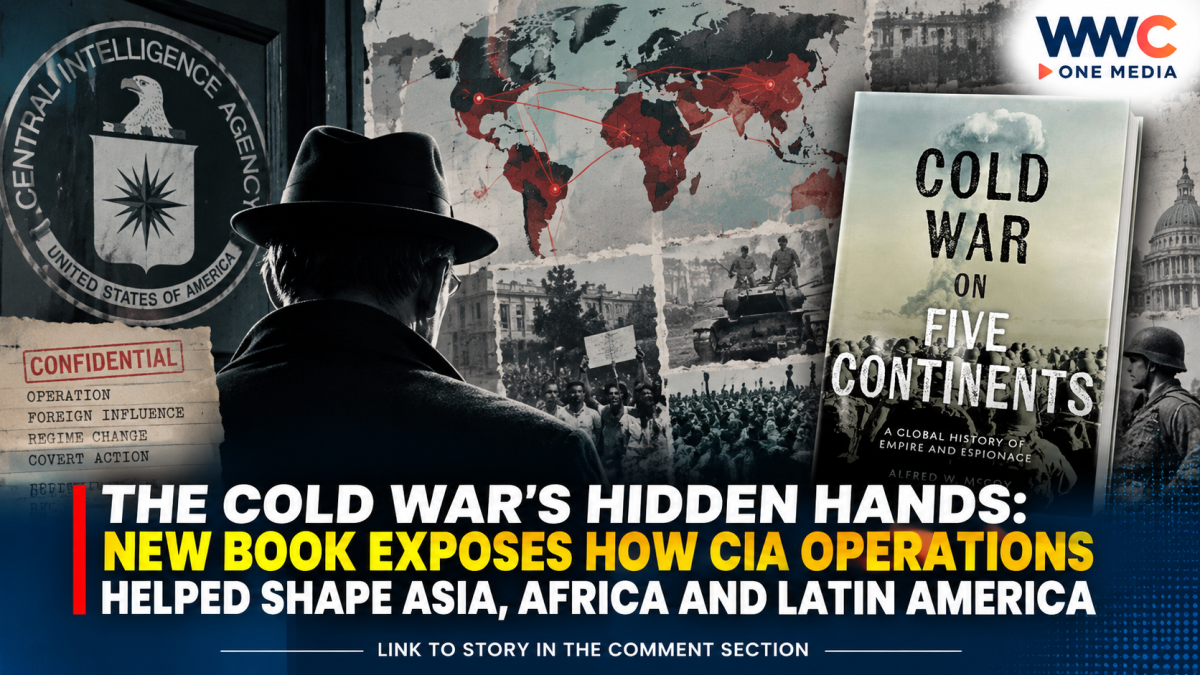
TAIPEI, Taiwan — For more than half a century, historian Alfred McCoy has investigated some of the darkest corners of American foreign policy. His latest book takes that investigation global, arguing that the Cold War was shaped not only by nuclear weapons, superpower diplomacy and open warfare, but also by a vast network of covert operations that transformed governments and societies across five continents.
In “The Cold War on Five Continents: A Global History of Empire and Resistance,” McCoy examines how the United States used intelligence operations, military intervention and alliances with authoritarian governments to fight the spread of communism.
The book’s central argument is unsettling: many of the political crises and conflicts that emerged during the Cold War did not simply disappear when the Soviet Union collapsed. Their consequences continue to shape the modern world.
A Historian Who Has Spent Decades Investigating the CIA
McCoy has long been one of the most controversial historians examining US intelligence operations.
He first drew international attention in the early 1970s with his book “The Politics of Heroin in Southeast Asia,” which examined allegations involving the drug trade and American covert operations during the Vietnam War era.
According to the Taipei Times review, McCoy’s work repeatedly placed him in conflict with the CIA and the US national security establishment, establishing a career focused on investigating the hidden side of American power.
His new work expands that focus dramatically, examining covert intervention across Asia, Africa, Latin America and other regions during the decades-long confrontation between Washington and Moscow.
The Cold War Was Fought Far Beyond Washington and Moscow
The Cold War is often remembered as a confrontation between two superpowers armed with nuclear weapons.
McCoy argues that this view misses much of the real story.
Across the developing world, the Cold War involved coups, secret intelligence operations, political assassinations, military interventions and support for governments willing to align themselves with either Washington or Moscow.
Many of these conflicts were fought far away from Europe.
Asia became one of the most important battlegrounds, with the United States supporting governments and military forces across the region as it attempted to contain communist influence.
The consequences were often devastating for local populations caught between global powers.
Taiwan’s Authoritarian Past Forms Part of a Bigger Story
McCoy’s global examination also places Taiwan’s Cold War history within a wider pattern of authoritarian governments that emerged with support from major powers.
During the Cold War, Taiwan was ruled under martial law by the Chinese Nationalist Party, or KMT, while receiving significant support from the United States as Washington viewed the island as strategically important in its broader competition with communist China.
The Taipei Times review notes that McCoy’s work places authoritarian Taiwan within a broader global pattern of Cold War intervention and political control.
That historical context remains important today as Taiwan faces a dramatically different geopolitical environment while continuing to deal with the legacy of its authoritarian past.
The Human Cost of Superpower Competition
One of the book’s major themes is the human cost of geopolitical rivalry.
The Cold War was frequently described in terms of strategy, ideology and military power.
But behind those larger concepts were millions of people living through wars, political repression and foreign intervention.
Countries became battlegrounds because of their strategic location rather than their own national interests.
Governments were supported or undermined depending on their position in the wider conflict.
Political movements were treated as pieces on a global chessboard.
McCoy argues that understanding those hidden interventions is essential to understanding why many regions continue to experience political instability today.
Why the Cold War Still Matters
The Soviet Union collapsed in 1991, but many of the systems and conflicts created during the Cold War survived.
Military governments remained in power.
Political institutions shaped by foreign intervention continued to influence national politics.
Regional conflicts that began during the superpower rivalry developed lives of their own.
McCoy’s book suggests that the Cold War should not be treated as a closed chapter of history.
Instead, its legacy continues to influence international relations, political institutions and conflicts in the 21st century.
That argument has gained renewed relevance as competition between major powers intensifies once again.
A Warning for a New Era of Global Rivalry
The world is now entering another period of intense geopolitical competition.
The United States and China are competing for influence across technology, trade, military power and international alliances.
Russia’s relationship with the West has deteriorated sharply.
Countries across Asia, Africa and Latin America are once again finding themselves under pressure from competing global powers.
McCoy’s history offers a warning about what can happen when powerful countries treat smaller nations primarily as strategic territory.
The methods may change, but the struggle for influence can produce consequences that last for generations.
The Bottom Line
Alfred McCoy’s new book argues that the Cold War was never simply a battle between Washington and Moscow.
Behind the public speeches and nuclear standoffs was another war — one fought through intelligence agencies, covert operations, authoritarian allies and political intervention across the globe.
By examining the Cold War across five continents, McCoy traces how hidden struggles for power helped shape countries from Asia to Latin America and Africa.
The Cold War may be over, but the forces it unleashed are still shaping the world — and McCoy’s history asks whether we have truly learned from them.
WWC ONE MEDIA J.M.D



Leave a Reply