
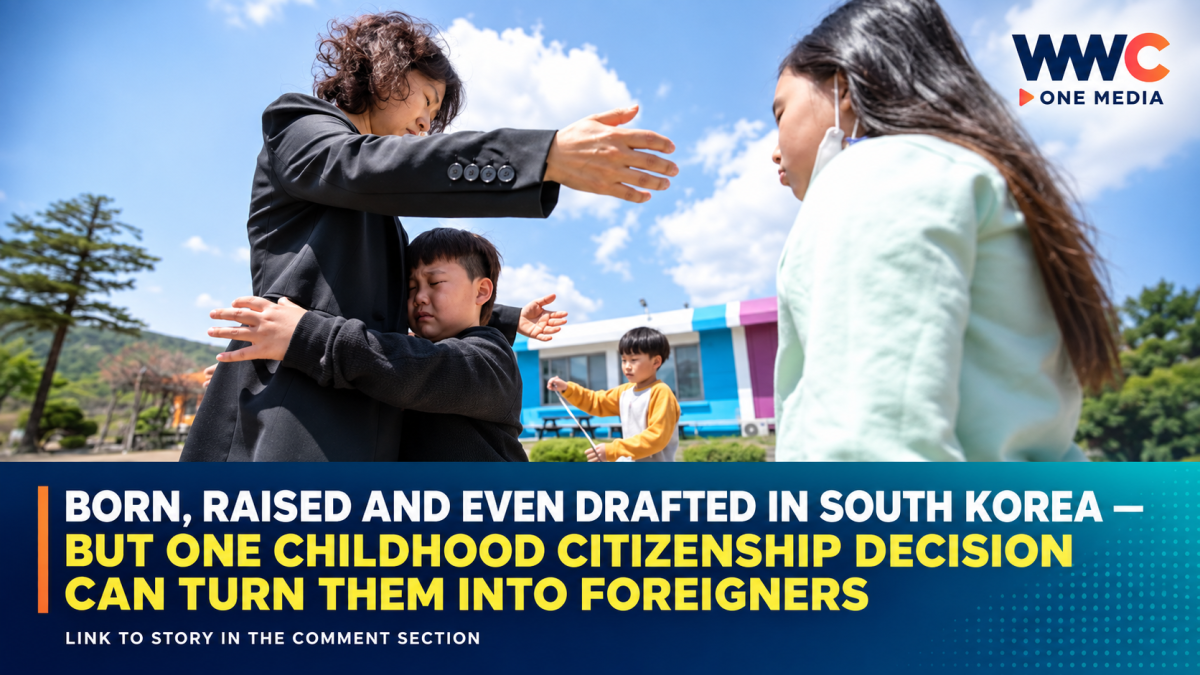
SEOUL — They went to Korean schools, carried Korean passports, received government benefits and, in at least one case, completed military service. Then some members of South Korea’s growing transnational families discovered that a citizenship decision made by their parents years earlier may have quietly stripped them of their Korean nationality.
A little-known provision in South Korea’s nationality law is throwing families into legal uncertainty and, in some cases, forcing people who have spent virtually their entire lives in the country to confront an extraordinary possibility:
They may legally be foreigners in the only country they consider home.
The issue, highlighted in a new investigation by Channel NewsAsia, centers on Article 15 of South Korea’s Nationality Act and the distinction between being a dual national from birth and acquiring another nationality later.
That distinction may sound technical.
For the families affected, it can determine whether someone is legally Korean at all.
The rule at the center of the controversy
South Korea primarily grants citizenship through parentage rather than simply because a child is born on Korean soil.
Under Article 2 of the Nationality Act, a child generally acquires South Korean nationality at birth if either parent is a South Korean citizen. A child born in South Korea to foreign parents does not automatically become Korean merely because the birth took place there, except in limited circumstances involving unknown or stateless parents.
South Korean law also allows some people who possess Korean and another nationality from birth to retain both, subject to nationality-selection and other legal requirements.
The problem arises when someone who is already Korean subsequently acquires a foreign nationality.
Article 15 states that a South Korean national who voluntarily acquires another country’s nationality loses Korean nationality when that foreign nationality is acquired. The law also provides different treatment for certain situations in which foreign nationality is acquired automatically, such as through marriage, adoption or as a minor accompanying a parent who loses Korean nationality, provided required retention procedures are followed.
For children, however, “voluntary” acquisition can become especially complicated because the decision may have been made entirely by their parents.
That is exactly where several families interviewed by CNA say they were caught.
He lived as Korean for 21 years — and served in the military
One of the most striking cases involves a 21-year-old man from Suwon who was born and raised in South Korea.
According to CNA, his parents registered him for Russian nationality when he was two years old.
For nearly two decades afterward, he lived as a Korean.
He attended school in South Korea. He considered himself Korean. He even fulfilled South Korea’s compulsory national-defense obligations.
Now he fears that acquiring Russian nationality as a toddler may have caused him to lose his Korean citizenship under Article 15.
The contradiction is particularly stark because, despite uncertainty over whether the state legally considers him Korean, CNA reported that he has still been summoned for reserve military training in October.
The young man has not yet sought a definitive determination of his nationality status because he fears the consequences for his employment and his ability to support his family.
His case exposes the central problem created by the law:
A child can grow up participating in virtually every part of Korean civic life while an old nationality transaction remains legally significant years later.
Another family was told to leave South Korea
A Korean father in Busan told CNA that he and his Australian wife believed their two South Korea-born children were lawful citizens of both countries.
The family travelled using Australian passports when entering Australia and Korean passports when returning to South Korea.
They apparently saw nothing unusual about it.
Then they began questioning whether the children’s later acquisition of Australian nationality had affected their Korean status.
When the father went to immigration authorities in 2023 to clarify the issue, he said officials determined that the children were no longer Korean nationals.
According to his account, the family was required to leave South Korea and the children later returned using their Australian passports as foreigners while beginning procedures to restore Korean nationality.
The family also received demands to repay about 15 million won, roughly US$11,000, in childcare subsidies and health-insurance benefits that authorities said had been received while their nationality status was invalid, CNA reported.
The father said he would never have pursued Australian citizenship for his children if he had known it could jeopardize their Korean nationality.
Families say even government advice was confusing
Perhaps the most troubling part of the controversy is that some parents say they attempted to check the rules before taking action.
One father in Ansan provided CNA with a recording of a conversation with South Korea’s Immigration Contact Center.
He specifically asked whether registering his Korean-born child with the Russian Embassy could cause the child to lose Korean nationality.
According to the recording, the official told him the child was a dual national and could retain both nationalities.
The father later contacted the Justice Ministry’s Nationality Division and said he received the opposite explanation: if the child acquired Russian nationality rather than possessing it from birth, Article 15 could apply.
The Justice Ministry told CNA that it provides nationality guidance through the Immigration Contact Center and regularly trains officials.
The conflicting accounts illustrate why nationality law can be unusually difficult for ordinary families to navigate.
The practical difference between “having another nationality from birth” and “acquiring another nationality after birth” can completely change the legal outcome.
Yet for a parent filling out embassy paperwork for a two-year-old child, that distinction may be far from obvious.
This is not a loophole affecting all multicultural children
That point deserves emphasis.
A viral interpretation of the story could easily suggest that children born to Korean and foreign parents suddenly risk losing their citizenship simply because they have two nationalities.
That would be inaccurate.
South Korean law expressly recognizes multiple nationality in certain circumstances. People who acquire Korean and foreign nationality simultaneously from birth may be permitted to retain both, provided they comply with applicable nationality-selection rules.
The current controversy involves a narrower category:
People who were already Korean and then obtained another nationality later, often because their parents completed a foreign registration or citizenship process for them while they were minors.
Those cases may fall under Article 15’s nationality-loss provision.
That legal distinction is central to understanding the story correctly.
South Korea’s multicultural population is becoming harder to ignore
The issue is emerging at a time when South Korea itself is becoming increasingly multicultural.
Government figures show 13,416 babies were born to multicultural families in 2024, up 10.4% from 2023.
That was the first increase in multicultural births in 12 years.
Those births represented 5.6% of every baby born in South Korea that year, up from 5.3% a year earlier.
Multicultural marriages also reached 21,450 in 2024, an increase of 5% from the previous year and equivalent to 9.6% of all marriages nationwide. Korean men married to foreign women accounted for the largest category.
Vietnamese women represented the largest share of foreign wives, followed by Chinese and Thai nationals.
The shift is important because South Korea has historically been one of Asia’s more ethnically homogeneous societies.
But labor shortages, international marriage, migration and the country’s demographic crisis are steadily changing that reality.
A country desperate for children is becoming more multicultural
The nationality debate also intersects with South Korea’s much larger population problem.
South Korea has spent years battling one of the world’s lowest fertility rates.
Its total fertility rate rose from 0.75 children per woman in 2024 to 0.80 in 2025, marking a second consecutive annual increase, according to government data reported by Reuters. The improvement is encouraging, but the rate remains far below the roughly 2.1 level needed to maintain a population without immigration.
South Korea’s population is projected to shrink sharply over coming decades unless birth trends improve substantially or immigration offsets part of the decline. Reuters reported government projections showing the population falling from around 51.8 million to about 36.2 million by 2072.
That creates an increasingly uncomfortable contradiction.
South Korea needs more young workers, more families and greater demographic diversity.
Yet some children from international households are discovering that a citizenship rule written for a very different era can leave their legal identity in doubt.
Multicultural families still report barriers
Separate South Korean government research also shows that legal nationality is only one challenge facing multicultural households.
A national survey covering more than 16,000 multicultural households found improvements in incomes and education but persistent experiences of discrimination.
Among respondents who experienced discrimination, 80.7% said they simply endured it rather than seeking help or taking action, The Korea Times reported.
Government officials have increasingly argued that multicultural families should be viewed not merely as recipients of assistance but as permanent contributors to South Korean society.
That shift in rhetoric makes the nationality controversy even more consequential.
If South Korea wants international families to become a larger part of its demographic future, citizenship rules must also be understandable enough for ordinary parents to follow.
The government now wants to change the law
South Korea’s Justice Ministry has acknowledged the problem and is pursuing changes to the Nationality Act.
According to CNA, the ministry is considering an amendment that would allow minor children from international marriages who obtain another nationality after birth to retain multiple nationalities under conditions similar to people who were dual nationals from birth.
The government is also studying transitional relief for people who have already lost Korean citizenship.
Under the proposal described by CNA, former Korean nationals who restore their citizenship within a specified period after the amendment takes effect could potentially retain both nationalities.
It is important to note that this particular reform has not yet been enacted into current Article 15.
South Korea did pass a separate amendment to the Nationality Act in June 2026, scheduled to take effect in December, but official legislative records show that amendment concerns simplified naturalization rules for spouses of descendants of Korean independence activists—not the transnational-child problem described by CNA.
So for affected families, the existing Article 15 remains the critical law while the Justice Ministry works on further reform.
Some families say simply restoring citizenship is not enough
Even that proposed solution may not satisfy everyone.
Attorney Kang Seok-jun, who represents about 40 Korean-Russian families, told CNA that his clients do not want authorities merely to restore a citizenship the government says they previously lost.
They want the government to recognize that they legally possessed both nationalities all along.
That distinction could matter enormously.
If citizenship is merely restored, questions could remain over the period during which a person was technically considered foreign—including access to benefits, employment rights, military obligations and other official acts.
If authorities instead recognize continuous citizenship, many of those questions could disappear.
That is likely to become one of the most difficult parts of any eventual reform.
The bigger question is no longer just about passports
For South Korea, this controversy reaches well beyond nationality paperwork.
It touches on what citizenship actually means in a country undergoing rapid demographic change.
Is someone Korean because of a legal status recorded in a database?
Because they were born to a Korean parent?
Because they grew up speaking Korean, attended Korean schools and served in the Korean military?
Legally, those questions have precise answers.
Socially, they are becoming much harder.
The 21-year-old in Suwon believed there was nothing to debate.
He had spent his entire life as Korean.
But because of a foreign nationality his parents obtained for him when he was two, the government may eventually tell him that the legal answer is different.
And as South Korea welcomes more international marriages and more multicultural children, his case may be a warning of a much larger challenge ahead:
The country is becoming more diverse faster than some of its citizenship rules were designed to handle.




Leave a Reply