
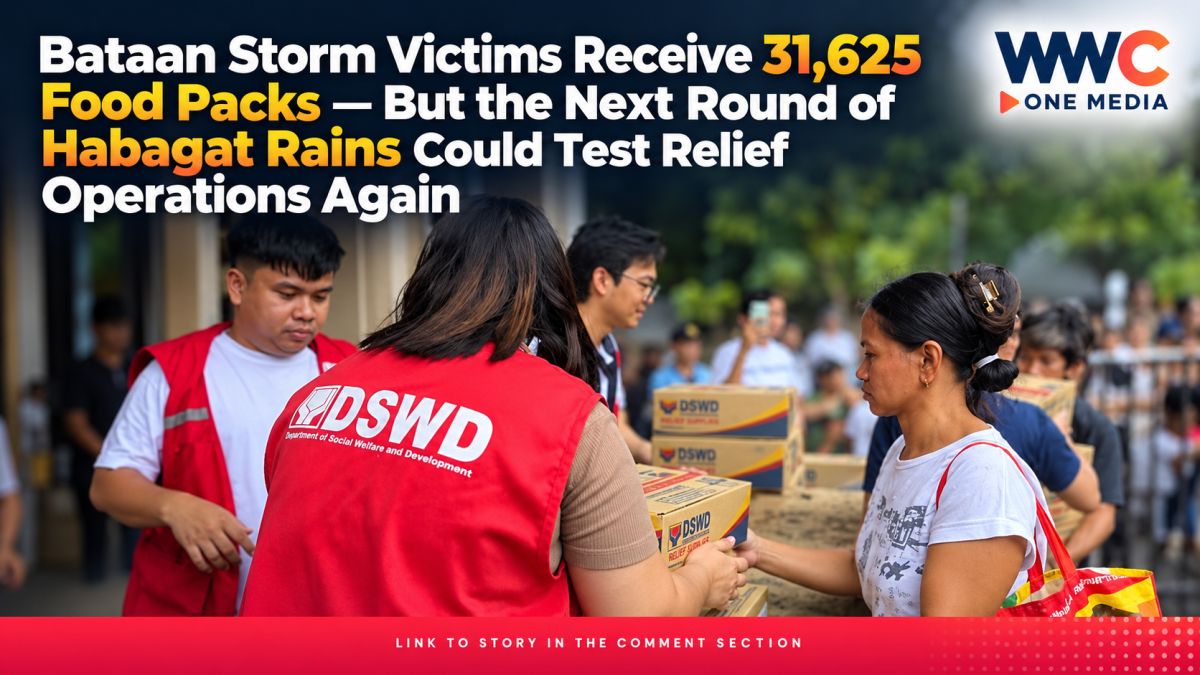
BATAAN, Philippines — Thousands of additional food packs are reaching families battered by weeks of severe weather in Bataan, but continuing monsoon rains mean the province’s humanitarian response remains far from finished.
A reported 31,625 food packs are being provided to typhoon-affected families in Bataan as government agencies and local authorities continue relief operations following successive tropical cyclones, flooding and the intensified southwest monsoon, or habagat.
The assistance provides an immediate lifeline for households whose homes, transportation, work and daily routines have been repeatedly disrupted by heavy rains.
But the 31,625 figure represents only part of a much larger relief effort already underway in the province.
Bataan relief operations are much larger than one distribution
Official figures from the Provincial Government of Bataan show that 157,708 food packs had already been distributed to affected communities as of September 1.
Of that number, 156,725 packs came from the Department of Social Welfare and Development and were distributed through local government units, while another 983 packs were supplied by the provincial government to families staying in evacuation centers.
That distinction is important.
The newly reported 31,625 packs should therefore be viewed as part of the continuing relief effort rather than Bataan’s overall cumulative distribution total.
Local governments throughout the province have continued identifying communities requiring assistance while response teams monitor flooded locations and coordinate deliveries of additional supplies.
More than 1.75 million packs distributed across Central Luzon
The scale of the disaster response becomes even clearer when Bataan is viewed alongside the rest of Central Luzon.
The DSWD said on September 9 that its Field Office 3 had distributed 1,756,607 family food packs across Central Luzon’s seven provinces following weeks of flooding and heavy rainfall linked to recent tropical cyclones and the enhanced southwest monsoon.
The agency said flooding has damaged homes and affected livelihoods, commerce and normal daily activities across communities in the region.
DSWD Regional Director Venus Rebuldela said coordination among field personnel, local governments and support offices has been crucial in keeping relief supplies moving while the emergency stretches over an extended period.
Bataan has been among the provinces repeatedly affected.
A Philippine News Agency report from August 26 showed DSWD personnel distributing relief supplies in Dinalupihan, Bataan, as national humanitarian assistance for communities affected by tropical cyclones Luis, Maymay and Neneng and the habagat reached more than P1.36 billion at that point.
The weather threat has not disappeared
Relief operations are continuing while Bataan remains exposed to more rainfall.
On the morning of September 9, PAGASA placed Bataan under an orange rainfall warning, indicating that flooding remained threatening because of heavy rain associated with the southwest monsoon.
The warning was later lowered to yellow, but flooding remained possible in vulnerable areas.
The Philippine News Agency also reported that occasional rains were forecast over Bataan, Zambales, Tarlac, Pampanga, Cavite, Batangas and Occidental Mindoro, with moderate to heavy rainfall capable of triggering flash floods or landslides.
The continuing weather threat underscores why relief distribution cannot be viewed simply as a one-time emergency operation.
Families that have already returned home could face renewed flooding, while households whose income depends on transportation, farming, fishing, informal work or small businesses may continue needing assistance even after floodwaters disappear.
DSWD replenishing stocks as disasters consume supplies
The national government has also been rebuilding its relief inventories as millions of food packs are deployed.
Before a major series of weather disturbances in August, DSWD Secretary Rex Gatchalian said the government’s national stockpile had reached about 5.2 million family food packs stored in roughly 1,000 warehouses nationwide.
By September 7, DSWD said more than 3.2 million family food packs remained prepositioned at strategic locations nationwide, showing both the size of its remaining emergency inventory and how significant recent relief deployments have been.
The department has also called for additional volunteers to help replenish its inventories, with production hubs continuing to repack supplies for future deployment.
What is actually inside a government food pack?
Questions over government relief spending have also circulated online.
DSWD recently clarified that the actual awarded procurement price for the contents of a prepacked family food pack is P797.80, not the P1,503.84 figure circulated in some social-media posts. The larger figure represented a procurement ceiling rather than the final contract price, according to the agency.
DSWD has separately said its family food packs undergo procurement, safety and quality-control procedures before they are sent to disaster-stricken communities.
That scrutiny has become increasingly important as the scale of government relief operations grows into the millions of boxes.
For Bataan, food relief is only the first stage
The distribution of food packs addresses the most immediate problem: ensuring displaced and flood-affected residents have something to eat.
Recovery, however, extends beyond emergency food supplies.
Repeated flooding can damage furniture and appliances, disrupt schooling, reduce household income, destroy crops, damage roads and expose communities to health risks long after evacuation centers begin emptying.
Bataan’s provincial government has said it continues working with its 12 local government units and national agencies to assess conditions and identify communities requiring further support.
That makes the 31,625 food packs significant—but also only one piece of a considerably larger disaster-response operation.
For thousands of families across Bataan, the bigger question is not simply whether another box of food will arrive.
It is how long communities will continue needing emergency assistance—and whether another round of habagat rains will force families who have only started recovering to evacuate once again.




Leave a Reply