
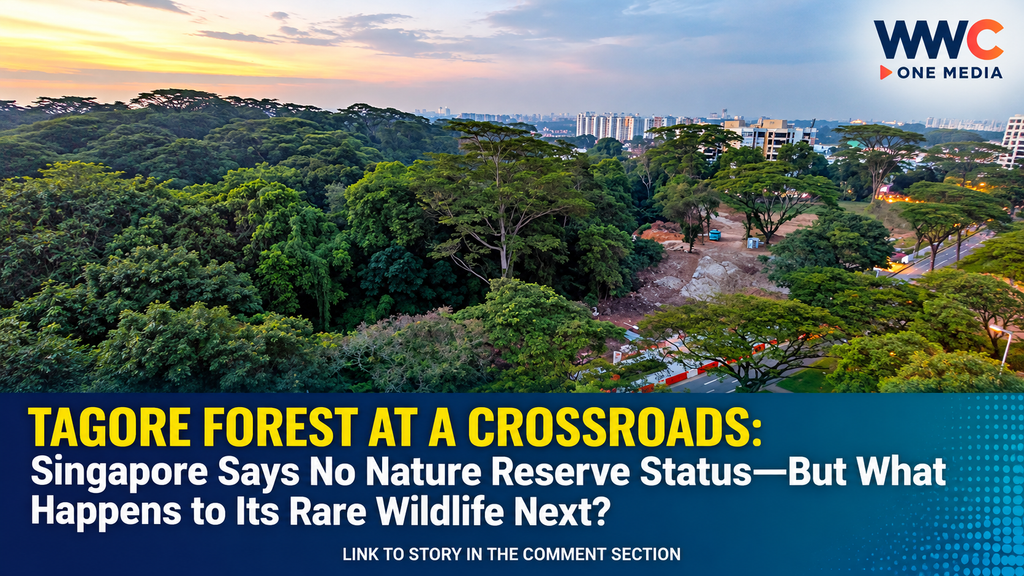
SINGAPORE — Tagore Forest will not be designated as a nature reserve for now, despite calls from scientists and conservationists to protect the ecologically significant forested site in the Lentor area.
National Development Minister Chee Hong Tat said on Sept. 8 that the Singapore Government currently has no plans to designate Tagore Forest as a Nature Reserve. The statement came in a written parliamentary reply to Workers’ Party MP Kenneth Tiong, who asked how Singapore determines which ecologically significant areas should receive nature-reserve protection.
The decision puts Tagore Forest at the centre of Singapore’s continuing debate over how to balance housing demand with biodiversity conservation in one of the world’s most land-scarce cities.
Why Tagore Forest matters
Tagore Forest is currently zoned for residential development.
But the site has attracted attention from scientists and conservation groups because of its ecological value and the wildlife found there. A 2024 proposal by nearly 40 scientists and conservationists called for the area to be studied for preservation, citing species including the Raffles’ banded langur and Sunda pangolin.
A more recent report by youth nature groups LepakInSG and Singapore Youth Voices for Biodiversity also called for Tagore Forest to be designated as a nature park.
That does not mean the forest has been designated for immediate clearance. Rather, the current government position is that the site remains within Singapore’s broader land-use planning framework, with residential development competing against conservation considerations.
Government: Singapore has to balance homes and nature
Chee said Singapore takes a science-based approach when deciding what natural areas should be conserved.
The Government considers an area’s biodiversity and ecological value, its importance to native wildlife and Singapore’s broader land-use requirements — including housing, industry, climate resilience and national security.
Singapore currently has four Nature Reserves:
- Bukit Timah Nature Reserve
- Central Catchment Nature Reserve
- Labrador Nature Reserve
- Sungei Buloh Wetland Reserve
The first two were gazetted in 1990, while Labrador and Sungei Buloh were gazetted in 2002. The Government describes these areas as Singapore’s most biodiverse landscapes and important strongholds for threatened and endemic species.
But Tagore Forest is not currently among them.
Singapore is still expanding its overall green footprint
The Government says the absence of nature-reserve status for Tagore Forest should not be viewed in isolation.
Singapore has set aside more than 7,800 hectares of green spaces, including nature reserves, nature areas, nature parks and other parks and green corridors.
That figure is planned to rise to 8,800 hectares by 2035.
The Urban Redevelopment Authority also says Singapore has added 130 hectares of new parks since 2021, while its Park Connector Network has expanded to 391km. More than 25 new parks and over 50km of additional park connectors are planned by 2030.
The strategy is essentially to create a connected “City in Nature”, rather than relying only on formally gazetted nature reserves.
What happens to wildlife if development proceeds?
This is where the issue becomes more complicated.
The Government says development on sites with potentially significant environmental impacts will be subject to an Environmental Impact Assessment (EIA).
Such assessments are intended to examine the nature and scale of environmental impacts and determine mitigation measures. Authorities may also consider retaining areas with higher ecological value, strengthening ecological connectivity and incorporating greenery into development plans.
Environmental Management and Monitoring Plans can subsequently be used to monitor whether mitigation measures are working.
However, conservationists have questioned whether protecting individual patches of greenery is enough when larger forests function as interconnected habitats.
Singapore’s National Parks Board uses an island-wide Ecological Profiling Exercise to identify important ecological corridors and wildlife routes. One example is EcoLink@BKE, which connects habitats and helps wildlife move between areas.
Housing demand remains a major factor
The Tagore Forest debate is also inseparable from Singapore’s housing strategy.
Chee said the Government expects housing demand to remain strong in the near to medium term, driven partly by household formation and decreasing household sizes. Agencies consider demographic trends, socioeconomic conditions, market conditions and the availability of resale flats when planning future housing supply.
The Government says it will make greater use of brownfield sites and under-utilised land where feasible before activating sites containing greenery or heritage.
It has also cited the redevelopment of predominantly low-density areas, such as Turf City, as an example of increasing housing density where practical.
But officials acknowledge that redevelopment of large amounts of landed housing is not a simple solution because it can require extensive acquisition and major upgrades to transportation and other infrastructure.
The bigger Singapore debate
Tagore Forest is part of a much wider conversation over Singapore’s remaining natural spaces.
Recent debates have also involved Maju Forest and Gillman Barracks, where the Government announced adjustments to proposed plans following public feedback, including retaining more greenery and reducing the number of homes planned for those sites.
That makes Tagore particularly significant: it illustrates the difficult question facing Singapore as the city continues to grow.
How much natural habitat can be retained while still providing enough homes and infrastructure for a growing population?
For now, the Government’s answer is clear: Tagore Forest will not receive Nature Reserve status.
But that does not necessarily end the conservation debate.
With rare wildlife, ecological corridors and future development all competing for the same limited land, Tagore Forest could become another major test of Singapore’s promise to remain both a global city and a “City in Nature.”
Leave a Reply