
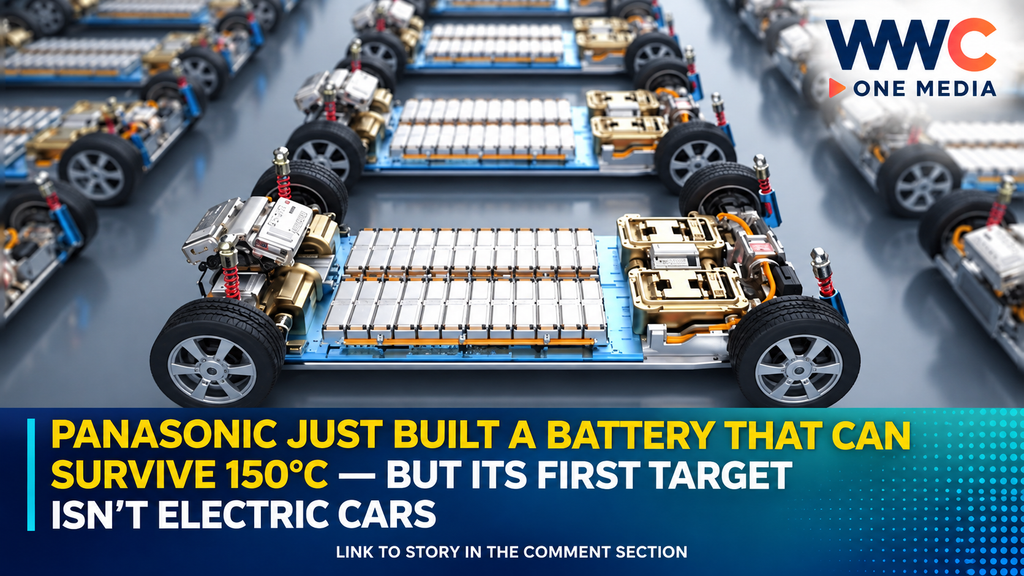
CHIBA, JAPAN — Panasonic Energy has developed a new solid-state battery capable of operating at temperatures as high as 150°C (302°F), marking a major step forward for battery technology designed for extreme environments.
The battery division of Panasonic Holdings has increased the maximum operating temperature of its solid-state technology from 125°C to 150°C, while also developing a new small prismatic-cell design alongside its existing coin-shaped configuration. Panasonic Energy CTO Shoichiro Watanabe disclosed the development on September 9.
And here’s where the development gets particularly interesting: Panasonic isn’t initially positioning the technology for electric vehicles.
Instead, the company plans to target applications where batteries must continue functioning in environments that can become extremely hot—including industrial machinery and vehicle sensors. The higher heat tolerance could eventually open the door to applications such as medical-equipment sterilization, according to Watanabe.
Why 150°C matters
Conventional batteries can face significant performance and durability challenges when exposed to extreme heat. Panasonic’s new solid-state approach is designed to maintain operation at temperatures that would be difficult for many conventional battery systems.
The company says its new prismatic format also offers an important practical advantage. Compared with coin-shaped cells, prismatic batteries can make it easier for manufacturers to arrange cells within equipment, potentially expanding the number of devices in which the technology can be integrated.
Panasonic previously described all-solid-state batteries as a promising next-generation technology because of their potential to operate in extreme environments. However, the company has also acknowledged that cost competitiveness remains one of the major obstacles to widespread commercialization.
Samples could arrive before the end of 2026
Panasonic Energy plans to begin sample shipments during the October–December 2026 quarter.
The company is then targeting mass production approximately one to two years after those sample shipments, suggesting that commercial-scale deployment could still be several years away rather than imminent.
That makes the latest announcement less about an immediate consumer product and more about Panasonic demonstrating that solid-state batteries can solve a specific problem: delivering reliable power in places where extreme heat makes conventional battery technology difficult to use.
And Panasonic is looking beyond industrial sensors
The company’s battery ambitions don’t stop there.
Panasonic Energy is also accelerating development of cylindrical batteries for humanoid robots. Watanabe said cylindrical cells could be well suited to humanoid robots because they can fit into limited spaces and conform better to rounded structures.
The move reflects a broader strategy by Panasonic Energy to develop different battery technologies for different markets rather than relying on a single battery architecture.
The company continues to pursue its established cylindrical lithium-ion battery business while exploring next-generation solid-state and other advanced battery technologies. Panasonic has previously said it sees solid-state batteries as particularly valuable for applications requiring performance in extreme temperatures.
Not the EV breakthrough many expected—yet
Despite the excitement surrounding solid-state batteries, Panasonic’s latest announcement should not be interpreted as the arrival of a 150°C solid-state EV battery.
The company is initially concentrating on industrial and sensor applications, where the technology’s high-temperature capability may provide a more immediate advantage.
Panasonic has previously indicated that it would consider solid-state batteries for automotive applications when their cost competitiveness becomes comparable with lithium-ion batteries.
That means the bigger story may not be what this battery can power today—but what becomes possible once high-temperature solid-state batteries become commercially viable.
From industrial robots and vehicle sensors to specialized medical equipment and potentially future robotic systems, Panasonic is betting that batteries capable of surviving extreme heat could unlock applications that conventional batteries struggle to serve.
The 150°C milestone may therefore be less about replacing today’s batteries—and more about expanding the places where batteries can work at all.
What we know so farCHIBA, JAPAN — Panasonic Energy has developed a new solid-state battery capable of operating at temperatures as high as 150°C (302°F), marking a major step forward for battery technology designed for extreme environments.
The battery division of Panasonic Holdings has increased the maximum operating temperature of its solid-state technology from 125°C to 150°C, while also developing a new small prismatic-cell design alongside its existing coin-shaped configuration. Panasonic Energy CTO Shoichiro Watanabe disclosed the development on September 9.
And here’s where the development gets particularly interesting: Panasonic isn’t initially positioning the technology for electric vehicles.
Instead, the company plans to target applications where batteries must continue functioning in environments that can become extremely hot—including industrial machinery and vehicle sensors. The higher heat tolerance could eventually open the door to applications such as medical-equipment sterilization, according to Watanabe.
Why 150°C matters
Conventional batteries can face significant performance and durability challenges when exposed to extreme heat. Panasonic’s new solid-state approach is designed to maintain operation at temperatures that would be difficult for many conventional battery systems.
The company says its new prismatic format also offers an important practical advantage. Compared with coin-shaped cells, prismatic batteries can make it easier for manufacturers to arrange cells within equipment, potentially expanding the number of devices in which the technology can be integrated.
Panasonic previously described all-solid-state batteries as a promising next-generation technology because of their potential to operate in extreme environments. However, the company has also acknowledged that cost competitiveness remains one of the major obstacles to widespread commercialization.
Samples could arrive before the end of 2026
Panasonic Energy plans to begin sample shipments during the October–December 2026 quarter.
The company is then targeting mass production approximately one to two years after those sample shipments, suggesting that commercial-scale deployment could still be several years away rather than imminent.
That makes the latest announcement less about an immediate consumer product and more about Panasonic demonstrating that solid-state batteries can solve a specific problem: delivering reliable power in places where extreme heat makes conventional battery technology difficult to use.
And Panasonic is looking beyond industrial sensors
The company’s battery ambitions don’t stop there.
Panasonic Energy is also accelerating development of cylindrical batteries for humanoid robots. Watanabe said cylindrical cells could be well suited to humanoid robots because they can fit into limited spaces and conform better to rounded structures.
The move reflects a broader strategy by Panasonic Energy to develop different battery technologies for different markets rather than relying on a single battery architecture.
The company continues to pursue its established cylindrical lithium-ion battery business while exploring next-generation solid-state and other advanced battery technologies. Panasonic has previously said it sees solid-state batteries as particularly valuable for applications requiring performance in extreme temperatures.
Not the EV breakthrough many expected—yet
Despite the excitement surrounding solid-state batteries, Panasonic’s latest announcement should not be interpreted as the arrival of a 150°C solid-state EV battery.
The company is initially concentrating on industrial and sensor applications, where the technology’s high-temperature capability may provide a more immediate advantage.
Panasonic has previously indicated that it would consider solid-state batteries for automotive applications when their cost competitiveness becomes comparable with lithium-ion batteries.
That means the bigger story may not be what this battery can power today—but what becomes possible once high-temperature solid-state batteries become commercially viable.
From industrial robots and vehicle sensors to specialized medical equipment and potentially future robotic systems, Panasonic is betting that batteries capable of surviving extreme heat could unlock applications that conventional batteries struggle to serve.
The 150°C milestone may therefore be less about replacing today’s batteries—and more about expanding the places where batteries can work at all.
What we know so far
🚗 EV status: Not Panasonic’s initial target for this particular technology
🔋 Technology: Solid-state battery
🌡️ Maximum operating temperature: Up to 150°C / 302°F
📈 Previous Panasonic target: 125°C
📦 New format: Small prismatic cell, alongside coin-shaped cells
🏭 Initial targets: Industrial machinery and vehicle sensors
🏥 Potential future use: Medical-equipment sterilization environments
🚚 Sample shipments: October–December 2026
🏗️ Mass-production target: About 1–2 years after samples
🤖 Separate development: Cylindrical batteries for humanoid robots
Leave a Reply