
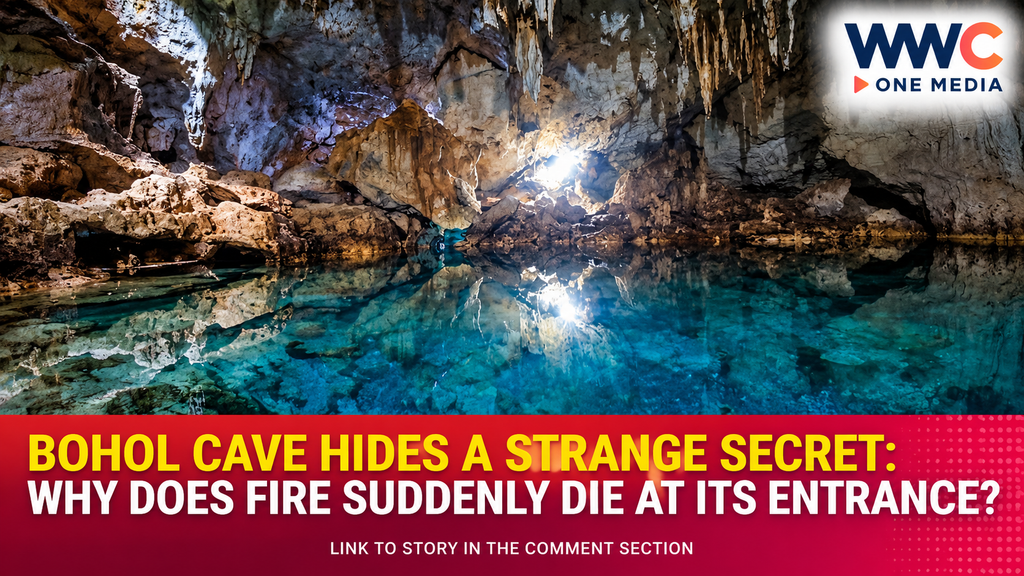
A mysterious phenomenon inside a cave in Bohol has caught the attention of locals and viewers after a simple flame appeared to die out when brought near the cave’s entrance.
The unusual occurrence was featured by GMA News through Kapuso Mo, Jessica Soho, with the question of what causes the flame to disappear becoming the central mystery surrounding the cave. GMA Public Affairs also published a video of the feature describing the phenomenon as a cave where a flame seemingly dies when placed at its opening.
At first glance, the scene may appear supernatural. But science offers several possible explanations for why a flame can suddenly go out in or around a cave.
Is there really something mysterious inside?
The unusual behavior of the flame does not, by itself, prove the presence of anything supernatural.
A fire needs sufficient oxygen, fuel and heat to continue burning. If the air around a flame contains too little oxygen or a higher concentration of non-combustible gases, the flame can weaken and eventually go out.
Caves can naturally have different air conditions from the open environment because their passages, chambers and openings affect how air circulates.
The Philippine government’s Biodiversity Management Bureau explains that so-called “bad air” can develop inside caves when carbon dioxide concentrations rise and oxygen levels fall. Poorly ventilated areas can therefore present an environment in which a flame may not continue burning normally.
However, this should not automatically be presented as the confirmed explanation for the specific Bohol cave featured by GMA. A proper scientific explanation would require measurements of oxygen, carbon dioxide, airflow and other gases at the exact location.
Bohol caves are already known for unusual underground conditions
The flame phenomenon comes at an interesting time for Bohol’s caves.
A 2026 research report from the University of the Philippines’ Office of the Vice President for Academic Affairs said researchers measured elevated levels of naturally occurring radioactive gases—radon and thoron—in three well-known Bohol caves: Hinagdanan, Batungay and Princess Manan-aw.
The study found that radon concentrations in those caves ranged from 127 to 1,829 Bq/m³, with the measured levels exceeding the recommended safety limit cited in the research. The researchers noted that cave structure and ventilation can influence the accumulation of these gases.
But there is an important distinction: radon and thoron are not being identified as the reason the flame in the GMA feature went out. The available research concerns specific caves and radioactive-gas measurements and does not establish a connection to the newly featured phenomenon.
Bohol’s caves are living ecosystems
Another GMA report about a cave in Trinidad, Bohol showed just how biologically complex the province’s underground environments can be.
Researchers documented bats, swiftlets and unusual cave-dwelling catfish, locally associated with stories about “puting diwata.” Scientists emphasized that caves function as critical habitats and that human disturbance can affect the animals living inside them.
The same report noted that bat populations observed in the cave had declined compared with observations more than a decade earlier, with researchers pointing to human disturbance as one possible concern. Local authorities consequently emphasized regulated tourism and limits on the number of visitors entering the cave at one time.
The mystery may be more scientific than supernatural
The dramatic reaction to the Bohol cave is understandable. Watching a flame burn normally and then suddenly disappear near an opening can look inexplicable.
But unusual cave behavior often has an environmental explanation.
Changes in oxygen concentration, carbon dioxide levels, humidity, temperature and airflow can all affect conditions inside underground spaces. The shape of a cave can also create areas where gases accumulate or where air movement differs significantly from what people experience outside.
The country’s cave-management literature similarly warns that caves can develop poor-air conditions, particularly where ventilation is limited.
That means the most intriguing question may not be whether the cave is “haunted,” but rather what is happening to the air at that particular point in the cave?
A mystery that deserves scientific investigation
For now, the flame-extinguishing phenomenon remains a fascinating observation rather than proof of a supernatural force.
To determine exactly why the flame goes out, scientists would need to conduct controlled measurements at the cave entrance and compare them with normal outdoor conditions.
Until then, the Bohol cave remains a compelling reminder that nature can produce phenomena that look mysterious long before science has had a chance to explain them.
And perhaps that’s what makes the discovery so fascinating: the flame disappears in seconds—but the real explanation may be hidden in something we cannot see at all.
Leave a Reply