
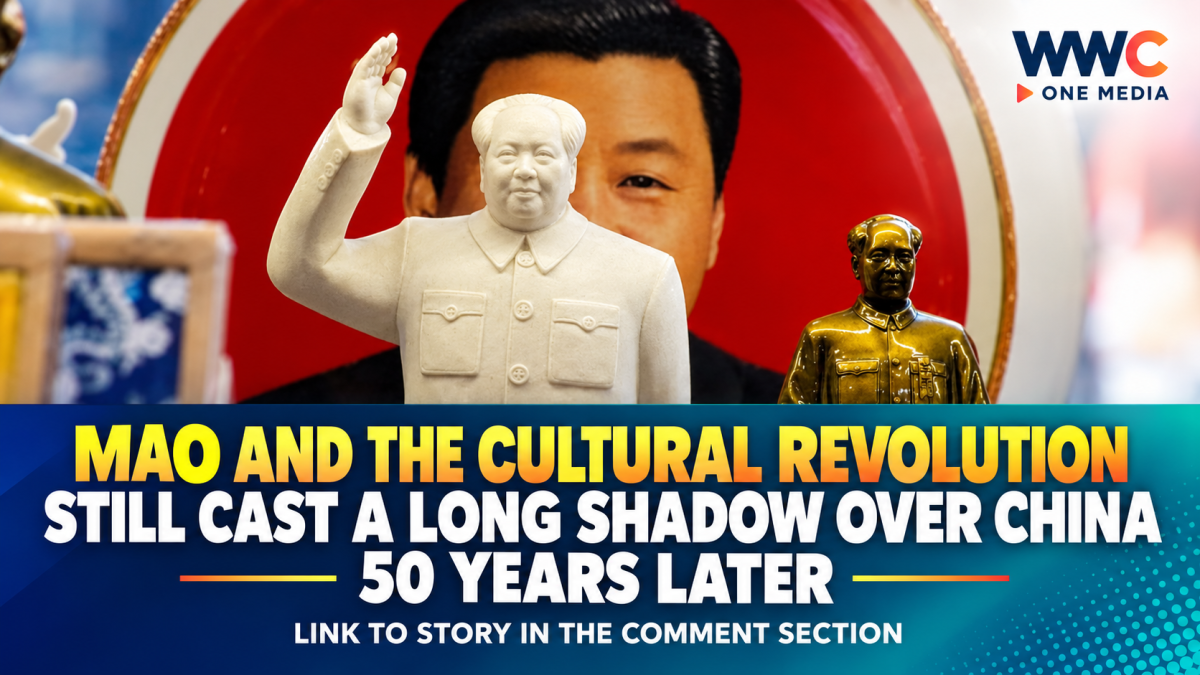
BEIJING — China marked 50 years since the death of Mao Zedong on Sept 9, with the legacy of the country’s founding leader and the trauma of the Cultural Revolution continuing to shape politics, society and the leadership of President Xi Jinping.
Mao died on Sept 9, 1976, at the age of 82, ending nearly three decades as China’s dominant leader.
His death also accelerated the end of the Cultural Revolution, the decade-long political movement he launched in 1966 that brought widespread upheaval, persecution and economic disruption across the country.
Half a century later, Mao remains one of China’s most revered and controversial figures. The Communist Party continues to honour him as the founder of the People’s Republic of China while also recognising the Cultural Revolution as a grave mistake for which he bore primary responsibility.
A leader still honoured across China
Mao’s image remains deeply embedded in China’s political landscape.
His portrait overlooks Tiananmen Square in Beijing, while his preserved body remains on display at the Chairman Mao Memorial Hall.
Visitors from across China continue to queue to pay their respects, and the memorial hall extended its opening hours for the 50th anniversary of his death in anticipation of increased visitors.
For many Chinese, Mao is remembered as the revolutionary leader who helped establish modern China and brought the Communist Party to power.
But his rule also left behind a far more complicated legacy, particularly because of the devastating political campaigns that took place during his leadership.
The Cultural Revolution changed China
Mao launched the Cultural Revolution in 1966, mobilising students and supporters against people accused of being enemies of the revolution or supporters of a capitalist path.
Young people, including members of the Red Guards, were encouraged to challenge authority and target perceived political and cultural enemies.
The movement quickly spiralled into years of turmoil.
Government institutions were disrupted, the economy suffered and millions of people faced political persecution, public humiliation, violence or imprisonment.
Families were divided, schools and universities were disrupted, and countless cultural and historical objects were destroyed.
The Cultural Revolution lasted until Mao’s death in 1976 and remains one of the most traumatic periods in modern Chinese history.
The Communist Party’s complicated relationship with Mao
After Mao’s death, the Communist Party officially described the Cultural Revolution as a serious error.
However, the party has never completely rejected Mao.
Instead, China’s official position has generally been that Mao’s contributions to the country outweigh his mistakes.
That balancing act continues today.
Mao remains central to the Communist Party’s history and legitimacy, making a full rejection of his legacy politically difficult.
At the same time, the Cultural Revolution serves as a warning about the dangers of political chaos and the breakdown of central authority.
Xi Jinping was personally affected by the turmoil
The Cultural Revolution also had a direct impact on President Xi Jinping and his family.
Xi’s father, former vice-premier Xi Zhongxun, was purged and persecuted during the political turmoil.
The family home was ransacked, while Xi himself faced political pressure as a teenager.
He was later sent to the countryside in 1969, where he spent years living in a poor village in northwestern China.
The experience has been widely viewed as an important influence on Xi’s political outlook.
Analysts say the chaos of the Cultural Revolution helped shape his belief in strong political control, party unity and stability.
Yet despite his family’s suffering, Xi has not publicly turned against Mao.
Xi has strengthened centralised power
Since becoming China’s top leader in 2012, Xi has consolidated political power and strengthened ideological control.
He has also placed greater emphasis on party discipline, nationalism and political unity.
Xi’s name has been formally incorporated into China’s state ideology, making him the first Chinese leader since Mao to achieve that distinction while still in office.
He also moved away from post-Mao term-limit norms that were intended to prevent the excessive concentration of power in one leader.
Analysts say Xi’s leadership has revived some elements associated with Mao-era political symbolism, although China’s modern political and economic system is vastly different from the country Mao ruled.
Mao’s legacy remains politically powerful
The continued importance of Mao reflects the challenge facing China’s leadership.
Rejecting Mao too strongly could undermine the historical foundation of the Communist Party and raise difficult questions about the party’s own past.
But ignoring the suffering caused by the Cultural Revolution also leaves one of the country’s most traumatic periods without a full public reckoning.
As a result, Mao remains both a symbol of national revolution and a reminder of political catastrophe.
His legacy continues to influence debates about leadership, ideology, stability and the role of the Communist Party in Chinese society.
The long shadow of the Cultural Revolution
The impact of the Cultural Revolution can still be seen in how China’s leaders view political instability.
For the generation that lived through the decade, the experience demonstrated how quickly political movements could spiral beyond the control of the government.
Many analysts believe this historical memory has contributed to the modern Chinese government’s strong focus on maintaining social stability and centralised authority.
The experience also continues to shape how the Communist Party approaches political dissent, ideological movements and challenges to its control.
The bottom line
Fifty years after Mao Zedong’s death, his influence remains deeply woven into China’s political identity.
The Communist Party continues to honour Mao as the founder of modern China while acknowledging the Cultural Revolution as a grave error that caused enormous suffering and disruption.
For President Xi Jinping, the legacy is particularly personal. His family suffered during the Cultural Revolution, yet his leadership has also drawn on Mao-era ideas about strong central authority, ideology and party discipline.
Mao may have died in 1976, but the political lessons, trauma and symbolism of his era continue to shape China half a century later.
WWC ONE MEDIA J.M.D

Leave a Reply