
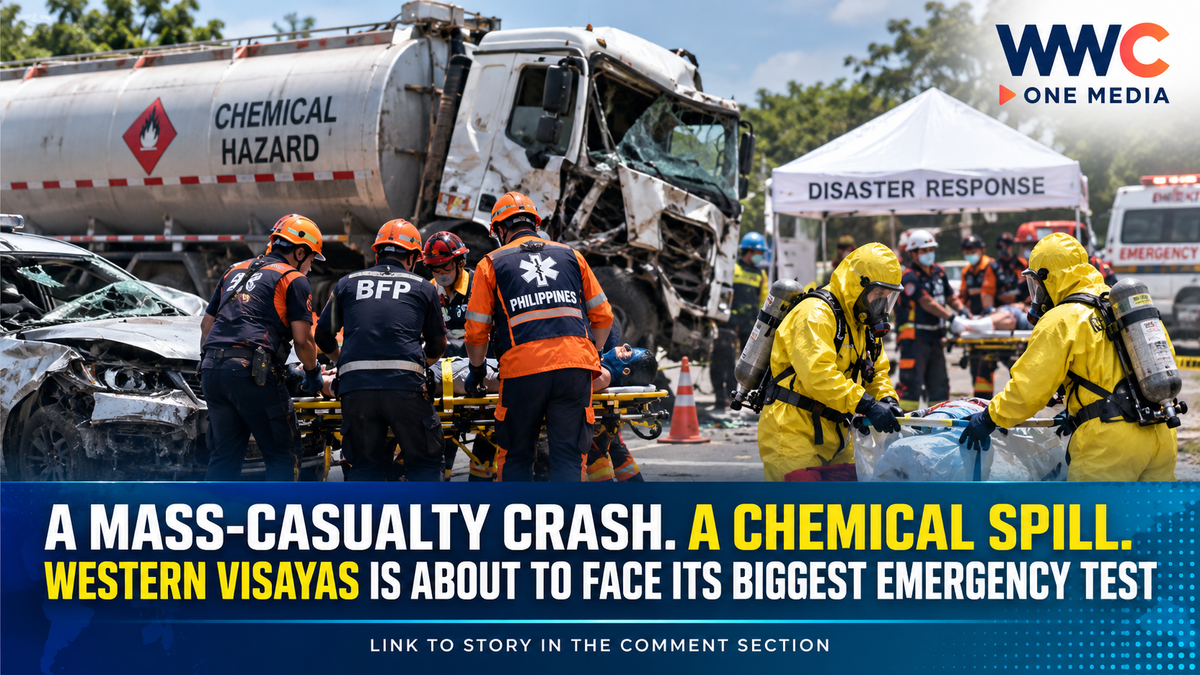
ILOILO — What would happen if a major highway crash suddenly became a hazardous chemical emergency?
That is the question Western Visayas emergency responders are being challenged to answer as more than 30 government agencies, hospitals, private organizations and humanitarian groups take part in a full-scale emergency simulation in Oton, Iloilo.
The exercise, known as PROJECT MedX: Western Visayas Emergency Medical Simulation Exercise (SimEx), is being conducted on Wednesday, September 9, along the Circumferential Road and Bypass Road in Barangay Pakiad, Oton, with Oton National High School designated as the medical staging area.
The scenario is deliberately complex: a commercial chemical tanker truck crashes into several passenger vehicles, creating a simulated mass-casualty incident while responders simultaneously confront hazardous chemical exposure.
The objective is not simply to see how quickly emergency crews can reach victims.
Organizers want to determine whether Western Visayas can maintain a coordinated response when rescue operations, HAZMAT containment, victim decontamination, mass-casualty triage and hospital overcrowding happen at the same time.
Testing the region before a real disaster strikes
The simulation is being led by the Asia-Pacific Alliance for Disaster Management Philippines (A-PAD PH) in partnership with the Iloilo Provincial Disaster Risk Reduction and Management Office, UP Resilience Institute, UP Manila DRRM-Health and the Municipality of Oton.
Among the agencies involved are the Office of Civil Defense, Iloilo Provincial Health Office, Philippine Information Agency, Bureau of Fire Protection and multiple municipal disaster response offices.
Emergency teams from Oton, Pavia, Tigbauan, Tubungan, Igbaras, San Joaquin, Miag-ao and Guimbal are participating, along with the Iloilo City DRRMO’s Urban Search and Rescue team.
Several major healthcare institutions are also part of the exercise, including Western Visayas Medical Center, West Visayas State University Medical Center, The Medical City Iloilo, St. Paul’s Hospital Iloilo, Healthway Hospital by Qualimed and Metro Iloilo Hospital and Medical Center.
Hospitals face a second test
One of the most critical parts of the simulation is what happens after victims are pulled from the crash site.
Hospitals will receive simulated patients as responders test whether the region can handle a sudden medical surge while maintaining communication and coordination between facilities.
This is important because a major disaster can overwhelm a healthcare system even when individual hospitals are well prepared. The ability to distribute patients efficiently and coordinate resources across several facilities can become just as important as the initial rescue.
A-PAD Philippines has emphasized that Project MedX is designed to strengthen emergency medical systems through cooperation among government, healthcare, academic, humanitarian and private-sector organizations.
Project MedX is bigger than one drill
The Oton exercise is part of a broader national effort to strengthen emergency medical preparedness.
A-PAD Philippines formally launched Project MedX in February 2026 as a flagship initiative intended to improve the country’s emergency medical response through coordinated, multisectoral exercises. Stakeholders from Western Visayas, Central Luzon, Caraga and national offices participated in the program’s initial consultation.
The organization previously conducted a major Project MedX exercise in Central Luzon in July, where responders simulated a magnitude 6.8 earthquake in San Fernando, Pampanga. That exercise tested mass-casualty management, patient transport, hospital surge capacity and inter-agency coordination.
The Western Visayas scenario changes the threat.
Instead of an earthquake, responders are dealing with the combined dangers of road transportation accidents and hazardous-material exposure — a scenario that requires specialized rescue, chemical-risk assessment and decontamination procedures.
The real goal: find the weaknesses now
The most important outcome may come after the simulated disaster ends.
Organizers will evaluate the exercise to identify weaknesses in communication, command structures, resource deployment, emergency medical coordination and standard operating procedures.
That approach mirrors the broader purpose of full-scale emergency exercises: testing whether agencies can actually mobilize personnel and resources and coordinate their actions under stressful, realistic conditions rather than simply having plans on paper.
A-PAD’s previous Project MedX exercise in Central Luzon followed the same philosophy. After the simulation, participating organizations conducted a structured debriefing to identify operational gaps and lessons that could improve future emergency response.
For Western Visayas, the message is straightforward:
The best time to discover a weakness in an emergency response system is during a drill — not when lives are already at risk.
And that is precisely why Oton’s simulated crash and chemical spill are being treated as a serious test of the region’s readiness.




Leave a Reply