
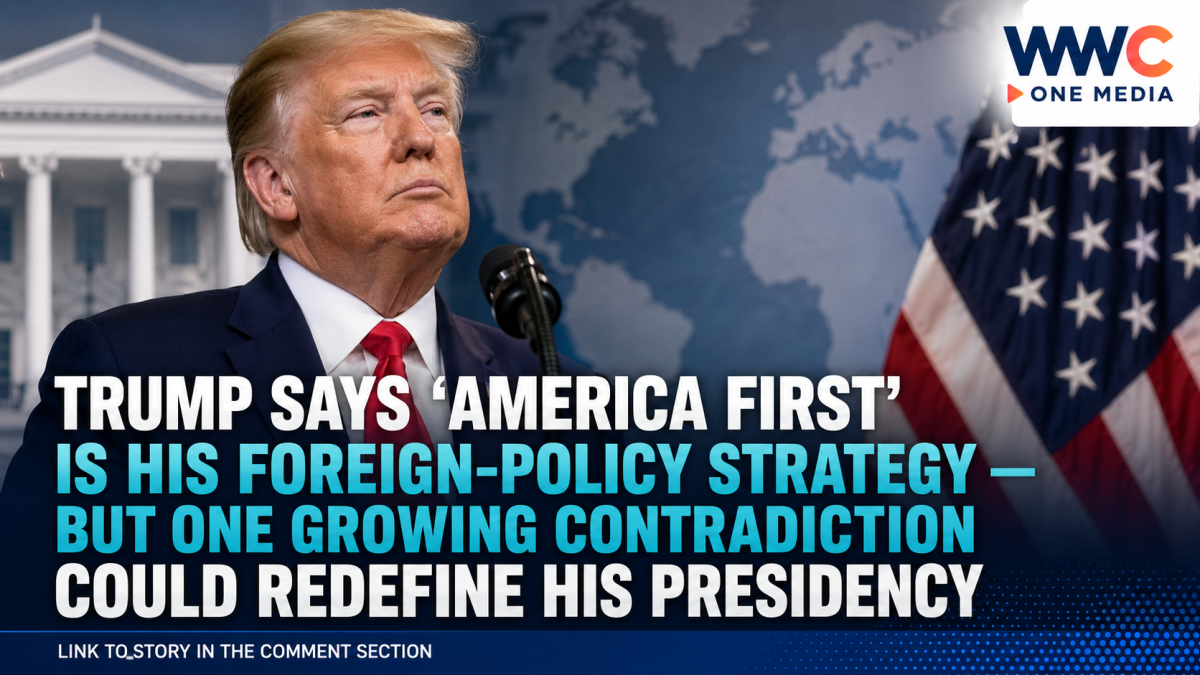
WASHINGTON — More than a year into Donald Trump’s second presidency, one of Washington’s biggest foreign-policy debates is no longer simply about whether the United States is becoming more isolationist, interventionist or transactional.
It is about whether all of Trump’s increasingly consequential moves abroad actually fit together.
The White House insists they do.
Its 2025 National Security Strategy explicitly describes Trump’s foreign policy as being driven above all by what works for the United States — summarized as “America First.” The document portrays the approach as pragmatic, skeptical of ideological labels and focused on American national interests rather than traditional foreign-policy schools.
Yet an August 29 Asia Times commentary by foreign-policy analyst Leon Hadar argues that Washington may be searching for a coherent “Trump Doctrine” that does not really exist.
That argument has become harder to dismiss as Trump’s second term produces a remarkable combination of military intervention, economic coercion, alliance pressure and deal-driven diplomacy.
Iran Has Become the Biggest Test
Perhaps nowhere is the tension clearer than Iran.
Trump entered national politics criticizing prolonged American wars in the Middle East. But by August 2026, the United States was six months into a conflict with Iran alongside Israel.
Associated Press reported on August 29 that the campaign had already cost the United States more than $37.5 billion, while Trump — after initially portraying the operation as something that could be concluded quickly — was signaling that he was in no rush to end the confrontation.
Washington has increasingly turned toward economic pressure. Reuters reported August 27 that Trump said the United States was not currently negotiating with Tehran and was instead intensifying an economic campaign against Iran, including threats of secondary sanctions against countries continuing major financial ties with Tehran.
That creates an obvious question for the “America First” philosophy: how does a prolonged Middle Eastern war fit with the movement’s longstanding criticism of costly foreign entanglements?
Supporters can answer that Trump is not pursuing nation-building or a large-scale occupation and is instead using overwhelming American military and economic power to force favorable outcomes.
Critics see something different: restraint in rhetoric but intervention when Trump believes decisive coercion can produce a deal.
Venezuela Pushes ‘America First’ Even Further
Venezuela may be an even more dramatic example.
U.S. forces captured Nicolás Maduro in January 2026, after which Trump said Washington would oversee Venezuela until a transition could be secured. Spain’s prime minister was among the leaders who publicly questioned the legality of the intervention.
The administration’s involvement has since expanded into energy.
On August 28, Reuters reported that Trump announced an agreement giving the United States majority control over interests covering more than 65 billion barrels of Venezuela’s proven oil reserves, with American companies expected to play a major role in developing the fields.
Supporters portray the agreement as a way to rebuild Venezuelan production, reduce American energy costs and curb the influence of U.S. rivals in the Western Hemisphere.
Critics argue that it demonstrates how far Trump’s second-term interpretation of “America First” has moved beyond traditional non-interventionism.
The Council on Foreign Relations has identified the same contradiction. Senior fellow Charles Kupchan argued earlier this year that Trump’s instincts contain neo-isolationist elements, while many of his actual policies — particularly the Venezuela intervention and military operations elsewhere — have been strikingly interventionist.
NATO Shows Where Trump’s Pressure Strategy Has Worked
But describing Trump’s foreign policy as simply chaotic overlooks several places where his pressure campaign has produced measurable results.
NATO is the strongest example.
Alliance members agreed to work toward defense and security spending equal to 5% of GDP by 2035, including 3.5% for core defense and another 1.5% for broader security-related spending.
Reuters reported that the commitment came after sustained pressure from Trump, who has spent years arguing that European allies rely too heavily on American military protection.
At the same time, the administration is examining the U.S. military footprint in Europe.
Reuters reported August 27 that the Pentagon is reviewing deployment options involving approximately 80,000 American troops in Europe, with questions being asked about allied defense spending, basing rights, overflight access and support for U.S. operations.
That combination — pressure allies to spend more while reconsidering how much America itself should provide — arguably represents one of the clearest strategic threads running through Trump’s foreign policy.
It is transactional, but not necessarily directionless.
Tariffs Have Become a Foreign-Policy Weapon
Trump has also blurred the traditional boundary between economic and foreign policy.
Tariffs, sanctions, investment restrictions and access to the U.S. market have increasingly become bargaining tools.
But even here, execution has faced constraints.
The U.S. Supreme Court curtailed Trump’s use of the International Emergency Economic Powers Act for his sweeping tariff program in February 2026. Trump responded by turning to other trade laws and announcing a temporary global tariff rate of up to 15% under Section 122.
The episode illustrates another recurring feature of Trump’s approach: apply maximum leverage first, then search for alternative mechanisms when legal, political or diplomatic resistance appears.
To supporters, that is flexibility.
To critics, it is policy being improvised in real time.
Asia Is Watching the Unpredictability
The uncertainty is especially important in Asia.
Reuters reported August 24 that Trump’s latest dealings with North Korean leader Kim Jong Un — including changes involving military exercises with South Korea — had renewed questions among U.S. partners about the predictability of American security commitments.
Officials and analysts cited by Reuters said concerns extended beyond Seoul to countries including Japan and other regional partners watching Washington’s simultaneous dealings with China, Iran and North Korea.
That matters because deterrence depends not merely on military capability but on whether allies and adversaries believe Washington will act consistently.
Strategic unpredictability can be useful if it keeps opponents guessing.
Too much unpredictability, however, can also leave allies guessing.
So Is There Actually a Trump Doctrine?
The answer depends heavily on what qualifies as a doctrine.
If a doctrine means a formal statement of priorities, Trump unquestionably has one.
The administration’s own National Security Strategy describes a foreign policy centered on American interests, stronger burden-sharing, economic security, military strength, regional balances of power and skepticism toward international commitments that Washington believes provide insufficient benefits to the United States.
But Hadar’s Asia Times argument asks a different question.
Does that framework consistently explain what Trump actually does?
Iran complicates the promise of avoiding prolonged wars.
Venezuela complicates non-interventionism.
Pressure on NATO fits burden-sharing almost perfectly.
Tariffs demonstrate economic nationalism but have repeatedly collided with domestic legal constraints.
Ukraine remains unresolved despite extensive diplomatic efforts; Reuters reported August 28 that new technical talks were expected, but Ukrainian officials cautioned against expecting an immediate breakthrough.
That leaves perhaps the most defensible description of Trump’s foreign policy somewhere between “no doctrine” and a traditional grand strategy.
There is a recognizable set of instincts: America First, economic nationalism, skepticism toward free-riding allies, preference for bilateral bargaining, willingness to threaten overwhelming force, emphasis on the Western Hemisphere and a belief that unpredictability creates negotiating leverage.
What is far less predictable is how those principles will be applied from one crisis to the next.
And that may be the real Trump Doctrine.
Not isolationism.
Not traditional realism.
Not neoconservative interventionism.
But a highly personalized form of transactional power politics in which alliances, tariffs, sanctions, military force and diplomacy are all treated as negotiating instruments — and where the president himself ultimately decides which instrument comes next.
For Washington’s allies and adversaries, that uncertainty may be more important than whatever label historians eventually give it.

Leave a Reply