
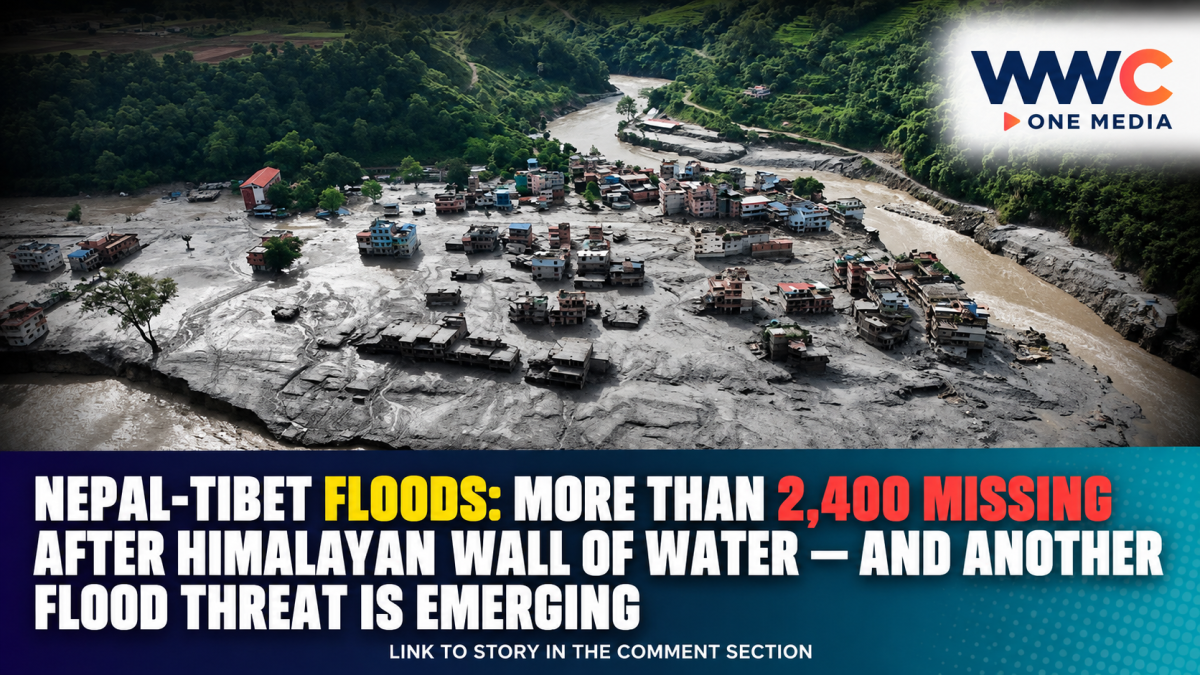
KATHMANDU, Nepal — A catastrophic flash flood that tore through communities along the Nepal-China border has turned into a massive search-and-rescue operation, with more than 2,400 people reported missing and hundreds confirmed dead as rescuers race against time in some of the Himalayas’ most difficult terrain.
The disaster struck on August 26, sending a powerful surge of water, mud, rocks and debris through parts of Nepal and China’s Tibet Autonomous Region.
By Saturday, Nepalese authorities said 579 people had died in Nepal, while China reported seven deaths in Tibet. Nepal had also recorded 1,924 people out of contact, including 517 foreign nationals, while another 554 people remained missing in Tibet, according to Chinese state media. The figures continue to change as authorities verify reports and rescue teams reach isolated areas.
The latest combined figures put the number of missing at more than 2,400, making the disaster one of the most devastating floods to hit the Himalayan border region in recent years.
A WALL OF WATER AND DEBRIS
The flooding was not simply the result of ordinary heavy rainfall.
Nepal’s health authorities said the initial surge into the Bhote Koshi River from the Tibetan side may have been linked to an upstream ice avalanche and temporary damming of the Lhende River. Scientists and officials are still assessing the exact chain of events.
The sudden release of water unleashed a destructive mixture of floodwater, mud, rocks and debris that swept through settlements and infrastructure.
Entire sections of roads and bridges were destroyed. Hydropower facilities were badly damaged, while border infrastructure connecting Nepal and China was devastated.
Reuters reported that Chinese rescue teams reaching the Gyirong area encountered widespread destruction, with the normally important border crossing left severely damaged.
RESCUERS RACE AGAINST TIME
More than 3,700 people have been rescued in Nepal, according to the latest information reported by the United Nations and other sources.
But reaching survivors remains extremely difficult.
Landslides, destroyed roads, damaged bridges and unstable mountain terrain have slowed the movement of rescue personnel and supplies. Helicopter operations have also been affected by dangerous weather and terrain.
Nepal has deployed thousands of security personnel for search-and-rescue operations, while international agencies are supporting the government-led response.
The United Nations said emergency teams are providing food, shelter, medical supplies and other assistance, while satellite imagery is being used to assess areas that remain difficult to reach.
THE FOREIGN NATIONALS STILL UNACCOUNTED FOR
The disaster has also triggered an international search for missing tourists, workers and religious pilgrims.
Among those reported missing are foreign nationals from countries including India, the United States, Australia, Britain, Canada, Malaysia and Ukraine.
Many were traveling through the region for work, tourism or pilgrimage, including journeys connected to Mount Kailash, one of the most important religious sites in the Himalayan region.
The number of missing foreigners is particularly difficult to establish because some people may have been rescued without immediately being removed from missing-person lists, while others may have been reported by families before authorities could confirm their whereabouts.
A SECOND FLOOD THREAT IS MAKING THE RESCUE EVEN MORE DANGEROUS
Perhaps the most alarming development is that rescuers are not dealing with only one disaster.
Authorities warned of another potential flood after water accumulated behind debris in the Tibetan region.
CNA reported that rescue operations in the hardest-hit part of Gyirong were temporarily suspended after officials detected the threat of renewed flooding. Chinese state media later said water levels had fallen and rescue operations could resume.
Reuters likewise reported that concerns over newly formed or blocked water bodies complicated rescue operations, forcing teams to balance the urgent need to reach survivors against the possibility of another sudden surge.
That threat is particularly dangerous because rescuers are working in valleys where a sudden release of trapped water could send another wave of debris downstream with little warning.
MORE THAN 90,000 PEOPLE NEED HELP
The humanitarian consequences extend far beyond the official death and missing-person figures.
The International Federation of Red Cross and Red Crescent Societies has estimated that at least 93,000 people have been affected and urgently need assistance.
The United Nations has warned that damaged roads and infrastructure are making access extremely difficult, while thousands of people need food, clean water, sanitation and shelter.
WHO has also warned of serious public-health risks.
Around 10,000 households are reported to need immediate relief, while several health facilities have been damaged or cut off. Disrupted water and sanitation systems, overcrowded shelters and damaged medical services could increase the risk of diarrhoeal and respiratory diseases and other health emergencies.
WHO has mobilized emergency medical supplies and support, including equipment intended to help meet the health needs of affected communities.
WHY THE DISASTER IS RAISING CLIMATE CONCERNS
The catastrophe is also drawing attention to the growing risks facing the Himalayan region as temperatures rise.
Glaciers and high-altitude lakes can become increasingly unstable as the climate warms, creating the potential for sudden releases of enormous volumes of water.
Experts have repeatedly warned that Himalayan communities face cascading hazards involving glaciers, landslides, rivers and increasingly vulnerable infrastructure.
The current disaster is therefore more than a single devastating flood. It is a warning about how quickly a chain of events in the high mountains can become a humanitarian catastrophe hundreds of kilometres downstream.
THE SEARCH CONTINUES
For families waiting for news, the numbers are more than statistics.
They represent sons, daughters, parents, workers, tourists and pilgrims whose whereabouts remain unknown.
Rescue teams continue to dig through mud and debris, search damaged communities and evacuate survivors while authorities monitor the possibility of additional flooding.
With thousands still unaccounted for, the final human toll of the Nepal-Tibet disaster may not be known for days or even weeks.
And with unstable water bodies still being monitored in the mountains, rescuers face a terrifying race against time: find those who may still be alive before the Himalayas unleash another wave.




Leave a Reply