
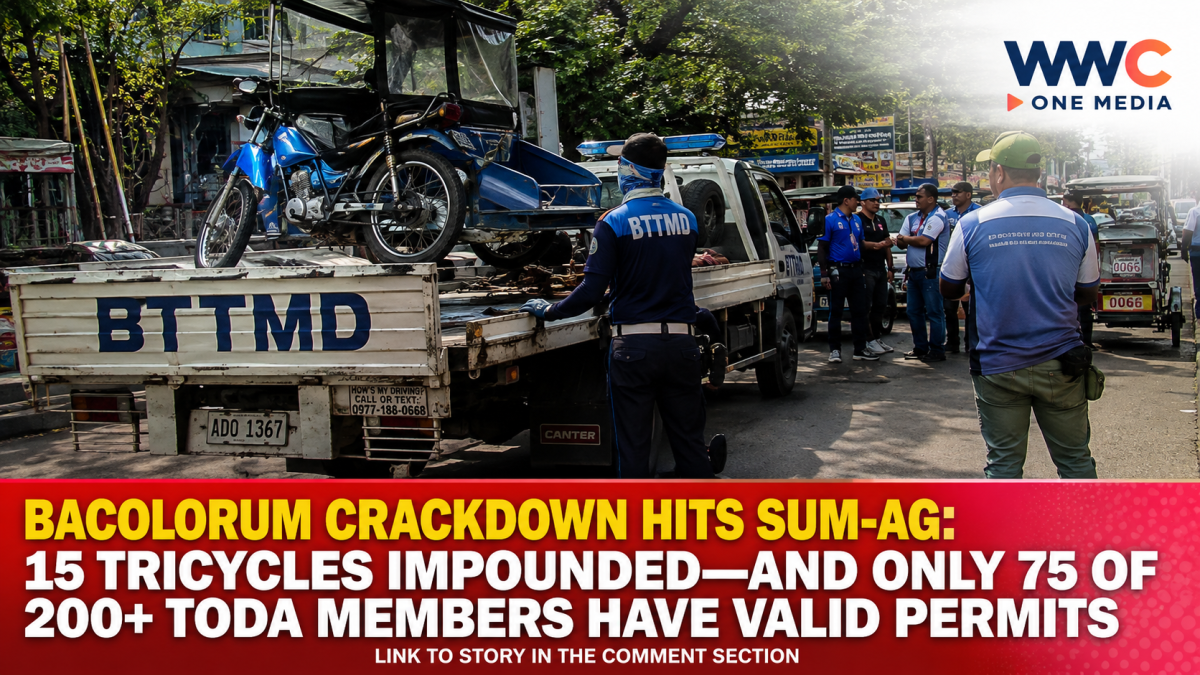
BACOLOD CITY — The Bacolod City government is intensifying its campaign against colorum public transportation, with 15 tricycles, five e-bikes and two motorcycles recently impounded in Barangay Sum-ag over various violations, including the failure to secure or renew the required permits and franchise.
The latest enforcement operation was carried out by the Bacolod Traffic and Transport Management Department (BTTMD) as authorities step up efforts to remove unauthorized public transport vehicles from the city’s roads.
According to BTTMD officer-in-charge Atty. Reuben Sabig, authorities have already given operators considerable time to process and renew their permits. However, with the year nearing its end, many operators still have not completed the required documentation.
Only 75 of more than 200 TODA members reportedly secured permits
The situation is particularly significant in Barangay Sum-ag, where BTTMD monitoring found that only 75 members out of more than 200 TODA members in the area had secured the necessary permit.
Many of the tricycles reportedly serve routes crossing between Bacolod City and Bago City, making compliance with Bacolod’s local requirements especially important for units operating within the city.
Sabig said the BTTMD is focused on whether the tricycle has a valid permit to operate in Bacolod City. Having documentation from another jurisdiction does not substitute for the permit required by Bacolod when the unit is operating within the city.
The BTTMD has also made clear that an expired 2025 permit cannot be presented as a valid current permit.
Why are the tricycles being classified as “colorum”?
Under Bacolod’s regulatory framework, tricycles operating without the required franchise or Motorized Tricycle Operator’s Permit (MTOP) can be treated as unauthorized or colorum operations.
Bacolod City Ordinance No. 185, as amended, establishes the city’s authority to regulate motorized tricycles and grant franchises for their operation.
The city has also specifically authorized the towing and impounding of vehicles found operating as colorum public utility vehicles or motorized tricycles for hire.
This means the latest enforcement drive is not simply about paperwork. For authorities, the issue involves whether a vehicle is legally authorized to transport passengers for a fare.
The crackdown is not new—and the numbers have been significant
The Sum-ag operation is part of a broader Bacolod campaign against colorum tricycles.
In May 2026, GMA Regional TV reported that the BTTMD had already impounded at least 40 colorum tricycles in a recent operation. Authorities said vehicles were being found not only on barangay roads but also on major roads such as Lacson and Araneta. At the time, officials estimated that as many as 3,000 colorum tricycles could be operating in Bacolod.
The city’s campaign also has a longer history. In 2024, SunStar reported that Bacolod had 4,647 registered motorized tricycles, but only 2,375 had MTOPs from the city government at that time. The city subsequently pursued efforts to help unlicensed operators legalize their operations.
Earlier enforcement campaigns were even larger. SunStar reported in 2023 that the city had issued thousands of tricycle franchises while authorities continued to confront a large number of unregistered units.
Authorities say the warning period is effectively over
Sabig said authorities had already provided operators with opportunities to comply. But those who continue operating without renewed permits can still be apprehended.
His message was direct: if a tricycle has not renewed its required authorization, it should not be operating as public transportation.
The BTTMD’s position is significant for operators who may assume that an old permit is enough. According to the latest report, a 2025 permit is already expired and cannot be used as proof of current authorization.
Why this matters to passengers
The crackdown also has implications for commuters.
SunStar previously reported that city officials have warned about the risks associated with colorum tricycles, particularly because unauthorized units may not have the same insurance and regulatory protections expected of legally operating public transportation.
For passengers, the issue is therefore not simply whether a tricycle is available for a ride. The bigger question is whether the vehicle and operator are properly authorized to provide public transport.
What happens next?
The BTTMD has indicated that enforcement will continue despite ongoing discussions at the city council concerning tricycle regulation.
That means the latest Sum-ag operation may be only one part of a wider campaign.
With more than 200 TODA members reportedly operating in the area but only 75 having secured permits, authorities face a substantial compliance gap.
For operators who have yet to renew, the message from the city is becoming increasingly difficult to ignore: secure the required documents before operating—or risk having the unit classified as colorum and impounded.




Leave a Reply