
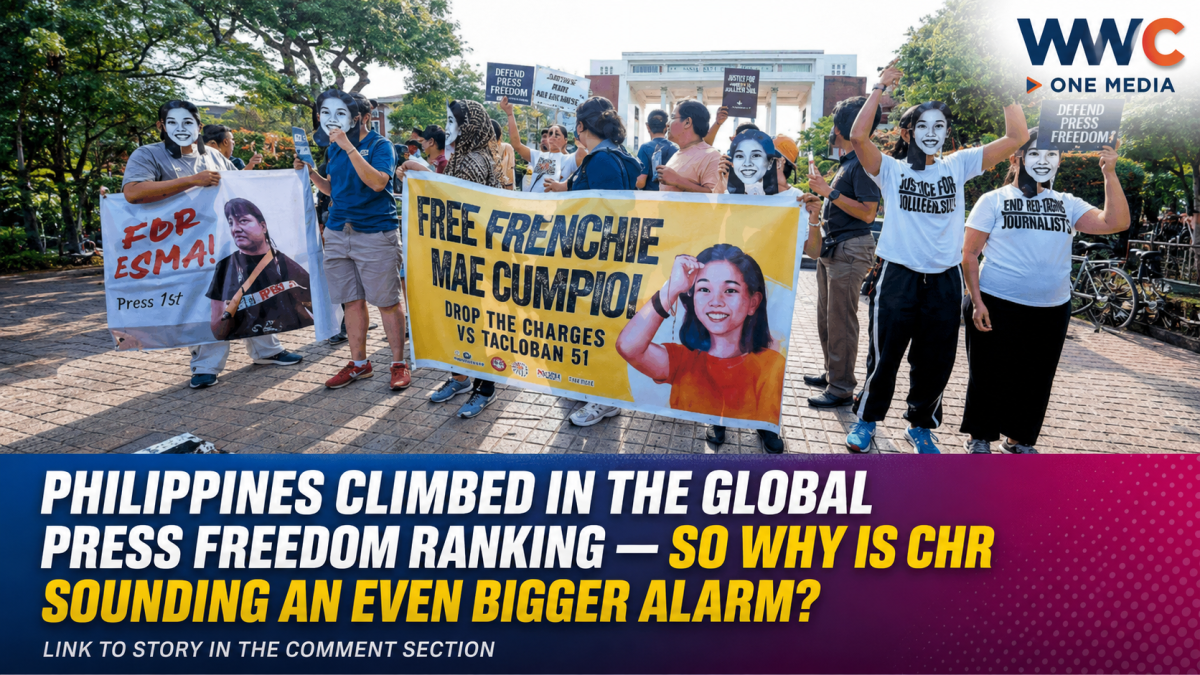
MANILA, Philippines — The Commission on Human Rights (CHR) is pressing the Philippine government to confront what it calls a continuing cycle of impunity surrounding attacks on journalists, warning that threats to the media now extend beyond physical violence to red-tagging, legal harassment, online intimidation, surveillance and emerging risks involving artificial intelligence.
The warning came on National Press Freedom Day, August 30, 2026, as the CHR said a free and independent press remains essential to holding institutions accountable and ensuring Filipinos have access to information needed to make informed decisions.
Philippines Rises in Press Freedom Ranking — But Problems Remain
The Philippines ranked 114th out of 180 countries in Reporters Without Borders’ 2026 World Press Freedom Index, improving two places from 116th in 2025.
But the improved ranking does not mean the risks facing Filipino journalists have disappeared.
RSF still places the Philippines in the lower half of its global ranking, while its 2026 Asia-Pacific assessment raised concerns over the use of terrorism-related accusations and red-tagging against journalists and independent media workers.
For the CHR, one of the most serious problems is accountability.
The commission warned that when attacks against media workers are not effectively investigated and prosecuted, the absence of accountability can encourage further abuses.
It urged authorities to prioritize investigations and deliver justice to victims and their families.
Nearly 260 Press Attacks Documented Under Marcos Administration
Separate data from the National Union of Journalists of the Philippines (NUJP) add weight to those concerns.
As of National Press Freedom Day, the NUJP has documented about 260 attacks against the press since President Ferdinand Marcos Jr. took office in June 2022, according to reporting by the Philippine Daily Inquirer.
More than 180 of the recorded cases involved journalists or media workers from local newspapers and radio stations, alternative media organizations and campus publications, highlighting the particular vulnerability of journalists working outside large national newsrooms.
An earlier NUJP tally released in July documented 256 attacks, including 80 cases of harassment, nearly 40 cases of red-tagging, 19 cyberattacks and almost 20 cases involving various forms of judicial harassment. The organization also reported that 12 media workers had been killed since the start of the Marcos administration, although individual cases can differ in motive and circumstances and should not automatically be characterized as work-related killings without investigation.
The figures illustrate why press-freedom groups argue that improvements in international rankings should be viewed alongside conditions journalists experience on the ground.
CHR Raises Alarm Over Red-Tagging
The CHR identified red-tagging, vilification and guilt by association as particularly serious threats to journalists.
It cited Supreme Court jurisprudence recognizing such practices as potential threats to a person’s life, liberty and security.
The commission’s own National Inquiry on Red-Tagging found journalists and media practitioners among those repeatedly targeted, particularly when their reporting was perceived as critical of government policies or programs.
The CHR is again calling for legislation that would specifically address red-tagging as a distinct offense.
CHR Wants Libel and Cyberlibel Decriminalized
The commission is also renewing its push to decriminalize libel and cyberlibel, arguing that journalists should not face imprisonment for work-related defamation disputes when proportionate civil remedies could instead be available.
Several measures seeking reforms to libel laws have been introduced in the 20th Congress, including bills in both the House of Representatives and Senate.
The CHR urged lawmakers to consolidate and prioritize proposals that would remove imprisonment while retaining appropriate civil remedies for people who have genuinely been defamed.
Anti-Fake News Laws Could Create Another Press Freedom Battle
The commission also warned lawmakers to proceed carefully with legislation intended to combat misinformation and disinformation.
Among the proposals under scrutiny is the proposed Digital Media Anti-False Information Act.
The CHR said overly broad definitions, vague provisions or disproportionate punishment could threaten legitimate speech and encourage self-censorship among journalists and ordinary citizens.
GMA News reported that versions of the proposed legislation include potential imprisonment and fines reaching ₱2 million for certain violations involving the willful spread of false information.
Rather than relying exclusively on punishment for individual pieces of content, the CHR urged lawmakers to examine the broader systems that allow disinformation to spread while ensuring that legitimate reporting, criticism and political expression remain protected.
AI and Digital Surveillance Create New Risks for Journalists
Another growing concern involves technology.
The CHR warned that artificial intelligence and digital surveillance tools can potentially be used to monitor journalists, identify confidential sources, suppress dissent or amplify fabricated information.
The commission said protecting press freedom in the digital age should therefore include safeguards for journalists’ personal data, communications and confidential sources.
Protection Mechanisms Already Exist — But Accountability Is Key
The CHR said it is continuing to work with the Presidential Task Force on Media Security to improve information-sharing, case development and assistance for journalists facing threats.
Media workers may also use the commission’s Alisto! Alert Mechanism to directly report threats and incidents for monitoring, investigation and possible intervention.
Still, protection programs alone will not resolve the larger problem if perpetrators believe attacks can be committed without consequences.
That is why the commission’s National Press Freedom Day message ultimately centered on one word: impunity.
The CHR stressed that attacks on journalists do not affect only reporters or news organizations. When journalists are intimidated, silenced or prevented from investigating matters of public interest, citizens can also lose access to information necessary to scrutinize government, expose wrongdoing and participate meaningfully in democracy.
Why August 30 Is National Press Freedom Day
National Press Freedom Day is observed every August 30 under Republic Act No. 11699, approved on April 13, 2022.
The law designated August 30 as a working holiday in honor of Filipino propagandist and journalist Marcelo H. del Pilar, known by his pen name Plaridel, who was born on August 30, 1850.
The law also calls on government institutions, schools and the private sector to participate in activities promoting awareness of press freedom, journalists’ rights and the elimination of violence against members of the media.
For the CHR, however, commemorating National Press Freedom Day cannot stop with ceremonies.
The bigger test is whether journalists can investigate powerful interests, question government policies and report uncomfortable truths without fearing violence, criminal prosecution, intimidation or retaliation.




Leave a Reply