
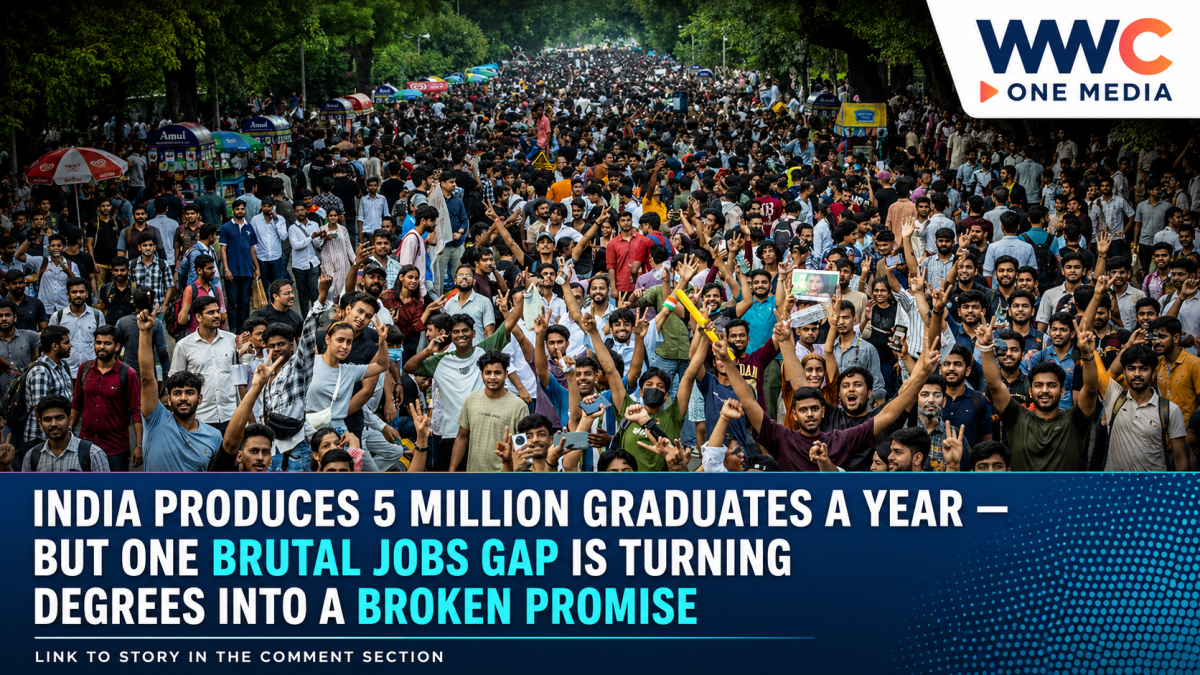
NEW DELHI — India is producing millions of university graduates every year and remains one of the world’s major growth engines. Yet for a growing number of young Indians, the promise that a college degree will lead to a secure career is becoming increasingly difficult to believe.
That frustration is now spilling far beyond job-search websites and family dinner tables.
Recent youth-led protests over alleged examination irregularities and recruitment scandals have evolved into something much bigger: a national argument over whether India’s education system and fast-growing economy are actually creating enough good jobs for the generation entering adulthood.
The numbers help explain why.
According to Azim Premji University’s State of Working India 2026 report, India produced an average of roughly 5 million graduates a year between 2004 and 2023, while graduate employment expanded by only about 2.8 million annually over that period.
Among graduates aged 25 and younger, unemployment was close to 40%, according to the report. For graduates aged 25 to 29, the figure was roughly 20%. The university cautions that the transition from education into employment has become one of the biggest challenges facing India’s young workforce.
That does not mean 2.2 million graduates automatically become unemployed every year — some continue studying, leave the labour force or pursue other paths — but the figures highlight a widening mismatch between the supply of degree-holders and the expansion of jobs suited to their qualifications.
INDIA’S HEADLINE JOB NUMBERS LOOK BETTER — UNTIL YOU LOOK AT THE YOUNG
India’s latest official statistics initially appear encouraging.
The overall unemployment rate for people aged 15 and above dropped to 5.1% in July 2026, down from 5.5% in June, according to the Periodic Labour Force Survey released by the Ministry of Statistics and Programme Implementation.
Labour-force participation also increased to 55.4%, while the worker-population ratio climbed to 52.5%.
But the picture changes dramatically among younger Indians.
Unemployment among people aged 15 to 29 stood at 15.6% in July. That was an improvement from 16.2% in June, but remained 0.7 percentage point above its level a year earlier.
The pressure was particularly severe for young women, whose unemployment rate stood at 19.5%, compared with 14.2% among young men.
For university graduates, the problem can be even more frustrating because many spent years — and often substantial family savings — preparing for jobs that may not exist in sufficient numbers.
CNA highlighted the case of 28-year-old Vivek Kumar Jaiswal, who earned a master’s degree in Hindi but was still searching for stable employment three years after graduating.
Jaiswal said many of the jobs available to him involved call-centre or data-entry work paying around US$120 a month, leaving him questioning the economic value of his degree.
His experience reflects a broader concern: India is not merely confronting unemployment. It is confronting underemployment and qualification mismatch, where graduates either cannot find work or accept positions well below the level they expected their education to provide.
WHY YOUNG INDIANS ARE TAKING THEIR ANGER TO THE STREETS
Those pressures have collided with another explosive issue — the integrity of India’s highly competitive examination and public-sector recruitment system.
Youth demonstrations initially erupted over alleged exam paper leaks and irregularities before expanding into wider demands involving jobs, education reforms and government accountability.
The movement associated with the Cockroach Janta Party, or CJP, began partly as online satire but developed into one of India’s most significant youth protest campaigns in years.
The demonstrations became a major political challenge after nationwide anger over examination controversies, eventually contributing to the resignation of Education Minister Dharmendra Pradhan in July.
Reuters reported that the government subsequently announced examination reforms, including stronger measures against misconduct.
But the unrest did not disappear.
On August 10, thousands of protesters in Jharkhand marched over alleged civil-service examination irregularities, leading to clashes in which police used tear gas, batons and water cannon.
Then on August 25, police again used water cannon during a protest in Bihar over allegations of leaked recruitment-examination papers.
The persistence of these demonstrations suggests exam scandals are acting as a trigger for dissatisfaction that was already building around employment.
For young Indians competing intensely for a limited number of government positions, a suspected paper leak is not simply an education controversy. It can be viewed as potentially destroying years of preparation for one of the few stable career opportunities available.
INDIA ALSO HAS A SKILLS PROBLEM
Creating more jobs is only part of the challenge.
Employers increasingly argue that many university programmes are failing to provide the skills required by a rapidly changing economy.
India’s Economic Survey 2025-26 acknowledged an ongoing skills mismatch, citing weak foundational skills, differences between industry requirements and training programmes, and difficulties adapting to emerging technologies.
The government review said stronger links between vocational education, industry requirements and conventional academic education would be needed to improve the transition from school to work.
Artificial intelligence could make that challenge even more urgent.
Routine entry-level tasks traditionally performed by young graduates are increasingly vulnerable to automation, while employers are putting greater emphasis on communication, adaptability, problem-solving, collaboration and technological literacy.
India’s Economic Survey cited employer research showing particularly strong demand for foundational and interpersonal skills alongside technical capabilities.
Engineering graduate Shubh Kansara told CNA that he spent around a year unemployed before accepting a position outside his original field because employers expected knowledge of technologies he said had not been taught at university.
THE NUMBERS ARE ABOUT TO GET EVEN BIGGER
India does have one enormous economic advantage: a young population capable of supplying workers, entrepreneurs and consumers for decades.
But that demographic dividend comes with a deadline.
The World Bank estimates that approximately 11 million young people will enter India’s labour market every year over the next two decades.
In June, the World Bank approved US$1.5 billion to support reforms aimed at boosting private-sector job creation in India, including measures designed to encourage entrepreneurship, investment, formal employment and greater workforce participation by women.
Azim Premji University similarly warns that India is approaching the peak of its demographic dividend, with the share of its working-age population expected eventually to begin declining after 2030.
That makes the present decade crucial.
India does not simply need millions of jobs.
It needs millions of productive, reasonably paid and increasingly skilled jobs capable of absorbing a generation that is more educated — and consequently has higher expectations — than generations before it.
THE BIGGER QUESTION FOR INDIA
The youth demonstrations sweeping parts of India may therefore be about much more than leaked examination papers.
They are exposing a deeper contradiction.
India has successfully expanded universities and produced millions of graduates. Its economy continues to grow. More young Indians have qualifications their parents could only have dreamed of obtaining.
But education creates expectations.
When those expectations collide with years of unemployment, low-paying work, recruitment scandals and jobs unrelated to a graduate’s training, a degree can stop feeling like a ladder into the middle class and start feeling like evidence of a system that promised more than the economy could deliver.
That may be the issue India ultimately has to solve.
Because with roughly 11 million young people expected to enter the labour market every year, the question is no longer simply whether India can educate its next generation.
It is whether the economy can create enough opportunities for them once they graduate.




Leave a Reply