
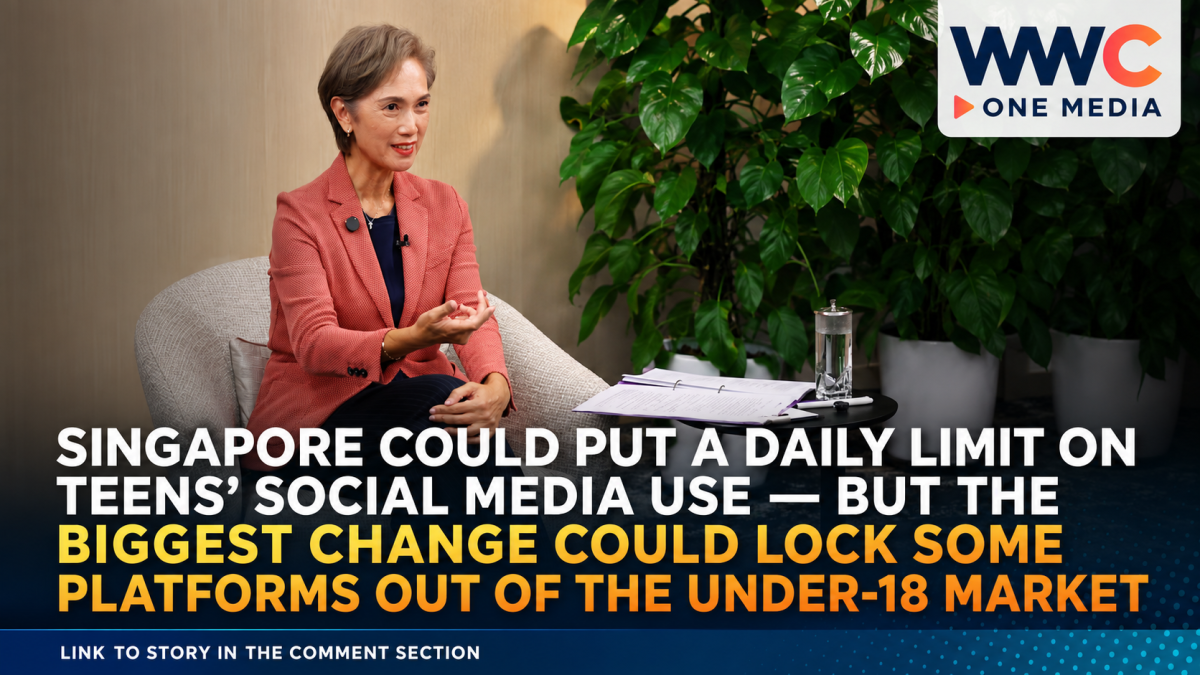
SINGAPORE — Singapore is preparing to dramatically tighten the rules governing how teenagers use social media, with daily usage limits, stronger age checks and restrictions on addictive design features all being considered as part of legislation expected to be introduced in early 2027.
And the consequences for platforms that fail to comply could be significant: they may no longer be allowed to serve users under 18.
Minister for Digital Development and Information Josephine Teo said the government intends to require social media companies to provide stronger protections for users aged 13 to 17, moving beyond voluntary safety tools towards enforceable safeguards.
The proposed rules could affect some of the world’s biggest platforms, including Facebook, Instagram, TikTok, YouTube and X, as Singapore takes aim not only at harmful content but also at the mechanics that keep young users scrolling. Singapore’s existing online-safety code currently covers Facebook, Instagram, TikTok, YouTube, HardwareZone and X.
Singapore Is Considering a Daily Social Media Time Limit
One of the biggest proposals under discussion is a mandatory daily usage limit for teenagers.
Mrs Teo said there is no single “magic number” that automatically separates healthy from unhealthy social media use. But research reviewed by Singapore’s Ministry of Health has raised concerns over very heavy use.
An expert panel convened by MOH found that one in three Singapore youths aged 15 to 17 spends more than three hours a day on social media, while one in six people aged 10 to 24 shows signs of problematic social media use.
Mrs Teo said those findings suggest that three hours a day is already “a bit too long” and that any eventual threshold should be lower.
That does not, however, mean Singapore has decided on a two-hour, one-hour or any other specific limit. The final number remains under discussion.
The Straits Times separately reported that daily time limits are among the mandatory safeguards being considered, alongside restrictions targeting infinite scrolling, autoplay and potentially dangerous interactions.
The Bigger Target May Be Infinite Scroll
The proposed time cap is only one part of a much wider regulatory push.
Singapore is examining whether social media platforms should be required to create natural stopping points rather than allowing teenagers to scroll endlessly through algorithmically generated content.
Officials are also scrutinising autoplay, recommendation algorithms and direct messages from strangers.
One notable difference between Singapore’s proposed approach and some existing industry measures involves autoplay.
Under measures Meta agreed to in a major US settlement, parents would have tools to disable autoplay for teen accounts. Singapore is considering going further by requiring autoplay to be off by default, with parents given the option to switch it back on.
That distinction is significant because Singapore appears increasingly focused on the principle of “safe by default” rather than expecting teenagers or their parents to actively find and enable protective settings.
Meta’s US Deal Is Giving Singapore a Real-World Test Case
The debate comes just days after Meta agreed to sweeping restrictions on teenage use of Facebook and Instagram as part of a landmark settlement with US states.
Under the agreement, Meta is set to introduce a two-hour default daily limit for users under 18, restrict access from midnight to 6am without parental approval and disable most notifications during school hours. Reuters reported that Meta could pay up to US$18 billion over a decade under the settlement.
Associated Press also reported that the agreement includes stronger age-verification measures and additional protections for teenage accounts.
Singapore officials are studying that framework as a useful reference, but have made clear that the Republic does not intend simply to copy the American rules.
Meta itself has called for rivals such as TikTok and YouTube to introduce comparable safeguards, arguing that restricting teenagers on one platform alone may simply push them towards another.
Singapore’s Existing Teen Protections Already Go Beyond Age Labels
Some protections are already operating locally.
Instagram Teen Accounts in Singapore include private accounts by default, tighter messaging controls and notifications encouraging teenagers to leave the app after 60 minutes. Notifications are also muted between 10pm and 7am.
Facebook provides similar protections for teenage users, including overnight notification restrictions and screen-time reminders.
The government’s next step, however, would be fundamentally different: instead of relying mainly on platform-designed controls, Singapore wants enforceable baseline requirements.
Platforms Could Be Forced to Raise Their Minimum Age to 18
This may ultimately become the most powerful part of the policy.
Singapore currently intends to enforce the industry-standard minimum social media age of 13, while requiring age-appropriate protections for users from 13 to under 18.
But platforms unwilling or unable to meet the new safety requirements could face a much tougher consequence: their minimum access age in Singapore could effectively be raised to 18.
That would give platforms a strong commercial incentive to redesign the teenage experience rather than simply treating child-safety features as optional add-ons.
Age Verification Will Be Another Major Battle
None of these restrictions will work unless platforms can reliably tell whether someone is 12, 15 or 25.
Singapore is therefore pushing for stronger age assurance, which can include age estimation, age inference or verification against more authoritative records.
The government has acknowledged that stronger checks could create inconvenience for ordinary users and raise privacy questions over what information platforms collect.
Mrs Teo said data used for age assurance should be collected proportionately while still allowing platforms to determine ages with sufficient accuracy. Platforms may also have to reassess accounts when new signals suggest a user is younger than originally believed.
Experts Warn That Screen Time Alone Isn’t the Whole Story
Singapore’s own expert panel has cautioned against reducing the issue to a simple number of hours.
The MOH panel found that problematic or compulsive social media use is more consistently associated with poorer well-being than screen time alone. It also said definitive causal links between social media and specific adverse mental-health outcomes have not yet been conclusively established, even though there is enough evidence of association to justify precautionary measures.
That is why the panel recommended addressing potentially harmful platform design rather than relying solely on blanket age bans.
The approach puts Singapore on a somewhat different path from jurisdictions that have focused primarily on raising minimum ages.
What Happens Next
Prime Minister Lawrence Wong signalled the tougher approach during his National Day Rally on August 23, saying self-declared ages are no longer sufficient and that platforms would be expected to introduce robust age checks and safer experiences for young users.
The government is now working towards legislative changes in early 2027.
The final daily limit, the exact technical requirements for platforms and how age verification will work have yet to be settled.
But the direction is increasingly clear.
Singapore is moving beyond asking social media companies to warn teenagers about excessive scrolling. It is preparing to regulate the design of the platforms themselves — and companies that cannot make their services safe enough for young users may eventually have to choose between changing their products or losing access to Singapore’s under-18 market.




Leave a Reply