
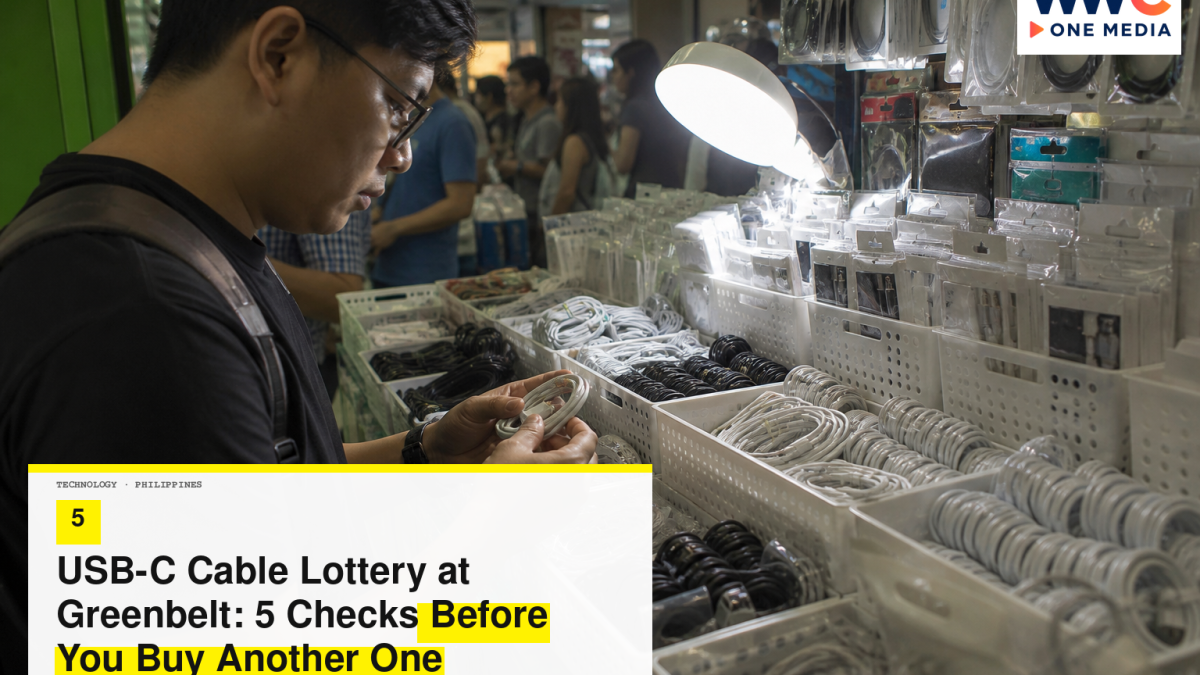
MAKATI, Philippines — Lunch hour at Greenbelt is a cable market wearing a mall smile. Office shirts from Ayala, weekend bags from BGC, a kiosk with braided leads hanging like fruit. The stall will sell you confidence. The USB-C cable lottery at Greenbelt starts the minute you point at a black cord because it looks thick enough and the word “fast” is printed on a tag that will not survive the first wash of a laptop bag. USB-C is a shape, not a promise. Phone trickle and laptop power are different jobs. Heat in a Makati bag is a third job. Five checks beat a second trip when a notebook will not take a charge before a meeting on Paseo.
This is not a teardown. It is not a brand exposé. It is not a lab with invented wattage. It is what you can see with your hands at a Greenbelt kiosk, what you can feel after a walk from Glorietta, and what you should refuse to buy if the cable cannot tell you what it is. Write the five checks before you hand over cash. The stall will still be there. Your 9 a.m. will not wait for a mystery lead.
1. The USB-C cable lottery at Greenbelt starts with markings, not the word fast
Look at the cable, not the laminated card. If the only text you can read is “fast charging,” “PD,” or a lightning-bolt sticker with no number, you are buying a lottery ticket. A real marking is boring. It is a printed wattage, a printed current, a printed USB version, a small moulded code on the head, something you can photograph and still parse when you are back in an Ayala tower pantry.
Greenbelt kiosks are good at atmosphere. The braid is tight. The nylon looks expensive. The display iPhone on the counter is already climbing a battery percentage because it is on a known brick behind the stall, not because the lead in your hand is the same animal. Ask to see the print on the cable you are actually taking home. Not the demo. The SKU in the plastic. If the stall owner waves the demo and bags a different coil from a drawer, stop. The drawer is where the lottery lives.
What a marking can honestly tell you, without pretending you have a benchtop:
- A wattage or current printed on the jacket or the head. 60W, 100W, 3A, 5A. Numbers. Not adjectives.
- A data hint. Some cables say USB 2.0, USB 3, or 480Mbps versus a higher figure. Phone photos and laptop backups care. A charge-only lead will still light a battery and then annoy you at a desk.
- A connector that is not already cloudy, chipped, or painted over. Paint over a USB-C head is how a stall hides a chewed tongue.
What a marking cannot tell you: whether the copper inside matches the print. You will not learn that from a Greenbelt aisle. You learn that later, when a laptop shrugs, a phone gets warm, or a file copy crawls. So you do the only honest thing a shopper can do in a mall. You refuse unmarked cable. You prefer a stall that will still be in the same bay next month. You buy one known job, not five “fast” coils for the drawer.
What not to do. Do not trust a hanging tag that names a protocol and no number. Do not buy because the braid is the same colour as the one that came in the laptop box. Colour is not a spec. Do not let a salesperson hold the cable against your phone, watch the icon appear, and call it proven. A phone will sip from a weak lead. A laptop may not. That sip is the lottery’s favourite trick.
City logistics. Greenbelt 1 walkways, the accessory cluster near Greenbelt 3, the denser phone-stall energy toward Glorietta and Landmark — the density changes, the pitch does not. If you work along Ayala Avenue and you are shopping on a break, you have twelve minutes and a brain that wants to be done. That is when unmarked cable wins. Put the checks in Notes before you leave the desk. Photograph the print. If there is no print, there is no purchase.
Objection you will hear: “USB-C is USB-C, it will charge.” The shape is standard. The wiring is not. The stall is not lying in a cinematic way. It is selling a category. You are the one who needs a job: phone, laptop, or both. Jobs need numbers.
2. Match the job: phone trickle is not laptop power
A thin cable that once charged a phone in a Grab on EDSA may not like a MacBook on a coffee table in Salcedo. USB-C on both ends fools people. The phone is a small appetite. Many phones will climb on a modest lead and a modest brick. A laptop is a different conversation. It wants a cable that can carry the power the brick is trying to send. If the cable is the bottleneck, the notebook idles, the battery falls while you work, and you blame the outlet in a Makati cafe that was never the problem.
Stand at the kiosk and say the job out loud. Not to perform. To keep yourself from buying a “universal” coil.
Three jobs, three buys:
- Phone only. You want a short or medium lead for a bag, a nightstand, a power bank. Flexibility matters. Extreme wattage print is less important than a head that will not snap after a month of twisting in a jeans pocket. Still demand a marking. Still refuse paint.
- Laptop power. You want the print to look like it belongs next to a notebook charger, not next to a novelty keychain. Length matters because you sit at dining tables that were never desks. A two-metre mystery cable that gets warm in a coil is a bad office companion.
- Data. If you dump photos, if you connect a phone as a webcam, if you use a dongle life, you need a cable that is not charge-only. Charge-only is legitimate. It is just a different SKU. Ask. If the stall cannot tell you, you do not need that stall.
The mixed household is how drawers fill. One person has an Android that came with a short lead. The other has a work laptop that only stopped shipping a barrel jack a few years ago. They share a Greenbelt bag of “USB-C.” Then Monday, the wrong coil goes into the backpack. The meeting is at 9. The battery is a performance.
A practical split that survives a Makati week:
- One short marked cable that lives with the phone and the power bank.
- One longer marked cable that lives with the laptop brick and does not get borrowed for the nightstand.
- A spare of the laptop cable if your work actually dies without it. Not five spares. One.
Label them with a bit of tape. Phone. Laptop. You will feel ridiculous in Greenbelt 5 with a roll of tape. You will feel calm at 8:55 a.m. in an Ayala lift.
What not to do. Do not buy one “thick” cable and declare the household solved. Thickness is theatre. Some thick jackets are padding. Some thin cables are fine for a phone and hopeless for a notebook. Do not use a laptop as an in-stall test unless the seller is willing to let you plug the cable you are buying into your own brick and your own machine for a minute of honest behaviour: the charge icon, the absence of immediate heat at the head. Even then, a minute is not a certification. It is only a veto. If the head is already hot in a minute, you do not bargain. You put it back.
Heat is information. A little warmth after a long session can be ordinary. A head that you cannot hold after a short phone charge is a stop. Unplug. Do not finish the sale.
3. Heat in a Greenbelt bag is a spec you can feel
Makati heat does not stay outside the mall. It gets into the tote, the backpack, the laptop sleeve that sat on a P2P seat. Cables live in that climate. A lead that is already marginal will tell you with temperature before it tells you with a dead laptop in a boardroom.
You cannot run a thermal camera at a kiosk. You can do three human checks:
- Feel the heads in the stall aircon. They should be ordinary plastic or metal, not sticky, not already warped.
- After any demo charge, feel the head and the first five centimetres of jacket. If it is aggressively hot, the cable is not a bargain.
- Think about the bag. Coiled against a power brick, pressed under a metal water bottle, left in a car along Ayala Avenue while you “quickly” go back for a receipt. That is an oven. Cheap strain relief fails first in ovens.
A cable is not only copper. It is strain relief, jacket, and the tiny moulded joint where most Greenbelt lottery tickets die. That joint is where people yank the lead out of a phone while the phone is still on a cafe table. It is where a bag strap rubs the same centimetre every weekday. Look at it. If the jacket is already wrinkling at the moulding while the cable is still hanging on the rack, it has failed the only test that matters in a mall: it is tired before it is yours.
Phone versus laptop shows up in heat too. A phone charge in a jeepney, cable draped, sun on the glass, is a different thermal story from a laptop on a lap in a coffee shop with the brick on the floor and the cable as a tripwire. Laptop cables that run warm along the whole jacket while the machine is trying to work are a cue to stop and use a known brick-and-cable pair, not to “just finish the deck.”
What not to do. Do not wrap a cable tightly around a brick while it is still warm. Do not leave a charging phone face-down on a dark car seat with a mystery lead cooking in the cup holder. Do not cover a charging laptop with a throw pillow in a Makati studio because the fan noise bothers you. Heat plus an unknown cable is how you turn a cheap stall purchase into a smell. If you smell hot plastic, you unplug. You do not wait for a percentage.
A small habit that is not glamorous: uncoil. A cable that lives in a tight bundle in a humid bag will take a set. The set becomes a kink. The kink becomes a break inside the jacket you cannot see. Store a loop, not a twist. The kiosk will sell you a tie. The tie is fine. The overwrap that leaves a white crease in the braid is not.
4. The gentle bend test, and the strain relief you can see
You are not being dramatic. You are being cheap on purpose. Hold the cable at the head. Bend it the way a bag will bend it, slowly, once or twice, not as a circus trick. You are looking for immediate kinks, jacket that gaps from the moulding, a head that already feels loose on the tongue. If it fails in your hands in Greenbelt aircon, it will not survive EDSA.
Do this on the cable in the packet, or ask the stall to open the packet you are buying. Demo units are handled all day. They can look worse than the stock. They can also be the only honest ones, because stock in a drawer was never flexed. Either way, you buy the unit you inspected.
A short numbered pass at the counter:
- Heads: no paint, no wobble, no grit in the port.
- Moulding: no crack, no glue thread, no jacket pulling out.
- Jacket: no crush from a hanger clip, no bleach-white crease.
- Length: what you will actually use. A three-metre coil in a small tote becomes a knot.
- Colour if you must, after the rest. Colour is last because it is how people skip 1 to 4.
If the stall hates the bend check, that is data. A stall that sells a working cable is not afraid of a gentle flex. You are not tearing the product. You are not doing a destructive test. You are refusing to buy a lead that already looks like week six of a bad commute.
What not to do. Do not yank. Do not fold the head at ninety degrees and hold it there to “see.” That is how you become the customer a stall is right to be angry at. Do not test data by plugging into a stranger’s display laptop. Your phone, your brick, or nothing. Public USB-C ports on a kiosk display are not your lab.
Return policy is part of this check. Ask where the stall sits when it is not Saturday. A Greenbelt kiosk that is a Saturday pop-up is a different product from a bay you can walk back to after a failed Monday. Mall bargaining is fine. Ghost vendors are not. If they cannot tell you a name you can find on a directory or a corner you can describe to a guard, you are buying a souvenir.
5. One good cable plus a spare, not five mystery ones
Drawer clutter is how you grab the wrong lead at 8:55 a.m. The USB-C cable lottery at Greenbelt is not only a bad first purchase. It is the pile. Five unmarked black coils in a kitchen drawer in a Makati studio will always produce the weakest one on the morning you need a laptop to live.
Buy like a kit:
- The daily phone cable, marked, short enough for a bag.
- The laptop cable, marked, long enough for a table that is not a desk.
- One spare of whichever cable would ruin your week if it died. For most office people, that is the laptop lead.
- The brick that matches the job. A cable cannot invent watts a weak brick does not have. This desk is about cables because that is what the kiosk is selling. Do not let a 20-something phone brick pretend it is a notebook supply.
Then you stop. You do not buy a rainbow pack because it is on a hook. You do not buy a “family” bundle for a household of two. You do not accept a free unmarked extra as a sweetener. The extra is how the drawer starts.
A spare should be as identified as the daily. Same markings, same job, in a pouch, not loose with earphones. When the daily fails — and strain relief fails, that is ordinary life — you swap. You do not go back to Greenbelt on a Tuesday morning in a panic because the spare was a different animal.
What not to do. Do not store all USB-C cables in one mug. The mug is how a charge-only lead and a laptop lead become interchangeable. Do not lend the laptop cable to a roommate for a nightstand and then take the phone cable to the office. Do not coil the spare so tight it takes a crease before it is ever used.
If you already have the pile, do a Sunday sort on a table. Any cable with no print, a cracked moulding, a head that wobbles, or a history of heat goes in a bag that is not the daily bag. Recycle it through a proper e-waste path if you have one. Do not throw a cable down a Greenbelt bin and call it done if the mall has a better drop. The point is not environmental theatre. The point is that the lottery ticket leaves your morning.
What a Greenbelt kiosk is actually selling
It is selling speed. You are on a break. The braid is pretty. The phone on the counter climbs. Someone behind you wants to look at AirTag copies. The stall would like you to choose with your eyes.
You are buying a part that has to survive a climate, a bag, and two different machines. Treat the kiosk like a hardware stall in a palengke. You would not buy unmarked wire for a house and hope. You should not buy unmarked USB-C for a work laptop and hope.
Walk the bay once without buying. Read prints. Notice which stalls have packets you can inspect and which only have hangers. Notice which ones get annoyed when you ask what the cable is for. Annoyance is a filter. Then you buy from the boring stall. Boring is a marking, a packet, a bay that will still be there after a failed Monday.
Glorietta and Landmark will feel like more choice. More choice is more lottery if you have not named the job. Name the job first, in the elevator down from the office, not at the hook.
Phone vs laptop, written as a household rule
Put one sentence in Notes that the house can live with:
Phones may share a marked short cable. Laptops get their own marked cable and do not share it with the nightstand. If a cable gets hot, it is retired. If a cable has no print, it is not in the work bag.
That sentence is the whole Greenbelt trip. The rest is resisting a stall that wants to sell you five.
If you use a tablet as a second screen, treat it as a laptop-class job until you know otherwise. Tablets sit in the awkward middle. They can sip like a phone and then ask for more when the brightness is up and a keyboard is attached. Do not make the tablet the reason you blur the two drawers.
If you still have a machine with a barrel jack, stop buying USB-C for it out of fashion. Use the barrel. USB-C is not a personality.
After you buy: the first week, not the first minute
The stall test is a veto. The first week is the real one. Charge the phone on the new lead at home, on your brick, where you can feel heat and see whether the percentage climbs in a way that matches what you already know about that phone. Charge the laptop on the new lead with the brick that belongs to it, on a table, not in a bag. If the machine runs on AC and the battery still falls, the cable or the brick is not doing the job. You walk back to the bay with the receipt and the packet if you still have them.
Keep the packet for a week. Greenbelt returns are easier when you look like a person with a receipt and not a person with a tangled story.
Watch for:
- Charge icon that appears and then lies, percentage stuck.
- Data that should work and does not.
- Heads that pick up lint faster than your old cable, a sign the tongue is rough.
- A smell. Always a stop.
None of this requires a lab number. It requires attention you already know how to pay when a charger from a year ago starts to fail in a boarding house in Makati. Pay it sooner.
What this desk is not telling you
We are not naming a stall as a villain with a fake failure rate. We are not quoting a wattage we did not measure. We are not telling you a brand is always counterfeit because the braid looks like another brand. Look-alike braids are a mall fact. Treating them as a crime drama with invented test numbers does not help you buy a cable before a meeting.
We are not telling you to open a cable and inspect the wires. You will ruin the cable and learn nothing you can use at the next kiosk.
We are not telling you that every cheap cable is dangerous. Some unmarked leads will charge a phone for a year and die of strain relief like anything else. The risk you are managing is mismatch: a phone cable asked to be a laptop cable, a hot head ignored, a drawer that randomises your morning.
If your company issues a laptop cable, use it for the laptop. Greenbelt is for the spare and the phone, not for replacing IT with a hook near a perfume counter.
Bottom line
The USB-C cable lottery at Greenbelt is a kiosk that sells a shape and a vibe. Five checks cut it down to a part: readable markings, a job that is phone or laptop and not both in one unmarked coil, heat you treat as information, a gentle look at strain relief, and one good cable plus a spare instead of a drawer of mystery. Greenbelt does not owe you a working meeting on Paseo. Your cable choice does. Buy the boring print. Walk back if the first week runs hot. Leave the word “fast” on the tag.




Leave a Reply