
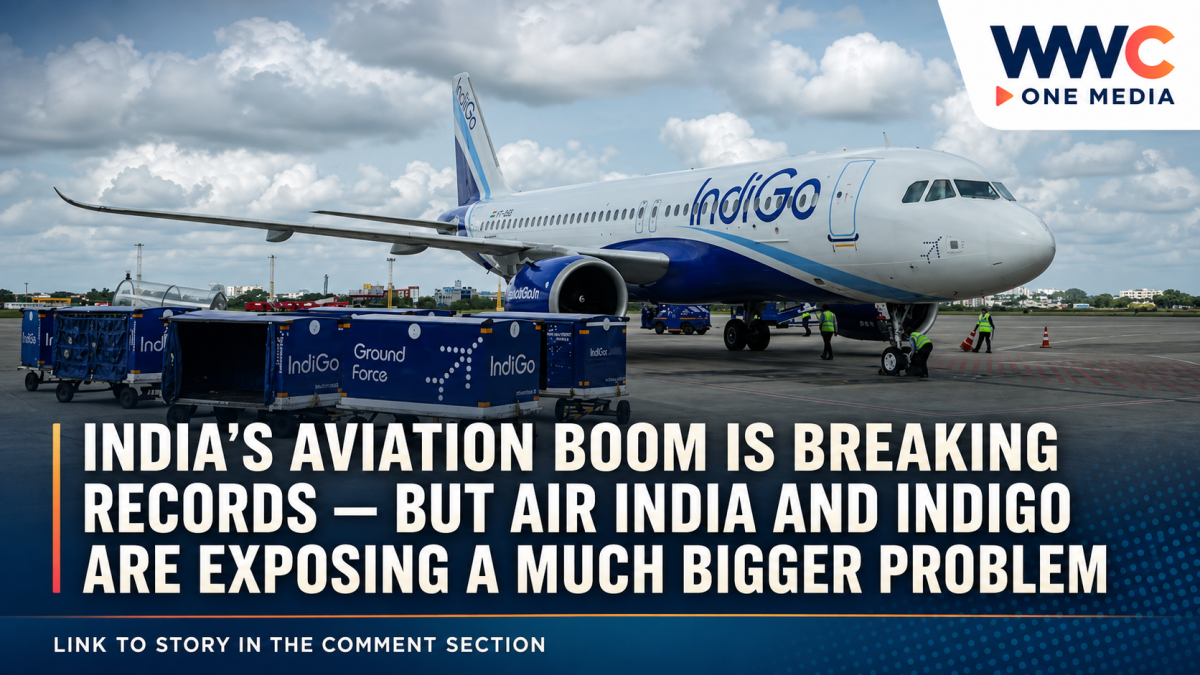
NEW DELHI — India spent years building one of the fastest-growing aviation markets on the planet. Now, a string of safety scares, operational breakdowns, soaring costs and regulatory questions is testing whether the infrastructure behind that growth expanded fast enough to keep up.
The numbers still tell an extraordinary growth story.
India’s airlines carried roughly 167 million domestic passengers last year, more than double the level recorded a decade earlier. More than 70 airports have been added over that period, while Indian carriers have placed orders for around 1,500 aircraft as they prepare for millions more Indians to take to the skies.
But beneath those headline numbers, the industry is confronting a much more uncomfortable question: Has Indian aviation grown faster than its airlines, regulators, safety systems and financial structure can sustainably manage?
That concern has intensified following crises involving the country’s two dominant aviation groups — IndiGo and Air India.
Together, they account for roughly nine out of every 10 domestic airline seats. Reuters reported in July that IndiGo controlled about 65.4% of India’s domestic market, while Air India held approximately 25%, leaving only a relatively small share for rivals.
Air India Faces Fresh Scrutiny After 300-Foot Midair Drop
The latest alarm came from Air India flight AI2379, an Airbus A320neo flying from Phuket to New Delhi on August 4.
The aircraft suddenly lost about 300 feet, or 91 metres, of altitude, and 24 people — including passengers and crew — were injured. India’s Aircraft Accident Investigation Bureau has classified the event as serious and is investigating it with technical assistance involving Airbus and France’s BEA accident investigation agency.
Initial reporting described the episode as turbulence, but subsequent analysis added another layer to the investigation.
The Indian Express reported that an initial Airbus assessment of flight-recorder data indicated a brief loss of hydraulic pressure across the aircraft’s hydraulic systems, resulting in the loss of key flight-control surfaces for approximately four seconds. The final cause, however, has not yet been formally determined by investigators.
Then came an entirely separate concern.
The aircraft’s captain tested positive for marijuana following the incident, according to Reuters. Air India subsequently expanded drug screening across its pilot workforce, going beyond India’s regulatory requirement for random testing of a portion of flight crews.
The two issues should not be conflated. The positive drug test has triggered questions about pilot oversight and airline procedures, while the aircraft’s sudden altitude loss remains the subject of a technical accident investigation. There has been no authoritative finding showing that the captain’s drug result caused the event.
The Shadow of the Ahmedabad Disaster
The scrutiny comes little more than a year after Air India suffered one of the darkest disasters in its history.
Flight AI171, a Boeing 787-8 bound for London, crashed shortly after departing Ahmedabad on June 12, 2025. Of the 242 people aboard, 241 were killed, while people on the ground also died, taking the overall death toll to 260. The investigation remains ongoing, and authorities have warned against drawing premature conclusions about its cause.
Separately from that crash investigation, regulatory examinations have revealed troubling compliance problems inside Air India.
A parliamentary committee cited a DGCA audit that identified approximately 100 safety lapses, including seven Level 1 violations requiring urgent remediation. The findings included issues involving recurrent pilot training, cabin-crew staffing and flight-duty limitations.
Earlier reporting on a July 2025 audit detailed dozens of findings involving pilot training, simulator approvals and crew rostering. Air India has said it remains committed to safety and regulatory compliance.
Perhaps equally important, the parliamentary panel raised questions about the regulator itself.
It noted a 48.3% vacancy rate and said that nearly half of the commercial aircraft examined in a broad DGCA audit had recurring technical defects, arguing that India’s rapidly expanding aviation system requires stronger surveillance capacity and more integrated safety monitoring.
IndiGo’s Crisis Showed Another Weak Point
India’s largest airline has faced a different kind of crisis.
In December 2025, IndiGo suffered a massive operational breakdown after struggling to adapt its crew schedules to tighter pilot fatigue rules.
Approximately 4,500 flights were cancelled, prompting widespread disruption and eventually a record regulatory fine of about US$2.45 million.
The DGCA blamed inadequate pilot roster planning and said the airline had placed heavy emphasis on aircraft and crew utilisation without sufficient operational resilience.
The underlying fatigue regulations were themselves safety measures.
Among other changes, the rules increased weekly rest requirements for pilots from 36 to 48 hours and imposed tighter limits on night operations. During the disruption, authorities temporarily relaxed parts of those rules to stabilise the aviation network — a decision that drew criticism from pilots and safety advocates who questioned whether operational pressure was overriding the intent of fatigue protections.
IndiGo has since continued operating at enormous scale, with roughly two-thirds of India’s domestic market, while attempting to push deeper into international aviation.
But even that expansion has encountered turbulence.
IndiGo Reworks Its Long-Haul Ambitions
IndiGo entered long-haul flying using Boeing 787-9 Dreamliners leased from Norway’s Norse Atlantic Airways while waiting for its own next-generation aircraft.
In July, however, the carrier announced it would wind down those damp-leased wide-body operations, with the aircraft due to be returned by late October.
The decision reflected higher operating costs, geopolitical disruption, expensive fuel, airspace restrictions and currency pressures.
That does not mean IndiGo is abandoning international expansion.
The airline has 60 Airbus A350 wide-body aircraft on order and is introducing Airbus A321XLR aircraft capable of operating longer international routes. Its longer-term ambition remains to transform itself from India’s dominant domestic carrier into a much more significant global airline.
The problem is that expansion is becoming more expensive just as the industry’s financial outlook is deteriorating.
Nearly ₹380 Billion in Industry Losses?
On August 27, ratings agency ICRA sharply revised its forecast for Indian aviation.
It now expects the sector to record a net loss of ₹360 billion to ₹380 billion in FY2027, compared with an estimated ₹280 billion to ₹300 billion loss in FY2026.
ICRA blamed the deterioration on the West Asia conflict, higher aviation turbine fuel prices, weakness in the Indian rupee, subdued passenger growth and continued aircraft-grounding problems caused partly by engine and maintenance constraints.
Air India alone reported a loss of approximately US$2.33 billion for the financial year ending in March 2026, more than double its previous year’s loss, according to Reuters.
The airline is seeking around US$1.5 billion in additional equity from Tata Sons and Singapore Airlines as it finances its enormous transformation programme and manages an extensive aircraft order book.
Pakistan’s continuing airspace restrictions on Indian airlines and conflict-related disruption across parts of the Middle East have also forced carriers onto longer routes, increased fuel consumption and complicated international schedules.
India Has Built the Demand. Now It Must Build the System Around It
Few analysts dispute India’s long-term aviation potential.
A vast population, expanding middle class, rising disposable income, new airports and increasing demand for international travel mean India could remain one of aviation’s most important growth markets for decades.
But passenger demand alone does not create a world-class aviation system.
Airlines need adequately trained pilots, engineers and cabin crews. Regulators need enough qualified inspectors to supervise rapidly expanding fleets. Airports need capacity. Airlines need sufficient financial strength to absorb disruptions. And safety rules must remain credible even when they interfere with commercial schedules.
That is why the problems facing Air India and IndiGo matter far beyond two individual companies.
With the pair controlling around 90% of India’s domestic market, a serious operational failure at either carrier can quickly become a national transportation problem.
The government’s desire for greater competition reflects that vulnerability. Reuters reported that billionaire Gautam Adani’s conglomerate has explored the possibility of entering the airline market, although discussions remained preliminary and no final decision had been made.
India has already proved that it can create extraordinary demand for air travel.
The harder test is now beginning: whether regulators, airlines, infrastructure and safety systems can mature quickly enough to support the aviation superpower India wants to become.
And if they cannot, the biggest danger to India’s aviation boom may not be a lack of passengers or aircraft.
It may be that the industry has simply grown faster than the system designed to keep it safe, competitive and financially sustainable.



Leave a Reply