
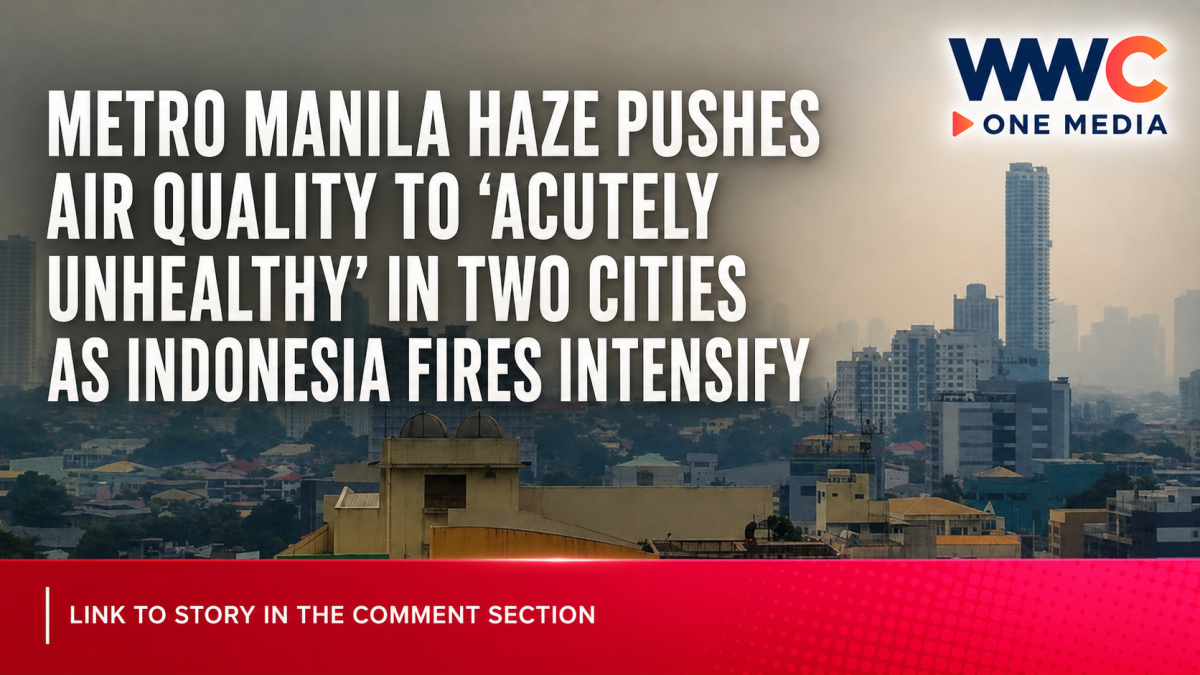
MANILA, Philippines — A blanket of haze has reached parts of Metro Manila, CALABARZON and MIMAROPA, sending air pollution readings to dangerous levels in several areas as Philippine authorities investigate whether smoke from raging forest and peatland fires in Indonesia has been carried north toward the country.
The Department of Environment and Natural Resources-Environmental Management Bureau (DENR-EMB) said the haze observed over parts of Luzon and MIMAROPA was possibly associated with smoke and transboundary haze from ongoing fires in Kalimantan, Indonesia, transported toward the Philippines by prevailing winds.
The deterioration was particularly severe in Metro Manila.
According to EMB-NCR monitoring, Las Piñas and Parañaque were classified as having “acutely unhealthy” air quality, while 10 other monitoring locations recorded “very unhealthy” conditions.
The areas placed in the “very unhealthy” category, with Air Quality Index readings ranging from 150 to 200, included Quezon City’s Ateneo monitoring station, Malabon, Mandaluyong, Manila, Marikina, Muntinlupa, Pasay, San Juan, Taguig and Valenzuela.
The readings immediately raised concern for children, senior citizens, pregnant women and people with respiratory or cardiovascular illnesses, who are generally more vulnerable when particulate pollution reaches elevated levels.
DENR-EMB urged residents in visibly hazy areas to minimize prolonged outdoor activity. Sensitive groups were advised to limit exposure, while people who must go outside were encouraged to use a well-fitting N95 or equivalent mask.
The Bigger Question: Is Indonesia’s Fire Crisis Reaching the Philippines?
Philippine environmental officials have stopped short of declaring Indonesia’s fires the definitive source of the haze.
But regional monitoring shows why authorities are closely examining the connection.
The ASEAN Specialised Meteorological Centre (ASMC) raised its southern ASEAN haze alert to Level 3 on August 26, saying prolonged dry conditions had caused the regional smoke situation to deteriorate significantly.
Satellite surveillance detected widespread moderate-to-dense smoke from clusters of hotspots across Kalimantan, including transboundary haze drifting northward from West Kalimantan. ASMC warned that continued dry weather and strengthening El Niño conditions could further increase the risk of severe transboundary haze across Southeast Asia.
That does not by itself prove that every particle detected over Metro Manila came from Indonesia. Local pollution sources can also contribute to poor air quality.
But the timing is significant: Indonesia is confronting one of its most intense wildfire seasons in years.
More Than 9,000 Hotspots Detected in Indonesia in August
Indonesia recorded more than 9,000 fire hotspots in August, according to figures cited by Reuters from the country’s forestry ministry monitoring system.
That was substantially higher than the 5,077 hotspots recorded in August 2015, the year Southeast Asia suffered one of its worst modern haze disasters.
Nearly 95,000 hectares of Indonesian land burned in July alone, almost twice the area damaged during the previous six months combined.
European Union climate-monitoring data cited by Reuters also showed that carbon emissions from Indonesia’s fires reached about 17.1 million metric tons over seven days, roughly 429% above the seasonal average.
The crisis is particularly difficult to contain in Borneo, where extensive peatlands can continue burning beneath the surface.
Unlike ordinary vegetation fires, peat fires can smoulder underground for prolonged periods, producing large volumes of smoke and making them exceptionally difficult to extinguish completely.
Air Pollution Has Already Reached Extreme Levels Across Borneo
Conditions closer to the Indonesian fires have become even more alarming.
Channel NewsAsia reported that Palangkaraya in Central Kalimantan registered an AQI reading of 780 at noon on August 31, placing pollution there at hazardous levels.
Indonesia has intensified water-bombing and cloud-seeding operations as authorities attempt to stop the fires from spreading.
Reuters reported that tens of thousands of personnel have been mobilized, while dozens of aircraft have been involved in firefighting operations. Indonesian authorities are also investigating companies holding concessions in areas affected by fires.
The human cost is already growing.
Indonesia’s deputy health minister said around 13,500 people were treated for respiratory infections during July and August, while millions of residents in Borneo and Sumatra have been exposed to the health risks created by heavy smoke.
Malaysia Is Seeing the Same Regional Warning Signs
The haze crisis has also crossed other national borders.
Malaysia’s Sarawak state recorded hazardous pollution in several locations on August 31, with the district of Serian reaching an Air Pollutant Index reading of 475, according to CNA.
Schools in parts of Malaysia have previously been temporarily closed as worsening haze pushed pollution into very unhealthy or hazardous territory.
The widening impact across Indonesia and Malaysia adds weight to concerns that smoke from the massive Kalimantan fire clusters can travel considerable distances when regional winds are favorable.
What Filipinos Should Watch Next
For the Philippines, the critical factor is what happens to the fires — and the winds — over the coming days.
A shift in wind direction, stronger rainfall or successful firefighting operations could reduce the amount of transported smoke.
But if Kalimantan’s fires continue intensifying while winds keep carrying haze northward, air-quality problems could persist or affect additional areas.
DENR-EMB said it is continuously monitoring conditions through its network of air-quality stations to determine the extent and potential effects of the haze.
Residents are being advised to monitor official air-quality advisories rather than relying only on visible conditions. Haze can change quickly as winds, rainfall and pollution concentrations shift.
For now, authorities are urging people in affected communities — particularly children, older adults and those with heart or respiratory conditions — to reduce unnecessary outdoor exposure and take precautions when air quality deteriorates.
What began as an environmental emergency hundreds of kilometers away in Indonesia is increasingly becoming a regional test.
And with thousands of fire hotspots still burning across Indonesia, the most important question for the Philippines may no longer be simply whether the haze has arrived — but how long the winds will continue carrying it north.



Leave a Reply