
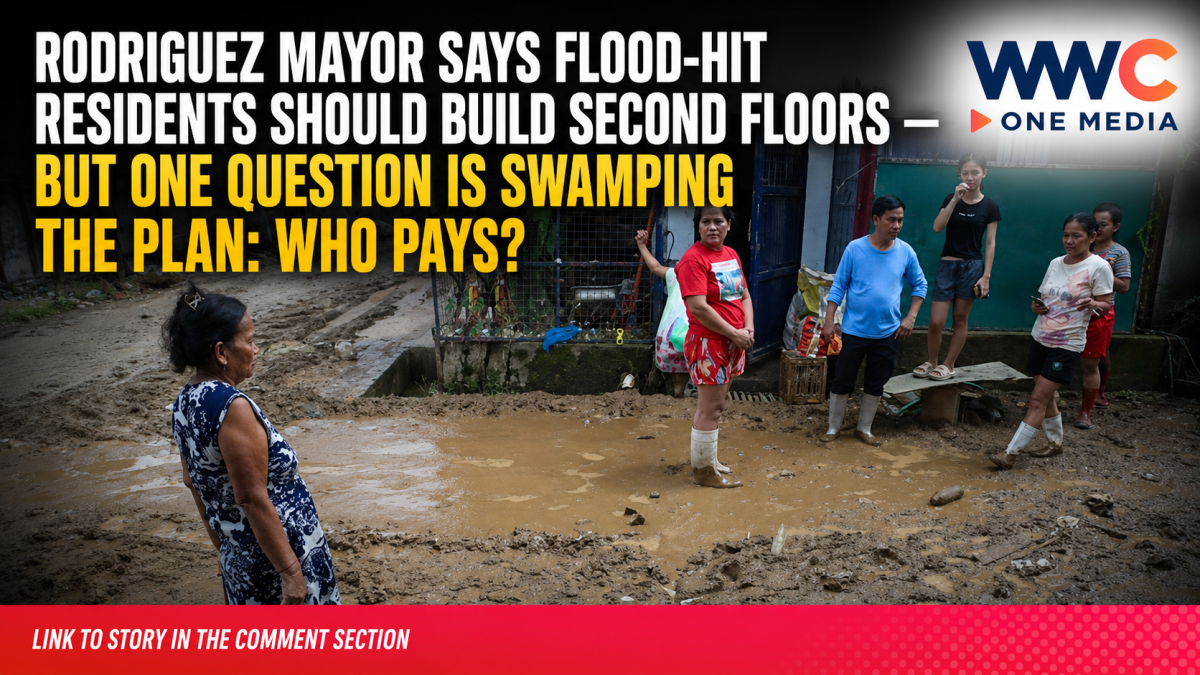
RODRIGUEZ, Rizal — After another night of frightening flash floods sent families scrambling for safety in Rodriguez, Rizal, Mayor Ronnie Evangelista has offered residents of some of the municipality’s most flood-prone communities a stark proposal: build upward.
The mayor said households repeatedly exposed to flooding may have to convert their homes into two-storey structures, arguing that Rodriguez — still widely known by its former name, Montalban — sits in a geographic position that makes flooding extremely difficult to avoid.
But the proposal has triggered an equally difficult question from residents:
Who is supposed to pay for it?
Evangelista told GMA’s 24 Oras that residents themselves would have to finance the construction because the number of affected households or properties runs into the thousands and would be beyond what the local government could shoulder.
Some residents immediately said the idea was financially impossible for low-income families, including a single mother interviewed by GMA who said she could not afford such an expansion.
The controversy erupted after severe Habagat rains again exposed just how quickly conditions can turn dangerous in Rodriguez.
A Night When Floodwaters Rose Faster Than Expected
On Saturday night, August 29, flash floods swept through parts of the municipality after prolonged rains brought by the southwest monsoon.
GMA reported that one vehicle was battered by rushing water before overturning and falling into a ravine.
In Barangay San Isidro, resident Lorely Bautista livestreamed pleas for rescue while trapped with her two young children, aged six and one. When rescuers could not immediately reach the family, an improvised rope evacuation route had to be used to get them out.
ABS-CBN separately reported fast-rising floodwaters inundating homes in several Rodriguez barangays that night, underscoring how rapidly the situation developed.
The August 29 flooding was part of a far larger Habagat emergency across the Philippines.
By August 30, the Office of Civil Defense said 429 areas across four regions — Ilocos, Central Luzon, Calabarzon and Metro Manila — remained flooded following heavy monsoon rains.
And Rodriguez had already been struggling before this latest deluge.
The municipality declared a state of calamity on August 10, weeks before the latest flash floods, after another round of heavy to intense Habagat rains battered the area.
Why Does Rodriguez Keep Flooding?
Evangelista argues that geography is at the heart of the problem.
He described Rodriguez as effectively functioning like a funnel for water coming from surrounding river systems and mountainous areas before eventually flowing toward Metro Manila.
The municipality sits upstream of the Marikina River system, with runoff from surrounding mountains and tributaries converging through the area.
That explanation has historical backing.
After Typhoon Ulysses devastated Rodriguez, San Mateo and Marikina in November 2020, the Department of Environment and Natural Resources investigated whether quarrying operations were responsible for the catastrophic flooding.
The DENR-Mines and Geosciences Bureau eventually concluded that the primary cause of the 2020 flooding was the enormous volume of rainfall from Ulysses combined with already saturated mountain areas following several earlier typhoons.
The agency also pointed to the Marikina River Basin’s natural geomorphology as a reason low-lying communities are vulnerable to river flooding.
That history helps explain Evangelista’s argument that flooding in Rodriguez existed even before today’s quarry operations.
But that does not completely remove quarrying — or broader land development — from the debate.
The Quarry Question Isn’t That Simple
Evangelista acknowledged that quarrying can contribute mud and environmental damage, while disputing the idea that it is the direct cause of Rodriguez’s floods.
That distinction matters.
DENR’s investigation into Ulysses did not find quarrying to be the proximate cause of that specific disaster. Authorities instead identified extreme rainfall, saturated watersheds and natural river-basin conditions as the main drivers.
Yet DENR has also warned more broadly that major changes in land use — including deforestation, construction, quarrying, agriculture and urban development — can accelerate upstream erosion.
More erosion can mean additional sediment entering rivers. Over time, sediment buildup can reduce the capacity of waterways to carry floodwater during intense rainfall.
DENR cited precisely that problem when explaining restoration work along the Marikina River after the devastating 2020 floods.
So the evidence suggests that Rodriguez’s flooding cannot credibly be reduced to one convenient culprit.
Extreme rainfall matters.
Topography matters.
River capacity matters.
Land use matters.
And the vulnerability of communities built in low-lying areas matters.
Rodriguez Has Seen This Before
The images emerging from Rodriguez in 2026 are disturbingly familiar.
During Typhoon Ulysses in November 2020, floodwaters rose high enough that residents in several Rodriguez communities were forced onto rooftops while awaiting rescue.
GMA reported at the time that more than 2,800 families from eight barangays were evacuated, with homes, appliances, food and personal belongings destroyed by fast-moving water and thick mud.
Six years later, residents are again cleaning mud from their homes and asking what happens when the next major rainfall event arrives.
That is what makes the debate over two-storey homes bigger than one controversial sound bite.
Building Higher May Save Belongings — But It Doesn’t Stop the Flood
There is a practical logic behind adding another floor to a repeatedly inundated home: families have somewhere higher to move people, valuables and emergency supplies when water rises.
But a second floor does not prevent a river from overflowing.
It does not stop flash floods.
And it does not answer how elderly residents, children or people with disabilities safely evacuate when currents become dangerous.
Most importantly, it does not answer the financial question being raised by residents who can barely afford their existing homes.
That is where Evangelista’s proposal has collided with economic reality.
For families with sufficient resources, elevating or expanding a home could become part of their adaptation strategy.
For poorer families, telling them to finance another storey can sound less like a flood-control plan and more like transferring the cost of surviving the next disaster directly to the people already living in harm’s way.
The Bigger Question for Montalban
Rodriguez cannot change its mountains or move its rivers.
But government policy can still influence where people are allowed to build, how waterways are maintained, how development and quarrying are regulated, whether drainage and flood-control infrastructure keeps pace with population growth, and whether families facing extreme and repeated danger receive relocation or housing assistance.
That is why the real debate should not simply be:
Should residents build a second floor?
The bigger question is whether communities repeatedly forced onto rooftops should be expected to adapt largely at their own expense — or whether repeated flooding has reached the point where a broader, long-term government solution is unavoidable.
Because after every flood, Rodriguez residents can clean the mud from their homes.
They can replace ruined furniture.
Some may even build another floor.
But unless the underlying vulnerability is addressed, the water will keep coming back.




Leave a Reply