
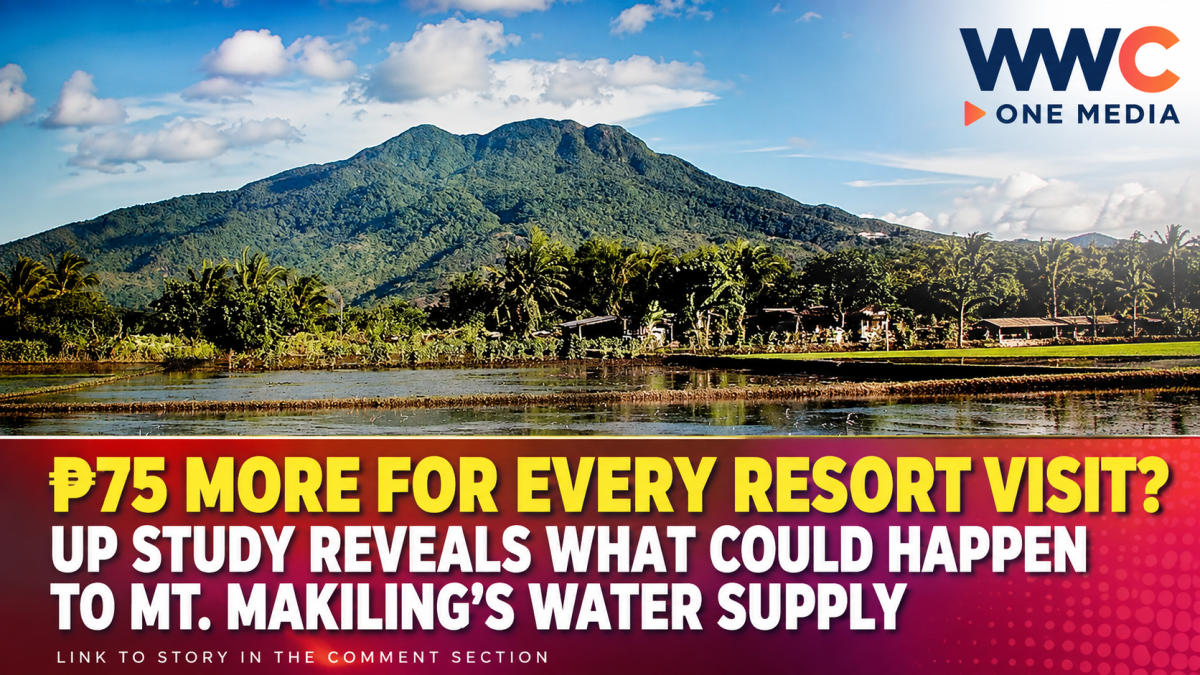
LAGUNA, Philippines — Would resort-goers be willing to pay a little more to help protect the water resources beneath Mt. Makiling?
A study by researchers from the University of the Philippines Los Baños (UPLB) suggests the answer is largely yes—with visitors indicating an estimated willingness to pay ₱75 per resort visit for improved groundwater conservation.
But there is an important catch: the ₱75 is not an existing environmental fee, nor is it currently being collected from resort visitors. It is an estimated amount derived from a hypothetical conservation program presented to 492 respondents in an online survey.
If such a payment mechanism were eventually implemented and the stated willingness to pay were captured, researchers estimated that it could generate about ₱159.52 million annually for groundwater conservation, resort water-management measures and Mt. Makiling management.
Why Mt. Makiling’s groundwater is at the center of the issue
The research focuses on the resort-heavy areas of Calamba City and Los Baños, Laguna, where hot springs and groundwater associated with Mt. Makiling have helped fuel a thriving tourism industry.
Mt. Makiling is a dormant volcano and an important watershed that provides water for domestic, agricultural and industrial uses. The researchers noted that the growth of resorts has increased pressure on groundwater resources, with many establishments relying on pumped groundwater for swimming pools and other uses.
An earlier inventory cited in the research counted 1,043 resorts in Calamba and Los Baños as of 2020—871 in Calamba and 172 in Los Baños.
The Department of Science and Technology (DOST) likewise reported that groundwater is heavily relied upon by resorts in the two areas and that pumping groundwater can be cheaper for establishments than purchasing metered water from local water districts.
Most visitors did not fully know where resort water comes from
One of the study’s striking findings was the limited public understanding of resort water sources.
Of the 492 respondents, 52.6% said they knew where the resort water came from. Among those who identified a source, 26.2% pointed to hot springs, 14.8% identified Mt. Makiling, while only 7.3% identified groundwater.
Only 40.7% correctly identified pumping as the way resort pools were filled, while 34.1% believed the water flowed naturally.
At the same time, awareness of the importance of forests was considerably higher. About 98.4% of respondents agreed that good forest cover is important to maintaining groundwater supply, although 33% still believed groundwater was unlimited regardless of consumption.
Why would visitors pay?
The strongest motivation was environmental conservation.
Among respondents willing to pay, 82.2% said they wanted to help conserve Mt. Makiling’s groundwater, while 52.3% cited the belief that groundwater is a finite resource.
The survey also found strong support for the proposed conservation measures. About 84% agreed or completely agreed that conserving Mt. Makiling could enhance groundwater supply, while 78% agreed or completely agreed that recycling pool water could help conserve groundwater.
The study’s findings were also reported by DOST and the Philippine Information Agency in 2025, which highlighted the potential for a water-user or environmental fee to help finance conservation efforts.
How could the ₱75 be used?
Under the hypothetical scenario examined by the researchers, an additional water-user fee would be collected on top of existing resort entrance fees.
The proposed allocation would be divided equally:
- 50% for maintaining pool-water quality and supporting water-conservation measures at resorts
- 50% for Mt. Makiling conservation and management
Using historical visitor figures, researchers estimated potential annual revenue of approximately ₱151.13 million from Calamba and ₱8.39 million from Los Baños, for a combined ₱159.52 million per year.
The researchers further estimated that, if the annual benefits remained constant, the potential present value over 20 years could reach about ₱1.358 billion, using a 10% discount rate.
Only four respondents said they would pay nothing
The survey presented respondents with possible payment amounts ranging from zero to more than ₱200.
Of the 492 participants, 488 selected an amount greater than zero, while only four—or 0.81%—selected zero.
The most frequently selected amounts were ₱50 and ₱100. The researchers’ statistical analysis produced the estimated mean willingness to pay of ₱75 per visit.
However, the researchers emphasized that willingness-to-pay surveys measure stated preferences, meaning the ₱75 figure should not be interpreted as a guarantee that visitors would actually pay that amount if a mandatory fee were introduced.
A surprising problem: visitors may prefer frequent water replacement
The study also uncovered a knowledge gap regarding swimming-pool water management.
Only 23.4% of respondents knew that properly treated and monitored pool water could remain in use for years without annual replacement, while 76.6% did not know this.
Researchers said better public education could help visitors understand that maintaining proper water quality does not necessarily require excessive replacement of pool water.
This could be particularly important in areas where resort tourism depends heavily on groundwater.
The bigger question: Can tourism help save the resource it depends on?
The researchers’ recommendation goes beyond simply adding another fee to resort bills.
They urged local governments to consider policies that could capture visitors’ willingness to contribute to groundwater conservation while directing the resulting funds toward Mt. Makiling management and improved water-conservation practices in resorts.
The study also called for stronger information campaigns targeting resort operators, tourists, the public and government officials.
The underlying message is straightforward: the tourism industry around Mt. Makiling depends on the area’s water resources, but protecting those resources may require changing how that water is used, managed and valued.
For now, however, there is no ₱75 conservation fee being automatically charged to resort visitors as a result of this study.
The ₱75 figure is a research-based estimate of what surveyed visitors said they would be willing to contribute under a proposed conservation framework—not a new entrance fee or an implemented government charge.




Leave a Reply