
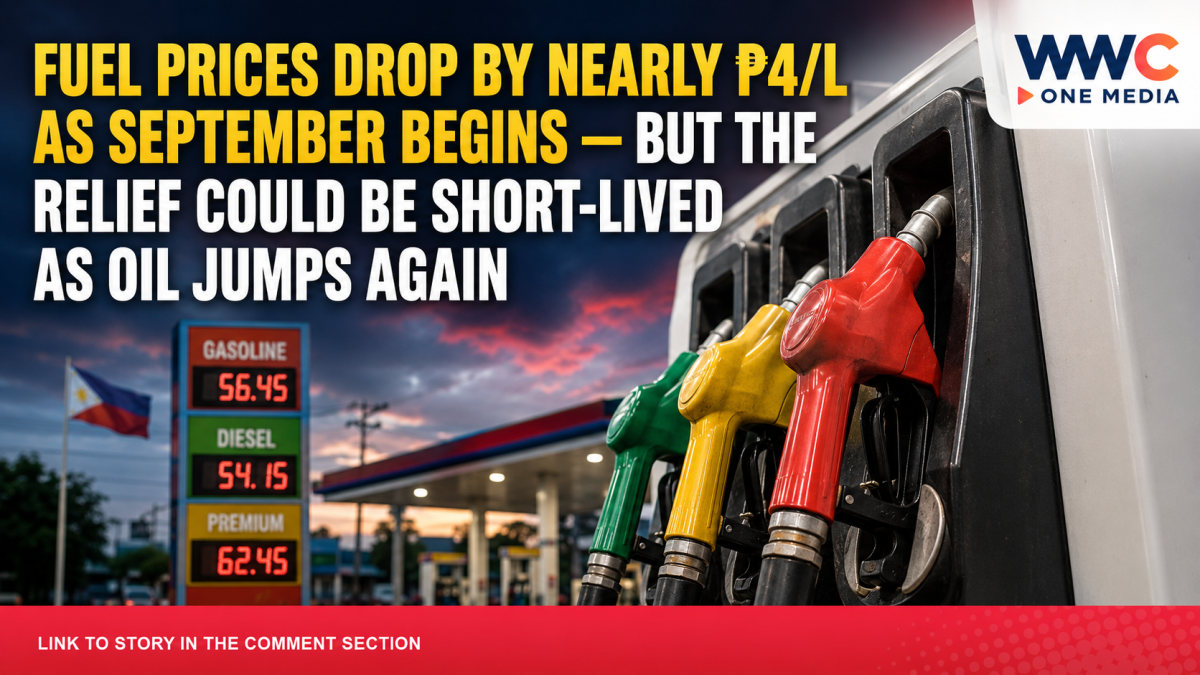
MANILA, Philippines — Filipino motorists are getting a much-needed break at the start of the “Ber” months, with oil companies slashing diesel and kerosene prices by nearly ₱4 per liter beginning Tuesday, September 1.
But the celebration at the pump may have to be tempered.
While diesel, gasoline and kerosene prices are moving lower this week, fresh tensions in the Middle East have already pushed international crude prices higher again — raising the possibility that this week’s unusually large rollback may not last.
And for households that rely on liquefied petroleum gas, or LPG, September could bring a price increase instead.
How much are fuel prices dropping on September 1?
The size of the rollback varies slightly among oil companies.
Seaoil announced reductions of ₱0.32 per liter for gasoline, ₱3.83 for diesel and ₱3.84 for kerosene, effective 6 a.m. Tuesday.
Shell Pilipinas announced cuts of ₱0.30 per liter for gasoline and ₱3.80 per liter each for diesel and kerosene.
Petron likewise announced reductions of ₱0.30 for gasoline and ₱3.80 for both diesel and kerosene, while Jetti Petroleum said it would slash gasoline by ₱0.40 per liter and diesel by an even bigger ₱3.90 per liter.
That means motorists could save roughly ₱190 to ₱195 on a 50-liter diesel fill-up, depending on the oil company.
A 50-liter gasoline fill-up, however, would produce a much smaller saving of around ₱15 to ₱20.
Why are diesel and kerosene getting such a big rollback?
The price cuts reflect movements in international petroleum markets before the latest round of pump-price adjustments was calculated.
Oil prices weakened late last week as markets reacted to diplomatic efforts surrounding the conflict involving Iran and to the possibility of improving shipping conditions through the Strait of Hormuz, one of the world’s most important energy routes.
Reuters reported that Brent crude settled at $89.31 per barrel on August 28, while U.S. West Texas Intermediate crude finished at $83.40, as traders weighed reports of possible progress involving shipping through Hormuz.
Jetti Petroleum president Leo Bellas similarly pointed to reduced market anxiety over immediate oil-supply disruptions and renewed mediation efforts as factors behind falling prices.
For Philippine consumers, those international declines eventually filtered through to local pump prices.
The rollback comes after two straight weeks of increases
The September 1 cuts are particularly welcome because motorists had just endured two consecutive weeks of price hikes.
In the previous adjustment alone, gasoline rose by ₱1.08 per liter, diesel by ₱2.31, and kerosene by ₱0.95.
Before Tuesday’s rollback, GMA News reported that year-to-date adjustments as of August 31 had already reached net increases of ₱54.92 per liter for gasoline, ₱59.06 for diesel and ₱51.65 for kerosene.
So while this week’s reduction is significant — particularly for diesel users — it only erases a portion of the massive fuel-price increases accumulated earlier in 2026.
That matters not only to private motorists.
Diesel prices directly affect buses, jeepneys, delivery fleets, trucking companies, agricultural machinery and other industries where transportation accounts for a significant share of operating costs.
But international oil prices are climbing again
Here is the catch.
The international market that produced this week’s Philippine rollback has already changed.
Reuters reported that Brent crude climbed to $90.49 per barrel on August 31, its highest level since August 25, after renewed military exchanges between the United States and Iran revived concerns about Gulf oil supplies and the security of the Strait of Hormuz.
Those developments will not automatically translate into an immediate Philippine pump-price hike because domestic adjustments reflect earlier trading periods and several other cost components.
But they illustrate just how quickly the direction of oil prices can reverse.
Reuters’ August survey of analysts also showed Brent crude expected to remain above $80 a barrel, with continuing Middle East supply disruptions among the major risks facing the market.
In other words, motorists should view the September 1 rollback as substantial relief — but not necessarily the beginning of a sustained decline in fuel prices.
LPG users may face the opposite story
There is another twist for Filipino households.
While motorists are paying less for fuel this week, LPG prices could move higher in September.
Regasco president Arnel Ty told The Philippine Star that LPG prices were estimated to increase by around ₱2 to ₱3 per kilogram.
For a standard 11-kilogram LPG cylinder, that would translate into an additional ₱22 to ₱33 per tank.
Ty cited a weaker Philippine peso and higher shipping costs as factors behind the expected increase.
Inquirer likewise reported that LPG prices could rise by as much as ₱3 per kilogram this month.
What motorists should watch next
For now, September opens with one of the more noticeable fuel-price rollbacks motorists have seen recently.
Diesel users are the biggest winners, with reductions approaching ₱4 per liter, while gasoline users receive a more modest break.
But the bigger story may be what happens next.
The Strait of Hormuz remains a critical uncertainty for world energy markets, geopolitical tensions have again lifted crude prices, the peso is under pressure, and LPG consumers may be facing higher costs even as pump prices fall.
So September begins with cheaper fuel at Philippine gas stations.
The question is whether this rollback marks the start of real relief — or merely a short window before global oil prices push Philippine consumers back in the other direction.




Leave a Reply