
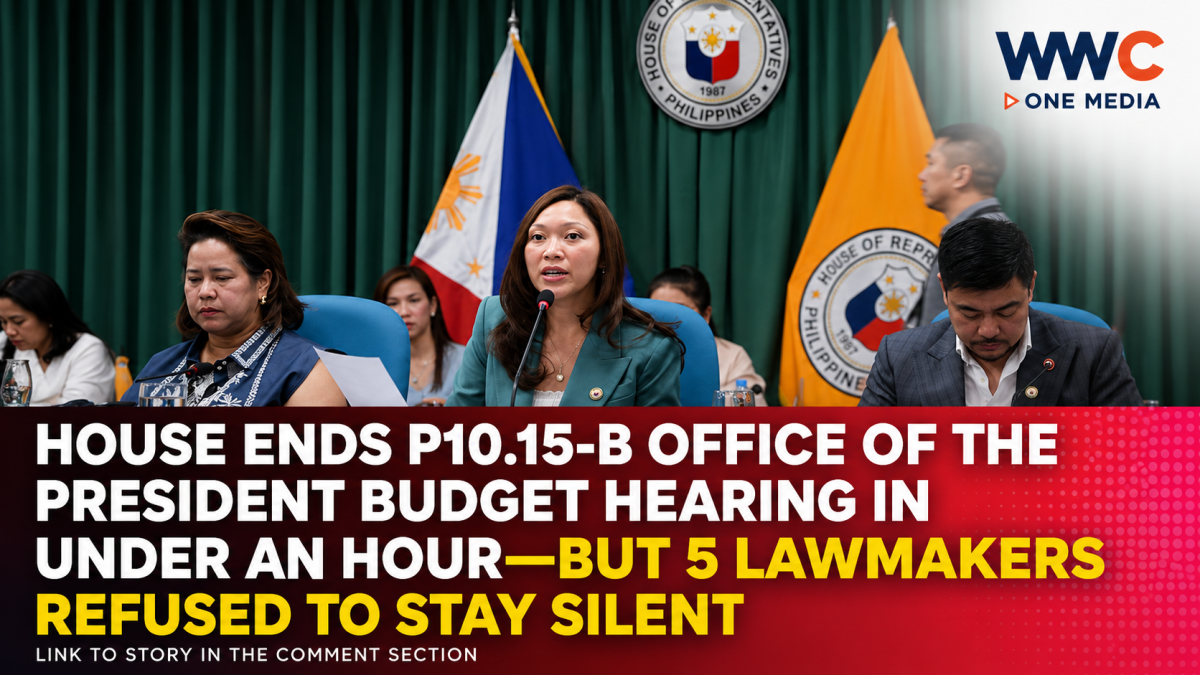
MANILA, Philippines — The House Committee on Appropriations abruptly ended its briefing on the proposed ₱10.156-billion 2027 budget of the Office of the President (OP) on Tuesday, September 1, after lawmakers voted to extend parliamentary courtesy and terminate the interpellation.
The hearing lasted less than an hour, despite objections from five minority lawmakers who argued that the President’s proposed budget should undergo closer scrutiny.
Executive Secretary Ralph Recto presented the OP’s proposed 2027 allocation, saying it was 64% lower than the office’s budget for the current year.
Recto attributed the sharp reduction largely to lower operational requirements and the completion of activities connected to the Philippines’ hosting of the ASEAN meeting, which he said would no longer require additional funding next year.
He maintained that the proposed amount would still be sufficient for the Office of the President to perform its functions amid challenges ranging from geopolitical tensions and disruptions in the Middle East to typhoons, El Niño and other calamities.
Parliamentary courtesy ends the questioning
Following Recto’s presentation, House Minority Leader Marcelino Libanan moved to terminate the interpellation as an extension of parliamentary courtesy to the Office of the President.
The motion was seconded by Rep. Ferdinand Hernandez.
But Rep. Antonio Tinio objected, arguing that the long-standing practice of parliamentary courtesy should no longer prevent lawmakers from examining government spending.
According to the Inquirer report, 37 members voted in favor of terminating the briefing, while five voted against it.
Representatives Renee Co, Elijah Fernando, Sarah Elago, Iris Montes and Antonio Tinio were among those who raised objections, stressing the need for greater scrutiny of the proposed presidential budget.
The hearing was subsequently terminated by Rep. Albert Garcia, senior vice chairperson of the appropriations panel.
Lawmakers were told that questions concerning the OP’s proposed spending and other issues could still be raised during or before the plenary stage.
The ₱10.156-billion figure is only one piece of a much bigger budget debate
The brief OP hearing comes as Congress begins examining the administration’s proposed ₱7.2-trillion national budget for 2027.
The Department of Budget and Management said the proposed national spending plan is ₱407 billion, or 6%, higher than the 2026 budget, with the administration presenting it as a program focused on people-centered growth, infrastructure, resilience and public services.
The House has already filed the ₱7.2-trillion spending bill, with the chamber targeting approval on final reading by October 9. The measure contains thousands of pages of proposed allocations that will undergo congressional scrutiny.
The OP budget is therefore being examined within a much broader debate over how the government intends to spend taxpayers’ money in 2027.
Confidential funds remain a major point of interest
One issue likely to attract continued attention is the OP’s proposed ₱4.55 billion in confidential and intelligence funds for 2027.
The amount consists of ₱2.25 billion in confidential funds and ₱2.3 billion in intelligence funds, with the total reportedly unchanged from 2026.
House Rep. Bienvenido “Benny” Abante Jr. has defended the proposed funds, arguing that President Ferdinand Marcos Jr., as commander in chief, has legitimate national-security responsibilities requiring confidential resources.
The issue is particularly significant because civil society groups and budget advocates have been calling for stronger transparency and accountability mechanisms in the 2027 spending plan.
Watchdogs are already warning about the wider budget
The short OP hearing also comes against the backdrop of growing scrutiny over the proposed national budget.
The People’s Budget Coalition has identified ₱735.56 billion in proposed 2027 spending that it considers vulnerable to political intervention or possible budget insertions.
The coalition categorized the amount into so-called “soft pork,” infrastructure-related “hard pork,” and “shadow pork,” the latter referring to ₱111.98 billion in unprogrammed appropriations. These classifications are the watchdog group’s assessment and should not be interpreted as proof that the funds themselves are illegal or anomalous.
The Inquirer likewise reported that budget watchdogs have warned that the proposed ₱7.2-trillion budget could become vulnerable to political manipulation ahead of the 2028 elections, particularly because of discretionary and localized programs.
At the same time, the DBM has defended the spending proposal, saying the 2027 budget was designed around fiscal discipline and measurable results.
Not the first time the OP budget hearing ended quickly
The early termination is also part of a recurring congressional practice.
In 2024, the House ended deliberations on the proposed OP budget of about ₱10.5 billion in less than 20 minutes, citing parliamentary courtesy.
In 2023, lawmakers likewise quickly terminated deliberations on the OP’s proposed ₱10.7-billion budget after allowing opposition lawmakers to make brief manifestations.
And in 2022, the House appropriations panel ended the OP budget briefing just seven minutes after it began.
The practice has repeatedly drawn criticism from lawmakers who argue that the public deserves a fuller accounting of how presidential offices intend to spend taxpayer money.
What happens next?
The early termination of the committee briefing does not mean the proposed OP budget has become final.
The ₱10.156-billion proposal remains part of the broader 2027 budget process, with further questions and possible amendments potentially arising as Congress moves toward plenary consideration and eventually the final General Appropriations Act.
For now, the central issue is no longer simply how much the Office of the President is asking for.
It is how closely Congress will examine where that money will go—and whether lawmakers will get another opportunity to question the Palace before the 2027 spending plan becomes law.
That next stage could prove far more consequential than Tuesday’s brief hearing.




Leave a Reply