
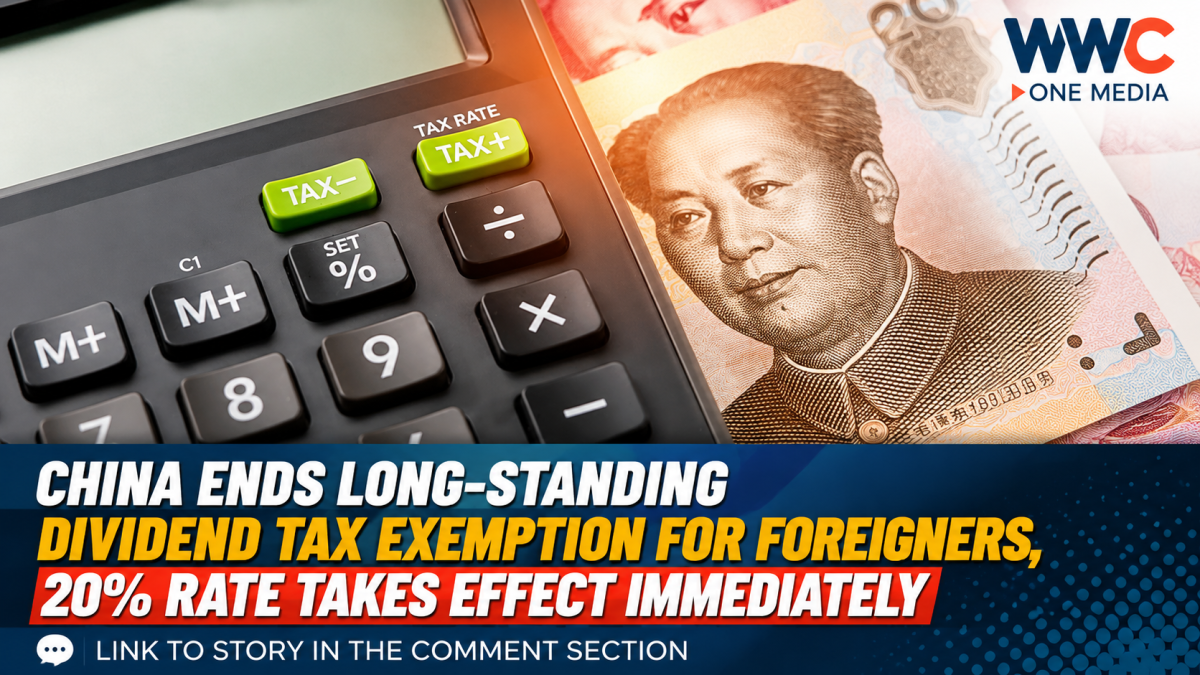
China has ended a decades-old personal income tax exemption for foreign individuals receiving dividends from foreign-invested enterprises in the country, with a 20% tax rate taking effect September 1, 2026.
The move, announced jointly by China’s Ministry of Finance and State Taxation Administration, effectively ends a preferential treatment that had been in place since 1994.
What changed?
Under the new policy, dividends and bonus income received by foreign individuals from foreign-invested enterprises in China will be treated as “interest, dividend and bonus income” and subject to a flat 20% individual income tax rate.
The previous exemption was introduced in 1994 as part of China’s efforts to encourage foreign investment and support the country’s reform and opening-up strategy. China’s tax authorities have now withdrawn that exemption as part of a broader effort to make the tax system more uniform.
Who could be affected?
The change primarily concerns foreign individuals receiving dividends from foreign-invested enterprises in China.
It is important not to interpret the announcement as a blanket new 20% tax on every form of income earned by foreigners in China. The specific announcement concerns dividend and bonus income from foreign-invested enterprises.
China’s existing individual income tax framework already sets a 20% proportional rate for categories including interest, dividends, bonuses, property transfers and certain other forms of income. The major change is the removal of the specific exemption previously available to foreign individuals receiving dividends from foreign-invested enterprises.
Companies will generally withhold the tax
The new announcement also establishes how the tax is to be collected.
When a foreign-invested enterprise pays dividends or bonuses to a foreign individual, the company is required to withhold the tax and report it by the 15th day of the following month.
If the company fails to withhold the tax, the foreign individual who received the income must pay it by June 30 of the following year, unless the tax authorities set another deadline.
Why is China making the change?
Chinese state media said the adjustment is intended to promote greater tax-system consistency and fairness.
The exemption was created more than 30 years ago when China was actively using tax incentives to attract foreign capital. Chinese officials and tax experts now argue that the country’s investment environment has changed significantly, with factors such as market size, industrial infrastructure and the broader business environment playing a larger role in attracting foreign investment.
Chinese reporting has also pointed to concerns about potential abuse of preferential treatment, including arrangements that could exploit the exemption through foreign-investment structures.
Does this mean foreigners will always be 20% worse off?
Not necessarily.
The headline rate is 20%, but the actual tax burden can depend on the investor’s circumstances, including applicable tax treaties and the tax treatment in the person’s home jurisdiction.
For example, Chinese authorities note that foreign taxpayers may in some circumstances receive credit for taxes paid in China when calculating their tax obligations in another country. That means the ultimate impact can differ from person to person.
Foreigners living and working in China also continue to have other tax rules and incentives that are separate from this dividend policy. Shanghai’s current tax guidance, for example, says certain tax benefits for qualifying foreign individuals—including eligible housing, education and other allowances—remain available through the end of 2027.
A major change after 32 years
The timing is significant.
The dividend exemption dates back to 1994, meaning foreign individuals had benefited from the preferential treatment for more than three decades.
As China moves toward a more standardized tax framework, the latest decision signals that Beijing is increasingly willing to remove older investment incentives that were created during an earlier stage of economic reform.
For foreign shareholders and expatriates with investments in Chinese foreign-funded companies, however, the practical question is now straightforward:
How much will the new 20% tax reduce their future dividend income?
That answer will depend on the size of their distributions, their tax residency and whether another jurisdiction provides relief through a tax treaty or foreign-tax credit.
The new policy is effective from September 1, 2026.
WWC ONE MEDIA J.M.D




Leave a Reply