
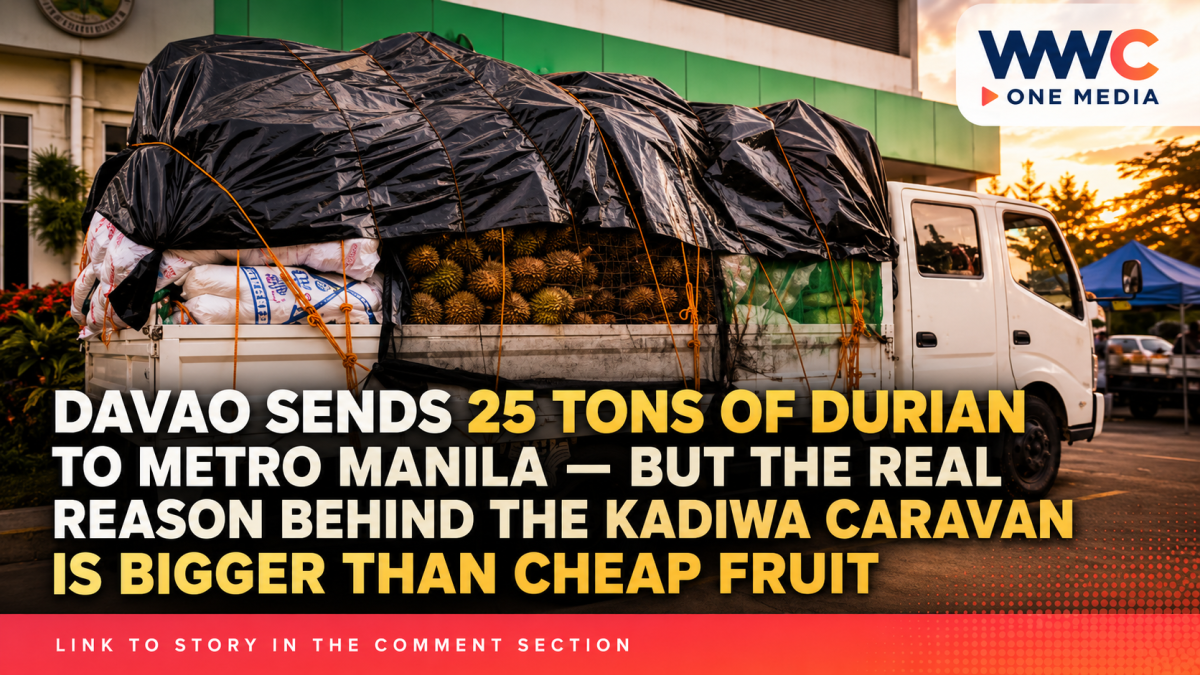
QUEZON CITY, Philippines — The unmistakable scent of Davao durian has reached Metro Manila as the Department of Agriculture’s Kadiwa on Wheels rolled into Quezon City on Tuesday, September 1, carrying tropical fruits directly from Mindanao farmers to consumers—and opening another outlet for growers facing the pressure of a heavy harvest season.
The Department of Agriculture in Davao Region (DA-11) opened its fruit-selling activity at the DA Central Office in Quezon City, showcasing durian, mangosteen, pomelo and other Davao-grown produce. The Quezon City stop runs from September 1 to 3, before the mobile market moves to Manila and later to Cebu, Baguio and Pasay.
But the Quezon City display is only the first visible part of a much bigger movement of fruit.
Days before the opening, DA-11 dispatched about 25 metric tons of fresh fruits from Davao for sale in Quezon City and Manila. Philippine News Agency reported that the shipment included produce sourced from farms in Calinan District, one of Davao City’s key fruit-producing areas.
SunStar Davao added that the shipment was launched from Bago Oshiro in Tugbok District and would travel by land as part of a broader market caravan. According to the report, participating sellers expect the fruits to be offered at prices comparable to those in Davao, potentially giving Metro Manila buyers access to fresher produce without the usual retail markups associated with long supply chains.
Why Davao Farmers Need New Buyers Now
The initiative is more than a traveling fruit market.
Earlier in August, DA-11 Regional Director Macario Gonzaga said the region’s fruit supply had increased sharply and that farmers were becoming concerned about low selling prices. The agency therefore planned Kadiwa on Wheels partly as a way to move excess produce into large consumer markets outside Mindanao.
That makes the caravan especially important for highly perishable crops such as durian and mangosteen. Farmers cannot simply store large volumes indefinitely while waiting for prices to improve. Moving the harvest quickly to Metro Manila, Cebu and Baguio can help create additional demand while reducing the risk that growers will be forced to dispose of produce at deeply discounted prices.
Official statistics show just how important fruit production is to the Davao economy. The Philippine Statistics Authority reported that the region produced 700,768.55 metric tons of fruit crops during the first quarter of 2026. Durian alone accounted for 4,658.10 metric tons during that quarter, while its production rises much more sharply during other parts of the harvest cycle.
For comparison, Davao Region produced more than 37,400 metric tons of durian during the third quarter of 2025, illustrating how dramatically supply can increase during peak season.
From Quezon City to Manila, Cebu and Baguio
The Davao fruit caravan is scheduled to continue beyond the DA compound.
After the September 1-3 Quezon City run, Kadiwa on Wheels is scheduled to move to the Kartilya ng Katipunan near Manila City Hall on September 4.
The announced succeeding stops are Cebu City from September 10 to 16, Baguio City from September 25 to 28, and the World Trade Center in Pasay City from October 8 to 10. DA-11 has set an overall target of 70 metric tons of produce for the initiative.
Among the groups identified as participating are the Davao City Durian Industry Development Council and the Durian Industry Association of Davao City.
For Davao farmers, reaching that 70-ton target could mean much more than a successful promotional event. It could provide another sales channel during periods when local supply outpaces demand.
Kadiwa Has Become a Much Bigger Food-Market Network
Kadiwa was designed around a relatively simple idea: connect farmers and fisherfolk more directly with consumers, cutting some layers between producers and the retail market.
The program has since grown substantially. Department of Agriculture figures released in July showed that KADIWA ng Pangulo generated ₱4.42 billion in cumulative sales from July 2022 through July 20, 2026, through more than 22,000 marketing activities, with the DA saying more than 12 million consumers had benefited. Those figures are government-reported program data.
The department has also described direct market access as a way of helping farmers secure buyers while giving consumers another source of agricultural products.
For the latest Davao run, however, the real test will come after the durians are opened and the stalls are packed away.
The bigger question is whether a temporary caravan can translate into repeat buyers, stronger distribution networks and more stable prices for farmers once Davao’s peak harvests flood the market again.
With only 25 tons making up the initial shipment and the program aiming to move 70 tons overall, the next several stops could reveal whether Kadiwa on Wheels becomes merely a seasonal showcase—or a meaningful new market for one of the country’s most productive agricultural regions.




Leave a Reply