
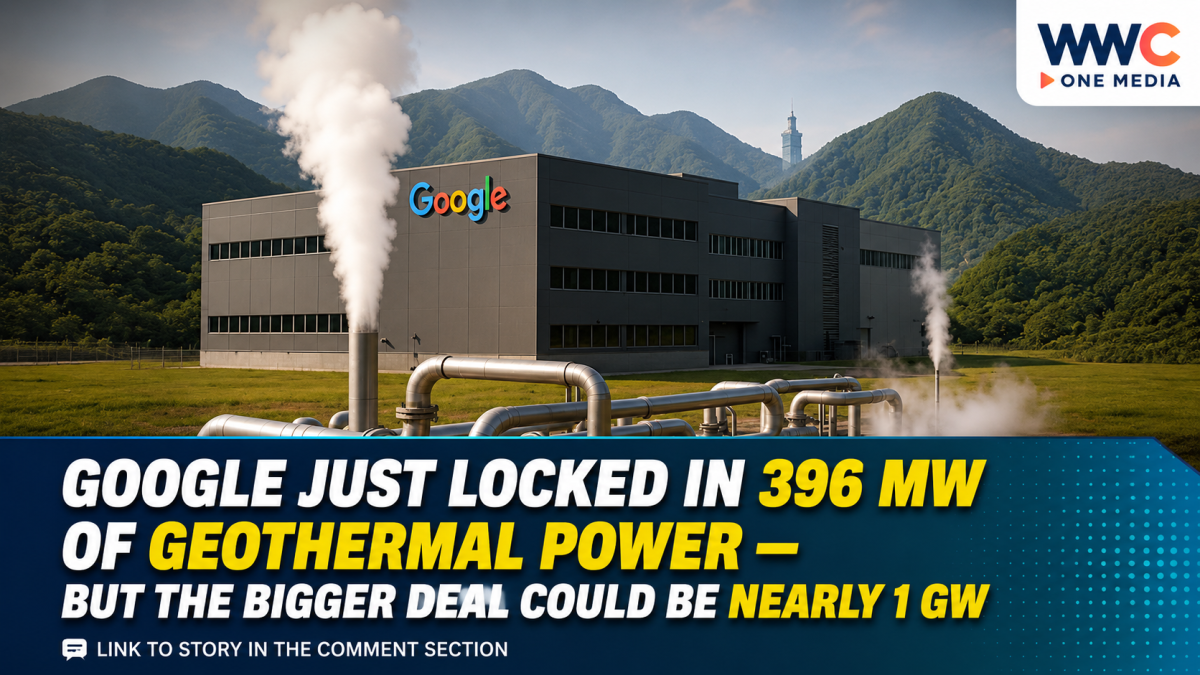
Fervo Energy has secured a major new power deal with Google that could reshape the race for reliable, around-the-clock clean energy — and investors immediately took notice.
Geothermal energy company Fervo Energy has signed a 396-megawatt power purchase agreement (PPA) with Google for electricity from its Cape Station enhanced geothermal systems project in Utah, sending Fervo shares soaring nearly 14% in premarket trading on Tuesday.
The agreement marks a major expansion of the partnership between Fervo and Google as technology companies race to secure dependable electricity for the rapidly growing energy demands of artificial-intelligence and data-center infrastructure.
A 396 MW deal — with the possibility of nearly 1 GW
Under the agreement, Google will purchase power from Fervo’s Cape Station project, an enhanced geothermal system (EGS) development in Beaver County, Utah.
The project is expected to begin delivering power in 2028, with the contracted 396 MW structured in four successive 99 MW blocks. The PPA carries a 15-year delivery term.
But the headline number may not be the biggest part of the announcement.
Fervo has agreed to offer Google an option to expand its purchases by approximately 600 MW. If that expansion proceeds, the total contracted capacity could reach roughly 950 MW — effectively approaching 1 gigawatt — by June 2030. The expansion remains subject to Google’s acceptance and a definitive agreement.
That potential scale is one reason the agreement is attracting attention beyond the geothermal industry.
Why Google wants geothermal power
The deal comes as electricity demand from data centers and AI infrastructure continues to rise sharply across the United States.
Unlike solar and wind generation, geothermal power can operate continuously, providing electricity around the clock rather than depending on sunlight or wind conditions.
That makes geothermal particularly attractive to large electricity users such as technology companies that need reliable power for data centers operating 24 hours a day.
Reuters reported that the Fervo agreement highlights the growing interest among major power consumers in securing dependable clean-energy supplies as data-center electricity demand rises.
Google says the Utah electricity is intended to provide a foundation for a potential data center in the state. However, the company’s final data-center plans have not been completed and remain dependent on engineering feasibility, regulatory approvals, local approvals and commercial conditions.
Fervo and Google have been building toward this
The latest agreement is not a one-off partnership.
Fervo and Google began working together through Project Red, Fervo’s geothermal pilot project in Nevada, which came online in 2023.
In June 2024, Fervo, Google and NV Energy also signed a 115 MW power purchase agreement designed to bring additional geothermal electricity onto Nevada’s grid.
Fervo subsequently announced in March 2026 that it had entered into a broader geothermal framework agreement with Google covering the development of up to 3 GW of geothermal capacity through 2033, including 1 GW of proposed projects during the first two years.
The new 396 MW agreement therefore represents another major step in a relationship that is expanding from pilot projects toward utility-scale geothermal generation.
What makes Cape Station different?
Cape Station is based on enhanced geothermal systems, or EGS.
Traditional geothermal plants generally depend on naturally occurring underground reservoirs of hot water or steam. EGS seeks to create or enhance geothermal reservoirs in hot rock, allowing developers to access geothermal resources in locations where conventional geothermal resources may be more limited.
Fervo has been developing an approach that draws heavily on drilling and reservoir techniques associated with the oil and gas industry.
The company describes Cape Station as a scalable, modular development designed to expand beyond its initial 100 MW phase. Its latest announcement described the 396 MW Google agreement as the world’s largest enhanced-geothermal power purchase agreement to date. That characterization comes from Fervo and has not been independently verified by Reuters.
Investors react immediately
Fervo’s stock jumped nearly 14% in premarket trading following news of the Google agreement, according to Reuters.
The reaction reflects more than the size of a single electricity contract.
For investors, the agreement offers another indication that Fervo’s geothermal technology is moving from demonstration projects toward larger commercial deployments.
Fervo has also been positioning geothermal power as a potential solution to one of the biggest challenges facing the AI boom: where to find enough reliable electricity to power the next generation of data centers.
The bigger energy race
The Fervo-Google agreement comes as major technology companies explore a range of energy sources to meet rapidly increasing electricity requirements.
Google has pursued geothermal, nuclear power and other technologies as part of its broader effort to secure reliable, lower-carbon electricity.
The attraction of geothermal is its potential combination of 24/7 generation, low operational carbon emissions and geographic flexibility compared with conventional geothermal resources.
But significant challenges remain.
Fervo must still execute a complex large-scale geothermal project, including drilling, reservoir development, power generation, transmission and regulatory requirements. The company’s SEC filing specifically identifies risks involving construction, permitting, interconnection, transmission availability and achieving targeted commercial-operation dates.
The real story may be what happens after 396 MW
For now, Google has committed to 396 MW from Cape Station.
But the agreement contains a potentially much larger opportunity: an additional approximately 600 MW that could push Google’s total contracted geothermal capacity at Cape Station close to 1 GW.
And that is where the story gets particularly significant.
If Fervo can successfully scale Cape Station and deliver reliable geothermal electricity at commercial scale, the project could provide a powerful test of whether enhanced geothermal systems can become a major source of electricity for America’s rapidly expanding AI and data-center economy.
For Google, it is another bet on clean, dependable power.
For Fervo, it could be the deal that demonstrates whether next-generation geothermal is ready to move from promising technology to a major player in the U.S. power market.
WWC ONE MEDIA MJE




Leave a Reply