
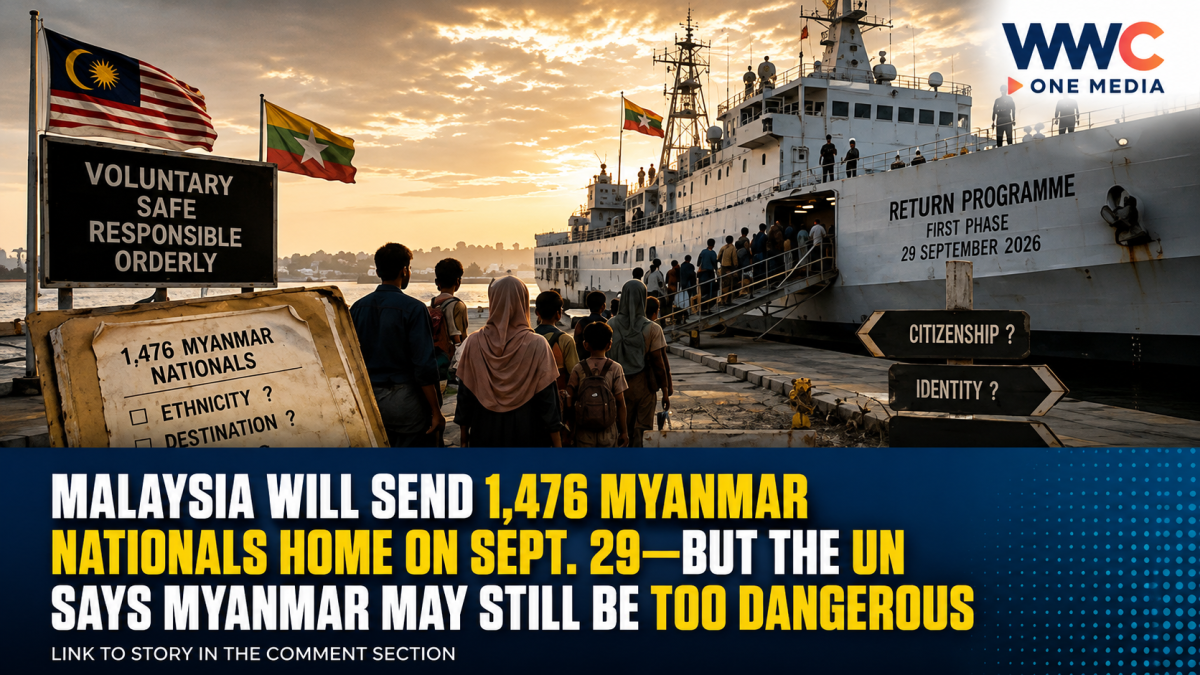
KUALA LUMPUR — Malaysia is moving ahead with the first phase of its planned voluntary repatriation of Myanmar nationals, but the United Nations refugee agency says it is not involved in the operation and warns that conditions in Myanmar remain too dangerous for a safe and dignified return.
Malaysia is scheduled to send 1,476 Myanmar nationals back to Myanmar on September 29, 2026, marking the first phase of a broader programme involving up to 5,000 people, according to Malaysia’s Home Ministry. The first group was identified by Myanmar authorities, with the return reportedly set to use two Myanmar Navy warships and a hospital ship.
But the planned operation has immediately raised a major humanitarian question: Can refugees and other displaced Myanmar nationals safely return while armed conflict and serious human-rights abuses continue across the country?
UNHCR: “We are not involved”
The United Nations High Commissioner for Refugees, or UNHCR, has made clear that it is not participating in Malaysia’s planned repatriation operation.
The agency has also warned that Myanmar remains affected by armed conflict and violence, meaning any return must meet international protection standards and must be genuinely voluntary, informed and carried out safely and with dignity.
That distinction is important because Malaysia has repeatedly described the programme as voluntary. Malaysian officials have also said the government would not proceed with returns if investigations found that people would face serious danger upon arrival.
Why the safety warning matters
The UN’s concerns come as the humanitarian and security situation inside Myanmar remains deeply unstable.
A recent UN human-rights report covering June 2025 to May 2026 described widespread abuses against civilians, including killings, torture, forced recruitment, forced labour, arbitrary detention and displacement. The report said both Myanmar’s military and the Arakan Army had been accused of serious violations against Rohingya communities.
The wider crisis is enormous. The UN has estimated that about 3.6 million people are internally displaced inside Myanmar, while millions face severe food insecurity. In Rakhine State, where many Rohingya originate, fighting and competing territorial control continue to complicate any prospect of large-scale safe return.
That is why the question surrounding Malaysia’s programme goes beyond simply whether people have somewhere to return to. The bigger issue is whether the conditions awaiting them are sufficiently safe and whether their return can happen without exposing them to renewed persecution, violence or displacement.
Malaysia has thousands of Myanmar nationals in detention
Malaysia’s Home Ministry said there were 10,388 Myanmar nationals in immigration detention depots as of August 15. Officials stressed that not all detainees should be considered refugees and said authorities were still verifying their identity, nationality and security background.
The government says it is also creating a new Refugee Registration Document (DPP) system as part of a broader effort to manage refugees and asylum seekers.
The new system replaces the previous UNHCR-led registration arrangement and gives Malaysian authorities greater control over registration and biometric information.
That policy shift has attracted concern from rights groups, particularly over whether refugees will have sufficient legal protection and privacy under the new system.
Malaysia hosts more than 200,000 registered refugees and asylum seekers
The repatriation plan is unfolding against the backdrop of a much larger refugee population.
UNHCR says that, as of the end of February 2026, about 215,600 refugees and asylum seekers were registered in Malaysia. Of that total, approximately 193,824 were from Myanmar, including about 126,144 Rohingya and thousands of Chin and other ethnic groups affected by conflict and persecution.
This means the 5,000-person repatriation programme represents only a fraction of Myanmar’s refugee population in Malaysia.
The Rohingya issue is particularly sensitive because the community has faced decades of persecution and displacement in Myanmar. The mass exodus from Rakhine State in 2017 sent more than 700,000 Rohingya fleeing into Bangladesh, while further violence and displacement followed Myanmar’s 2021 military coup.
Myanmar itself says security remains a problem
Another development complicates Malaysia’s timetable.
Myanmar authorities recently confirmed nearly 309,000 Rohingya in Bangladesh as former residents of Rakhine State, but said security problems were delaying broader repatriation efforts.
That creates a striking contradiction at the heart of the regional refugee crisis: governments may be discussing repatriation, but conditions inside Myanmar remain unsettled enough to make large-scale returns extremely difficult.
What happens next?
Malaysia’s first repatriation group is scheduled for September 29, but the UN’s warning puts the safety and voluntariness of those returns under a powerful international spotlight.
Malaysia insists that returns will be voluntary and that people will not be sent back if their lives are found to be at risk. UNHCR, meanwhile, says it is not part of the planned operation and continues to stress the need for safe, voluntary and dignified returns.
The coming weeks could therefore determine whether Malaysia’s plan becomes the beginning of a broader repatriation programme—or another highly controversial chapter in the long-running Myanmar refugee crisis.
The September 29 departure date is approaching. The bigger question is whether “voluntary return” can truly be considered safe when conflict and displacement are still unfolding in Myanmar.
WWC ONE MEDIA MJE




Leave a Reply