
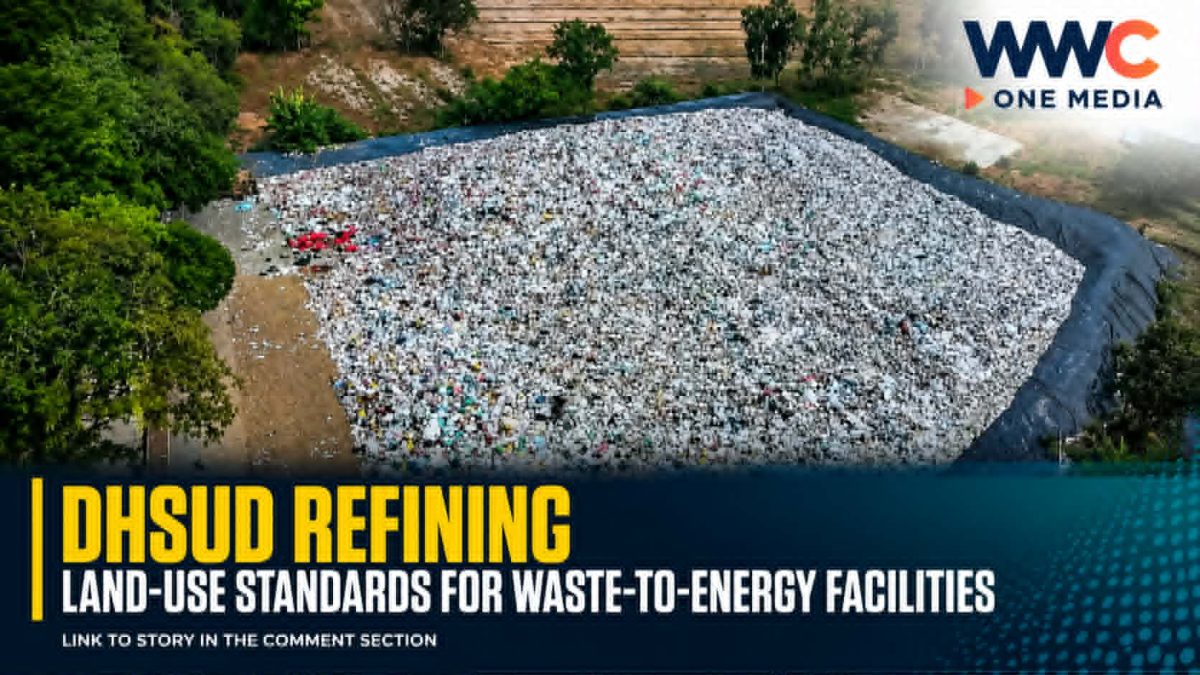
MANILA, Philippines — The Department of Human Settlements and Urban Development (DHSUD) is refining land-use standards for waste-to-energy (WTE) facilities as the Marcos administration accelerates efforts to turn the country’s mounting waste problem into a potential source of energy.
But the government’s push for waste-to-energy will not mean a free pass for new facilities.
DHSUD officials say local government units (LGUs) must carefully determine where WTE facilities can be located, how close they may be to communities, whether environmental risks can be managed, and whether there will be enough waste to keep the facilities operating over the long term.
The issue has become increasingly important after President Ferdinand R. Marcos Jr. renewed his call for waste-to-energy technology as part of the government’s response to the country’s garbage and flooding problems.
DHSUD: Location and safety come first
DHSUD Environmental Land Use and Urban Planning and Development Bureau officer-in-charge Assistant Director Ivan Sumilang said Comprehensive Land Use Plans, or CLUPs, will play a major role in determining suitable locations for WTE facilities.
According to DHSUD, WTE plants can potentially be placed in designated utility, transportation and service zones under existing planning frameworks. However, LGUs must examine the possible effects of these facilities on surrounding communities and the environment.
One major consideration is emissions and the distance between WTE facilities and residential areas. The location must also account for possible impacts on nearby water bodies and other sensitive areas.
In other words, a proposed WTE facility cannot simply be placed on available land because it is close to a landfill.
Zoning, land-use planning, environmental safeguards and community safety still matter.
The waste supply problem could be just as important
DHSUD is also warning LGUs about another issue that could determine whether a WTE project succeeds: having enough waste to keep it running.
While some proposals envision locating WTE facilities close to sanitary landfills to reduce hauling and transportation costs, DHSUD says LGUs first need to determine whether their waste volume can sustain the facility.
Sanitary landfills are primarily intended for residual waste—material that can no longer be recovered through recycling or reuse.
A WTE facility, however, requires a dependable and sufficient feedstock supply. If the available waste is insufficient, a costly facility could fail to operate at its intended capacity, potentially turning a major infrastructure investment into an underused asset.
That means LGUs will have to look beyond simply asking, “Where can we build it?”
They also need to ask:
“Do we have enough waste to keep it running?”
DENR also demands proven environmental and health safeguards
The DHSUD move comes as the Department of Environment and Natural Resources (DENR) separately signals support for WTE technology—but with an important condition: the technology used must be demonstrated to be safe for people and the environment.
Recent DENR statements have emphasized the need for technologies that can meet environmental and health safeguards rather than treating every WTE technology as automatically acceptable.
This is significant because WTE projects can involve thermal treatment and emissions controls, making proper technology selection, monitoring and regulatory compliance critical.
The country already has national guidelines governing WTE facilities. DENR’s environmental management framework includes guidelines for the establishment and operation of WTE facilities as part of integrated solid waste management.
Marcos administration accelerates WTE push
The DHSUD review is part of a much broader government effort.
In August, the Department of Energy said it was stepping up implementation of the country’s WTE program following President Marcos’ renewed call to turn residual waste into a productive resource, particularly amid concerns about garbage accumulation in waterways and its contribution to flooding.
Marcos has also said the government is looking at potential locations for WTE facilities, with the aim of reducing the amount of waste transported to landfills and potentially lowering hauling costs for LGUs.
The government is therefore looking at WTE not only as a waste-management solution, but also as a possible source of electricity and an additional component of the country’s energy strategy.
Projects are already moving forward
The WTE push is no longer purely theoretical.
The Bases Conversion and Development Authority (BCDA) said the DENR has supported the development of a PHP4-billion large-scale WTE facility in New Clark City, Tarlac, describing it as part of the administration’s broader efforts involving environmental protection, energy security and sustainable urban development.
The government has also been exploring WTE projects in other parts of the country, including Metro Manila.
However, the emerging policy direction makes one thing clear: the expansion of WTE cannot be separated from proper land-use planning and environmental regulation.
LGUs will remain on the front line
Although national agencies establish planning and environmental standards, implementation of land-use and zoning decisions is largely devolved to local governments.
DHSUD says proposed land-use plans of component cities and municipalities undergo evaluation through Provincial Land Use Committees, which include DHSUD and DENR representation.
For highly urbanized cities, proposed plans are reviewed through Regional Land Use Committees before ratification.
That gives LGUs a critical role in determining whether a proposed WTE facility fits within their long-term development plans.
And that means local governments will need reliable data—not only on available land, but also on waste generation, waste composition, recycling and recovery rates, transportation requirements and environmental risks.
The bigger question: energy solution or another environmental challenge?
Waste-to-energy promises two potential benefits: less residual waste going to landfills and energy generation from material that would otherwise require disposal.
But the technology also comes with legitimate environmental concerns, particularly regarding emissions, ash and the need for effective pollution-control systems.
Environmental groups have raised concerns about WTE projects, arguing that the country should prioritize waste reduction, reuse, recycling and other approaches within a circular-economy framework.
The government’s challenge, therefore, is not simply to build more WTE plants.
It is to make sure that any facility approved for development is properly located, properly designed, properly monitored and supported by a sustainable waste supply.
No shortcuts
The DHSUD’s latest position sends a clear message to LGUs and project proponents: waste-to-energy may be part of the Philippines’ future waste-management strategy, but location, safety, environmental protection and long-term viability cannot be treated as afterthoughts.
The country may be moving closer to turning garbage into electricity.
But before the first kilowatt is generated, the biggest decision may be what happens before construction even begins—and where these facilities will ultimately be allowed to stand.
WWC ONE MEDIA G.A




Leave a Reply