
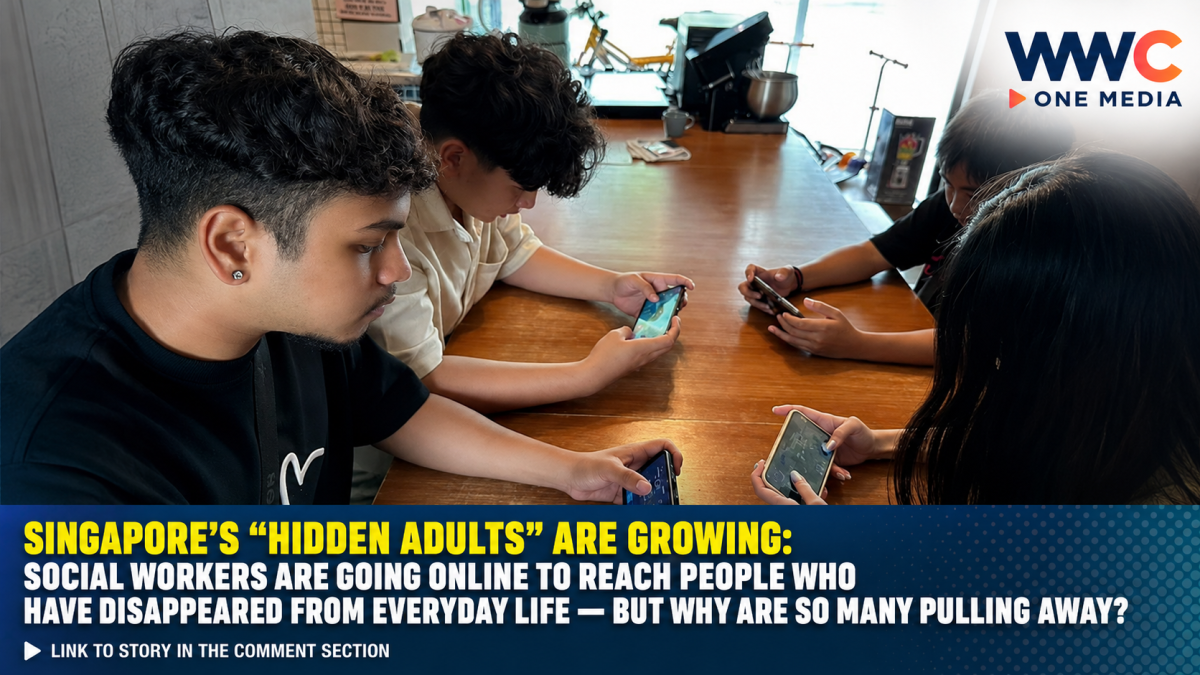
SINGAPORE — A growing number of adults in Singapore are retreating from work, relationships and everyday social life, with some remaining largely confined to their homes or bedrooms for months — and in some cases, years.
Social service agencies say they are encountering more people who have become increasingly disconnected from society, prompting social workers to change the way they reach out.
Instead of waiting for isolated adults to walk into a service centre, some social workers are now entering the online spaces where these individuals feel most comfortable, including gaming communities, Twitch and Discord.
The phenomenon has been described as involving “hidden adults” — working-age people who withdraw from public life to an extent that they can become almost invisible to conventional support systems.
Cases are rising, but Singapore still does not know the full scale
The exact number of socially withdrawn adults in Singapore remains unknown.
But agencies working directly with affected individuals are reporting a rise in enquiries and cases.
Fei Yue Community Services, for example, has assisted about 40 cases, roughly double the approximately 20 cases it had encountered when it began focusing on the issue in 2024.
Meanwhile, TOUCH Community Services received about 250 enquiries in 2025 involving socially withdrawn individuals — more than twice the number recorded in 2022.
Those figures do not mean that Singapore has definitively recorded a nationwide doubling of “hidden adults.” Rather, they indicate that frontline social-service agencies are seeing more people seeking help or being identified as socially withdrawn.
Social workers also expect reported cases to increase as awareness improves and families become more willing to seek assistance.
For some, the outside world becomes overwhelming
The reasons behind prolonged withdrawal are not necessarily the same for everyone.
CNA reported cases involving factors such as anxiety, depression, bullying, family pressures and a loss of purpose. Some adults may still leave home occasionally, while others rarely leave their rooms.
One individual interviewed by CNA, identified by the pseudonym David, said anxiety and depression contributed to his withdrawal. He described becoming afraid of attempting new things because of the possibility of making mistakes.
That illustrates why simply telling someone to “go outside” or “get a job” can miss the underlying problem.
For someone already experiencing intense anxiety or fear, even ordinary social interactions can become difficult.
So social workers are meeting people where they already are
For social worker Stephanie Tan of Youth Guidance Outreach Services, that can mean logging into an online game.
She uses games and platforms such as Twitch and Discord as potential entry points for reaching people who may be uncomfortable with traditional face-to-face services.
The approach is deliberately gradual.
A social worker may first send a direct message, establish familiarity and build trust. Over time, an online conversation could eventually develop into a voice call, an invitation to meet or even something as simple as having a meal outside.
The goal is not necessarily to force someone back into society overnight.
It is to establish a first connection.
Singapore’s mental-health system is also moving toward earlier, community-based intervention
The development comes as Singapore expands its broader mental-health support network.
Under the National Mental Health and Well-being Strategy, Singapore has been developing a tiered system intended to provide people with support according to the severity of their needs, ranging from community and peer support to specialist and hospital care.
The Ministry of Health said in February 2026 that more than 160,000 frontline personnel and volunteers had been trained to identify people experiencing mental distress and guide them toward appropriate support.
Singapore has also expanded its national mindline 1771, which provides 24-hour mental-health support through telephone, WhatsApp and online webchat.
Since its launch in June 2025, the service had received more than 47,000 calls, messages and webchats by early April 2026, according to MOH.
Another MOH update found that among people who disclosed their age to mindline counsellors, the largest group was 20 to 35 years old, accounting for 44 per cent of those whose age was known in the data cited.
The bigger problem may be the people nobody sees
Singapore’s 2024 National Population Health Survey found that 15.4 per cent of residents experienced poor mental health, with the highest prevalence among young adults aged 18 to 29, at 25.5 per cent. At the same time, willingness to seek help from healthcare professionals increased to 64 per cent in 2024, up from 47.8 per cent in 2019.
But socially withdrawn people may be particularly difficult to reach because they may not actively seek help in the first place.
That creates a gap between having mental-health services available and getting isolated individuals to actually use them.
A person who rarely leaves home may not attend a clinic.
Someone uncomfortable speaking face-to-face may not approach a social worker.
And an adult who has spent years disconnected from society may not even identify themselves as someone who needs formal assistance.
That is why online outreach is emerging as another possible bridge.
Singapore is still trying to understand the phenomenon
The country does not yet have a definitive national count of “hidden adults,” and the term itself describes a pattern of severe or prolonged social withdrawal rather than a formal psychiatric diagnosis.
The Institute of Mental Health is currently conducting Singapore’s third national mental-health study, with data collection scheduled from 2026 through 2027. The study is expected to involve about 6,000 residents aged 15 and above, using face-to-face and online surveys to examine mental-health conditions, well-being and help-seeking behaviour.
That research could provide a broader picture of mental-health needs and help-seeking patterns across Singapore.
Meanwhile, experts and social workers are stressing the importance of early intervention.
Waiting until a person has been isolated for months or years can make reintegration much harder.
The message behind Singapore’s “hidden adults” story
The most important shift may be happening in the way society defines outreach.
For some people, help will not begin in a counselling room.
It may begin with a message.
A conversation in Discord.
A teammate encountered during an online game.
Or simply someone willing to stay and talk without demanding that the person immediately change their life.
Singapore’s experience suggests that for people who have withdrawn from society, the first step back may not be getting them outside — it may be reaching them wherever they still feel safe enough to be found.
WWC ONE MEDIA MJE




Leave a Reply