
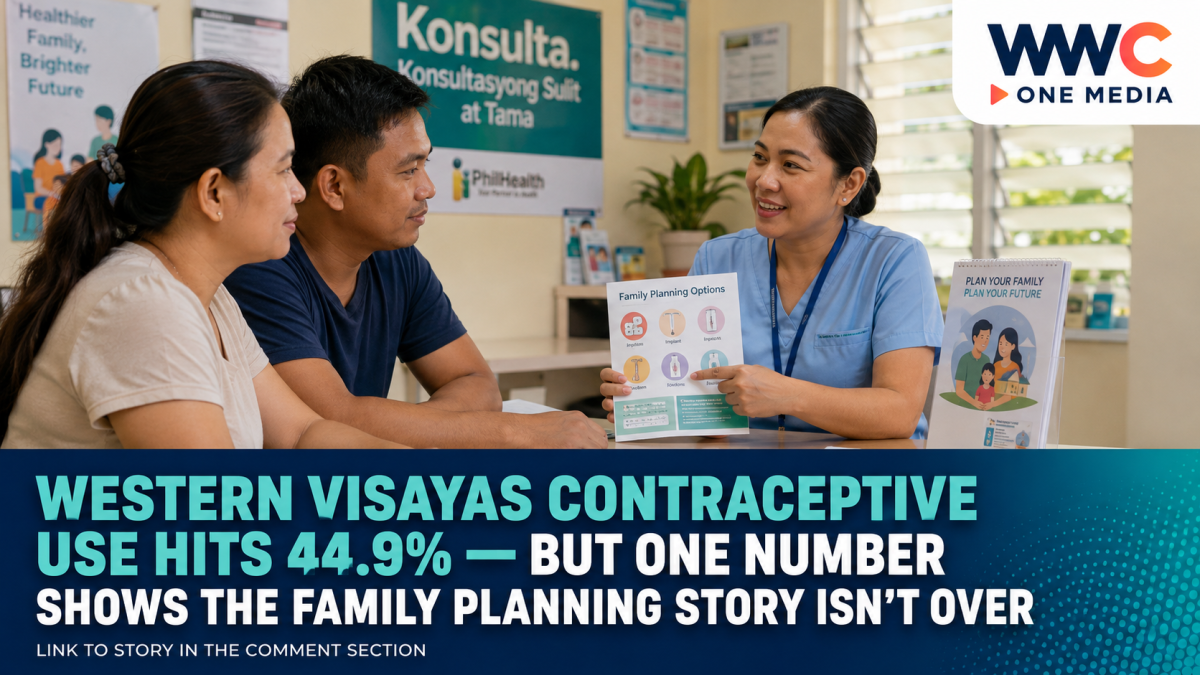
ILOILO CITY — Western Visayas is undergoing a quiet but significant demographic shift, with more married women using modern contraceptives and the region’s fertility rate falling further, according to the latest government survey.
Modern contraceptive use among currently married women aged 15 to 49 in Western Visayas reached 44.9 percent in 2025, slightly above the 44.5-percent national average, figures from the 2025 National Demographic and Health Survey show. The comparable PSA Region VI series puts the regional rate at 44.2 percent in 2022.
That puts Western Visayas above the Philippine average — but it is important not to overstate the result. Region VI does not have the highest contraceptive prevalence rate in the country. PSA data show that Davao Region recorded the highest modern-method use among currently married women in 2025 at 58.2 percent, while BARMM was lowest at 20.2 percent.
The more striking change may be happening in fertility.
The latest PSA regional report estimates Western Visayas’ total fertility rate at 1.9 children per woman, meaning a woman would have an average of 1.9 children over her reproductive years if current age-specific fertility patterns continued. The national fertility rate stood even lower at 1.7 children per woman in 2025.
Why the 2022 comparison needs explanation
Some reports compare Western Visayas’ latest 1.9 fertility rate with 2.2 children per woman in 2022. That 2.2 figure was indeed reported in the original 2022 NDHS when Negros Occidental was still counted under Western Visayas.
But the current regional picture changed following the establishment of the Negros Island Region, which removed Negros Occidental and Bacolod from Region VI. Daily Guardian noted that the 2022 Western Visayas figure included areas now belonging to NIR, while the 2025 data use the new regional configuration.
The PSA’s latest Region VI chart therefore shows the comparable Western Visayas fertility estimate at 2.0 in 2022 and 1.9 in 2025, rather than treating 2.2 and 1.9 as perfectly like-for-like figures.
That distinction matters because the demographic shift is real, but exaggerating the speed of the decline would give readers the wrong picture.
More married women are using family planning
The survey found that 61.9 percent of currently married women aged 15 to 49 in Western Visayas were using some form of contraception in 2025.
Of these, 44.9 percent were using modern methods while 17 percent relied on traditional methods. Modern-method use increased from the PSA Region VI comparable figure of 44.2 percent in 2022, while traditional-method use declined from 19.8 percent.
Among all women aged 15 to 49 in the region — not just those who were currently married — 38 percent reported using any contraceptive method and 27.2 percent were using a modern method.
Pills remained the most frequently used modern contraceptive method at 13.9 percent, followed by injectables at 3.8 percent and female sterilization at 3.3 percent.
The national pattern similarly moved toward modern contraception. Across the Philippines, modern-method use among currently married women increased from 41.8 percent in 2022 to 44.5 percent in 2025, while traditional-method use declined from 16.5 percent to 14.1 percent.
But 13.7% still have an unmet family planning need
The progress comes with a major caveat.
Despite broader access to contraception, 13.7 percent of currently married women in Western Visayas still had an unmet need for family planning in 2025. That refers broadly to women who want to postpone or stop childbearing but are not using contraception, including certain women with mistimed or unwanted pregnancies.
The figure improved from 15.5 percent in 2022, but it means access, information and continuity of reproductive health services remain unfinished issues.
Around 75.6 percent of married women had a demand for family planning, and 81.9 percent of that demand was satisfied by any method. However, only 59.4 percent of demand was satisfied specifically by modern methods, although that was an improvement from 55.6 percent in 2022.
Those numbers add an important dimension to the headline: higher contraceptive prevalence does not necessarily mean everyone who wants to prevent or delay pregnancy can obtain and consistently use the method that works for them.
More women say their families are complete
The survey also points to changing preferences about how many children couples want.
Among currently married women aged 15 to 49 in Western Visayas, 53.1 percent said they wanted no more children or were already sterilized, while 17.8 percent wanted to wait at least two years before having another child. Only about 12 percent said they wanted another child within two years.
The preference becomes particularly strong after couples already have several children. Among married women with two children, 66.1 percent said they wanted no more children or were sterilized. Among those with three children, the proportion rose to 81.9 percent.
Those figures help explain why Western Visayas’ fertility rate has moved downward over the long term.
In 1993, fertility in the region was estimated at more than four children per woman. It has since fallen to roughly two, reflecting decades of change in reproductive choices, education, health access, household economics and attitudes toward parenthood.
Poverty and education remain part of the equation
The decline cannot be attributed to contraception alone.
Commission on Population and Development officials have stressed that fertility patterns are also closely connected with income, education and access to reproductive health services.
Daily Guardian reported CPD Region 6 Director Harold Alfred Marshall as pointing to national data showing fertility of 2.8 children per woman among the poorest households compared with 1.1 among the richest, arguing that reproductive outcomes are partly shaped by socioeconomic conditions rather than simply personal preference.
That national divide is mirrored in contraceptive behavior. PSA found modern contraceptive use nationally was actually higher among married women in the poorest wealth quintile, at 48.6 percent, than among those in the richest quintile, at 37.7 percent.
The figures underline why family planning policy increasingly goes beyond simply distributing contraceptives. Access to medical advice, education, poverty reduction, reliable health facilities and the ability of women and couples to make informed reproductive decisions all affect the outcome.
Region VI also scores strongly in maternal care
The 2025 survey offers another encouraging sign for Western Visayas.
Region VI recorded the highest antenatal-care coverage in the country at 98.5 percent among women covered by the survey indicator. It also posted the country’s highest rate of mothers receiving a postnatal check within the first two days after birth, at 91.4 percent.
Institutional deliveries in Western Visayas reached 96.7 percent, with an equal 96.7 percent of live births assisted by skilled providers, according to the PSA regional report.
Together, the figures suggest that the region’s demographic changes are occurring alongside broader improvements in access to maternal and reproductive healthcare.
Smaller families bring opportunities — and longer-term questions
CPD officials have previously described declining fertility as a potential opportunity for families and the economy because households with fewer dependents may have greater capacity to spend on education, health, savings and investment.
But the transition also carries longer-term implications.
As fertility falls and population growth slows, the share of younger people can eventually decline while the elderly population grows. The Philippine Information Agency, citing CPD Region 6, has warned that sustained demographic change can eventually place greater pressure on healthcare, pensions and the future labor force if economic and social policies fail to adjust.
For now, Western Visayas is not facing an overnight population collapse. Fertility rates can fluctuate, and population trends are also affected by migration, age structure and mortality.
What the 2025 data clearly show is something more immediate: women and couples in Western Visayas are increasingly choosing smaller families, modern contraception is becoming more common, and reproductive preferences are changing faster than they were a generation ago.
The challenge for government is ensuring that those choices remain genuinely voluntary and informed — and that the 13.7 percent of married women whose family planning needs remain unmet are not left behind.
WWC ONE MEDIA MJE




Leave a Reply