
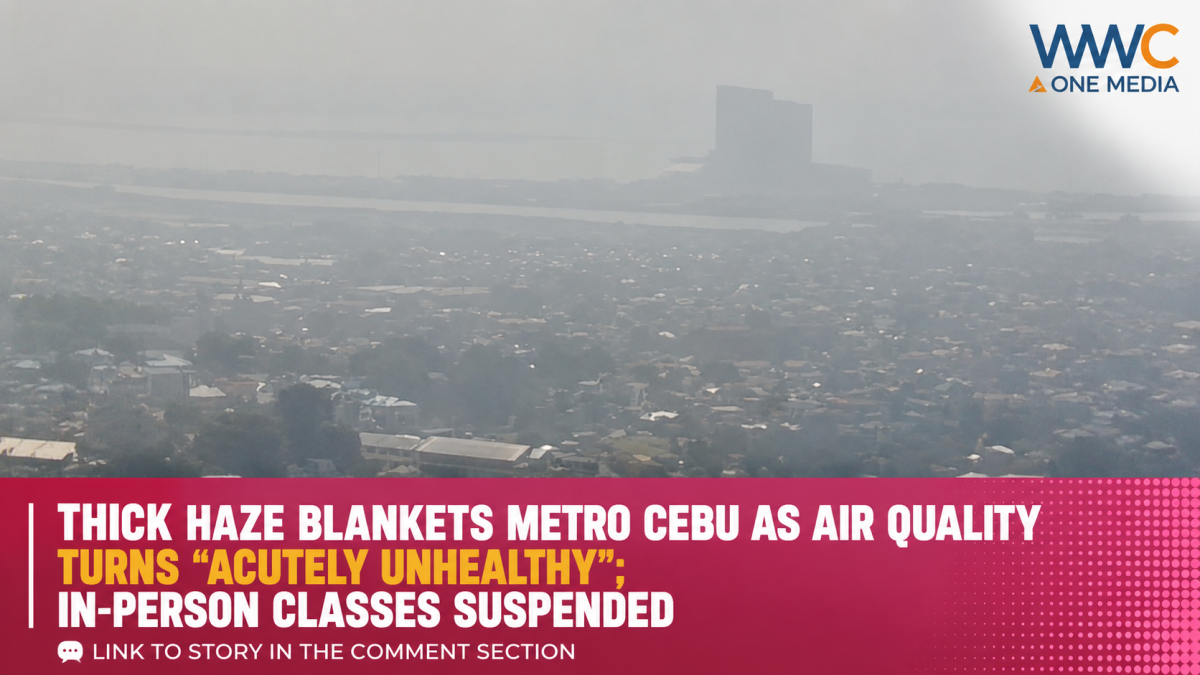
CEBU CITY, Philippines — A thick blanket of transboundary haze has covered Metro Cebu, prompting local governments to suspend face-to-face classes as air pollution reached potentially hazardous levels on Wednesday, September 2, 2026.
The latest readings from the Department of Environment and Natural Resources–Environmental Management Bureau (DENR-EMB) Region 7 showed the Air Quality Index (AQI) climbing to 208 in the morning and 215 by the afternoon, placing the air quality in the “Acutely Unhealthy” range. The pollutant of particular concern is PM2.5, extremely fine particles that can penetrate deep into the respiratory system.
The deterioration comes a day after the Talisay monitoring station recorded AQI readings of 152, 172 and 173 on September 1.
Cebu cities suspend face-to-face classes
The worsening conditions have already affected schools across Metro Cebu.
Cebu City Mayor Nestor Archival ordered the suspension of face-to-face classes in all public and private schools beginning at 2 p.m. Wednesday through Thursday, September 3. The city said regular classes are expected to resume Friday, September 4, depending on air-quality conditions.
Lapu-Lapu City also suspended face-to-face classes across public and private schools on Thursday, while Talisay City suspended in-person classes in public schools. Schools were instructed to continue education through alternative arrangements, including modular and asynchronous learning where applicable.
The impact is also being felt by higher education. Cebu Technological University–Main Campus announced that face-to-face classes would be suspended from 3 p.m. Wednesday through September 3, while flexible work arrangements were introduced for some non-essential personnel.
Where is the haze coming from?
This is not simply ordinary Cebu smog.
DENR-EMB 7 has linked the worsening air quality to forest fires in Kalimantan, Indonesia, with smoke and fine particulate matter transported toward the Philippines by prevailing winds, including the southwest monsoon or Habagat.
Officials say the situation can persist while the Indonesian fires continue and wind patterns keep transporting pollutants toward Central Visayas.
The same haze has affected other parts of the Philippines. The Philippine News Agency reported that haze-related pollution has shifted toward the Visayas and Mindanao, while conditions in Metro Manila showed some improvement as wind direction changed.
Why PM2.5 is causing concern
PM2.5 refers to particles measuring 2.5 micrometers or smaller. Because they are so small, they can travel deep into the lungs.
Health officials are particularly concerned about children, senior citizens and people with respiratory or cardiovascular conditions.
The Department of Health in Central Visayas has advised residents to limit unnecessary outdoor activities and use N95 or KN95 masks when going outside. People experiencing serious coughing, breathing difficulties or other concerning symptoms should seek medical attention.
Officials are watching what happens next
The biggest uncertainty is how long the haze will remain.
DENR-EMB officials have emphasized that conditions depend heavily on the Indonesian fires, wind direction and weather over the Philippines. Rainfall could help remove airborne particles, but continuing fires and favorable winds could keep bringing smoke into the region.
For now, residents are being urged to reduce outdoor exposure, wear appropriate masks, monitor official air-quality bulletins and follow local government advisories.
And with Metro Cebu’s AQI reaching 215, the decision to move students away from prolonged outdoor exposure is becoming more than just a precaution — it is now a public-health response to an air-quality emergency.
What residents should do
- Limit unnecessary outdoor activities.
- Wear an N95 or KN95 mask when outdoor exposure cannot be avoided.
- Keep children, older adults and vulnerable individuals indoors as much as possible.
- Avoid strenuous outdoor exercise.
- Monitor DENR-EMB and local government advisories.
- Seek medical attention for severe breathing difficulty or persistent concerning symptoms.
- WWC ONE MEDIA J.M.D




Leave a Reply