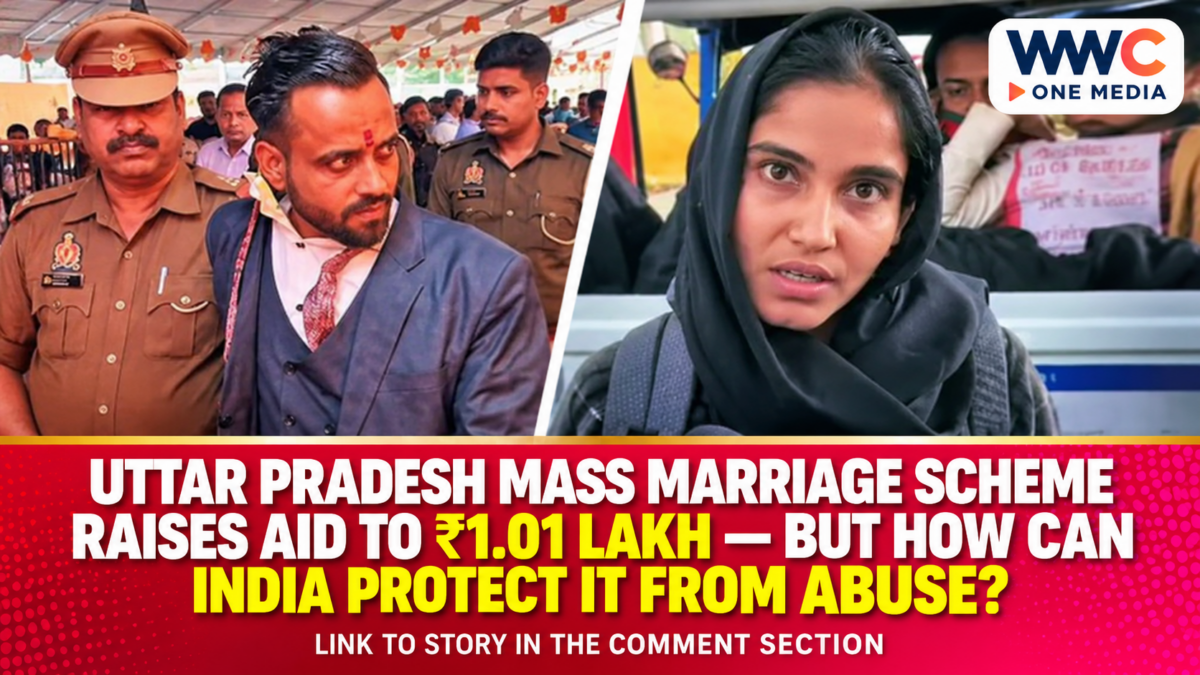
UTTAR PRADESH, India — The UP Mass Marriage Scheme has nearly doubled its financial assistance package, increasing support from ₹51,000 to ₹101,000 for eligible marriages as part of the state’s social welfare programme.
Uttar Pradesh’s 2026–2027 budget also proposes ₹750 crore in funding for the initiative, officially known as the Mukhyamantri Samuhik Vivah Yojana.
While the expansion offers greater financial relief to economically disadvantaged families, it also highlights an important administrative challenge: ensuring that public money reaches eligible beneficiaries and that marriages comply with applicable legal requirements.
UP Mass Marriage Scheme: How much financial assistance is available?
The revised assistance package represents an increase of ₹50,000, or approximately 98% over the previous amount.
However, the ₹101,000 package should not be interpreted as an unrestricted cash payment to either spouse.
The programme includes:
- ₹60,000 in financial assistance for the bride.
- ₹25,000 worth of marriage-related materials.
- Other programme-related expenditure within the overall assistance framework.
The distinction is important because government-sponsored marriage assistance is intended to reduce financial pressure on eligible families rather than provide an unconditional financial reward for getting married.
The expansion also forms part of a wider discussion about financial security and eligibility for government-supported programmes in India, including the country’s proposed provident fund withdrawal reforms.
Although the programmes serve different purposes, both illustrate why clearly defined eligibility requirements matter when administering financial benefits.
Who qualifies for Uttar Pradesh’s marriage assistance programme?
The scheme targets economically weaker families, with eligible couples coming from households whose income does not exceed ₹300,000, or three lakh rupees.
Applications can be submitted through the designated online government portal.
For families facing financial difficulties, assistance with marriage expenses can reduce the need to borrow money or divert savings from essential household requirements.
However, financial eligibility should not be confused with legal eligibility to marry.
A couple’s participation in a government-funded ceremony does not automatically resolve questions concerning marital status, identity or other requirements under applicable marriage laws.
This is where effective administrative verification becomes particularly important.
Why marriage verification matters
Increasing the value of welfare assistance makes accurate beneficiary screening increasingly important.
Before public money is distributed, administrators should be able to establish whether applicants genuinely qualify for the programme.
Verification could include reviewing identity documents, household income information and relevant marital-status records.
Where an applicant was previously married, officials may also need to establish whether that marriage was legally dissolved or otherwise terminated under applicable law.
Such checks should protect legitimate applicants without creating unnecessary obstacles for eligible families.
Legal disputes must also be distinguished from established wrongdoing. An allegation concerning a person’s marital status does not, by itself, establish criminal liability or prove that government assistance was fraudulently obtained.
The importance of evidence and due process is also examined in WWC ONE MEDIA’s coverage of police investigations involving a woman’s death in Pune.
The same principle applies to suspected welfare irregularities: conclusions must follow verified evidence rather than speculation.
The ₹750-crore question: How can public funds be protected?
Uttar Pradesh’s proposed ₹750-crore allocation is equivalent to ₹7.5 billion.
The scale of the proposed funding makes accountability an important consideration for taxpayers, beneficiaries and programme administrators.
A well-designed assistance programme should balance accessibility with financial safeguards.
Potential measures include accurate applicant records, documented eligibility assessments, transparent disbursement procedures and accessible complaint mechanisms.
Digital applications can help organise beneficiary information, but collecting information is not necessarily the same as independently verifying it.
Authorities should also consider how disputed applications are handled before funds are released.
An effective review process would distinguish administrative errors from deliberate misrepresentation and ensure that affected applicants have an opportunity to respond.
Importantly, the proposed budget allocation does not establish that ₹750 crore has already been distributed or that any particular individual has improperly received assistance.
Protecting women must remain central to the programme
The allocation of ₹60,000 specifically for the bride is a significant feature of the scheme’s financial structure.
Beyond financial assistance, marriage-related welfare programmes should consider the personal security, informed consent and legal rights of participants.
An applicant who enters a marriage without knowing relevant information about their prospective spouse could face serious personal and financial consequences.
Accessible reporting channels and proper documentation could help address such concerns.
The importance of protecting vulnerable individuals while avoiding premature conclusions also features in WWC ONE MEDIA’s coverage of the Gujarat pregnant teen death investigation.
These are separate issues, but both underline the importance of safeguarding individual rights and establishing facts through appropriate legal procedures.
What happens next?
The critical question is how effectively Uttar Pradesh administers its expanded marriage assistance package.
Future assessment should examine actual beneficiary numbers, the release of allocated funds, the accuracy of eligibility screening and the resolution of complaints.
Greater financial assistance can make marriage expenses more manageable for economically disadvantaged households.
However, the programme’s long-term credibility will depend not only on how much money is available but also on whether the assistance reaches its intended recipients.
The objective should be straightforward: protect eligible families, safeguard women and ensure responsible use of public resources.