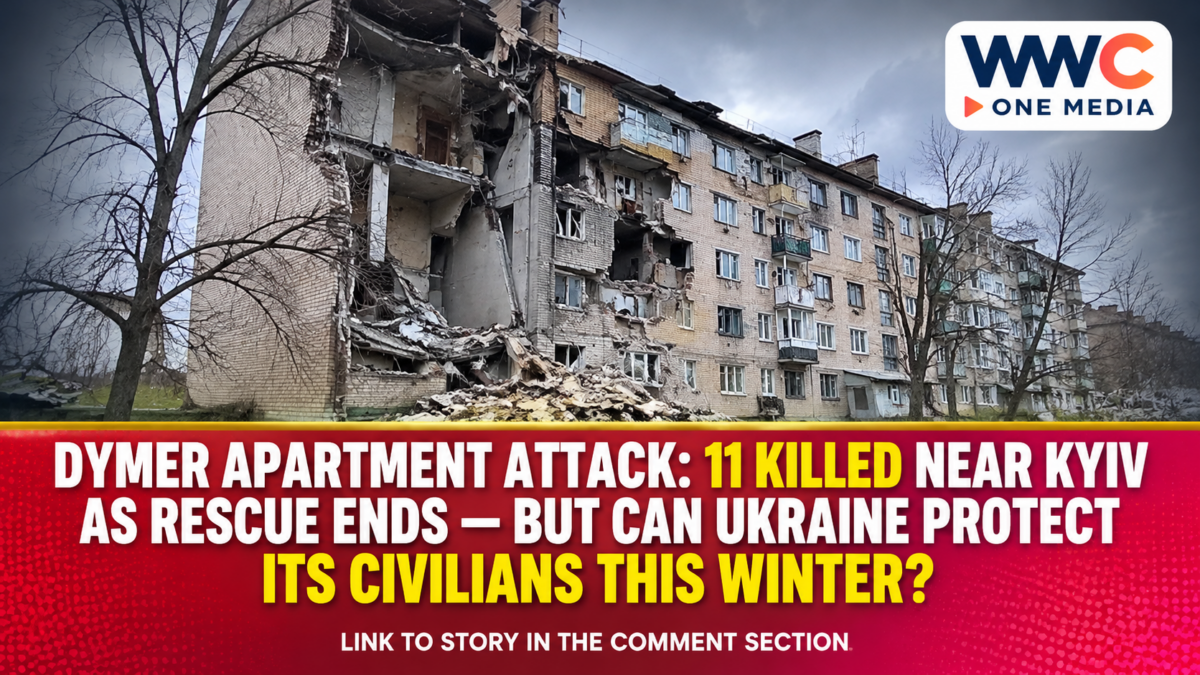
KYIV, UKRAINE — The Dymer apartment attack has claimed 11 lives, including that of an 11-year-old girl, after a Russian strike devastated a residential building in Ukraine’s Kyiv region on Nov. 22, 2026.
Emergency rescue operations concluded on Nov. 23, with a seven-year-old boy and a 79-year-old woman among those rescued from the rubble.
Five people remained under medical supervision in hospitals as of the latest official update, while specialists were still working to establish the identities of two of those killed.
The tragedy raises renewed questions about civilian protection as Ukraine approaches another winter marked by war, damaged infrastructure and interruptions to essential services.
Dymer apartment attack leaves families facing an uncertain future
For the residents of Dymer, the end of emergency rescue operations represents only the beginning of a much longer recovery.
More than 2,000 tonnes of construction debris were removed during the emergency response, while dangerous structural elements were dismantled.
Police are expected to maintain a presence at the site to document the incident and preserve public order.
Beyond the immediate destruction, affected households face questions about accommodation, access to personal belongings, medical treatment and psychological recovery.
These concerns illustrate why the humanitarian consequences of residential attacks cannot be measured through casualty figures alone.
Even after emergency personnel finish their work, displaced families may require assistance for months or longer.
A child and an elderly woman survive the destruction
Among the most significant developments in Dymer was the rescue of a seven-year-old boy and a 79-year-old woman.
Their survival offered a measure of relief amid the tragedy.
The operation involved more than 130 personnel, highlighting the substantial emergency resources required when residential buildings suffer extensive structural damage.
However, survival does not necessarily mark the end of a person’s ordeal.
Physical rehabilitation, psychological assistance and access to secure accommodation may become essential components of recovery, particularly for children and elderly residents.
The incident also reinforces the importance of public emergency systems, an issue previously explored in WWC ONE MEDIA’s coverage of Europe’s household emergency preparedness strategy.
Individual preparedness, however, cannot replace effective civilian protection or professional emergency assistance.
Ukraine’s civilian casualties rise sharply in 2026
The Dymer tragedy comes amid a significant deterioration in civilian security across Ukraine.
Between January and October 2026, verified civilian casualty figures reached:
| Classification | Total |
|---|---|
| Civilians killed | 2,957 |
| Civilians injured | 17,218 |
| Increase in combined casualties compared with the same period in 2025 | 63% |
The figures cover the first ten months of 2026 and do not include the Nov. 22 Dymer attack.
The rising toll demonstrates that humanitarian pressures remain substantial even as international discussions continue over military assistance, security guarantees and potential diplomatic settlements.
For families living in affected communities, the distinction between frontline and non-frontline areas offers limited reassurance when residential neighbourhoods remain exposed to attacks.
Winter threatens to deepen Ukraine’s humanitarian crisis
Ukraine is approaching its fifth winter since Russia launched its full-scale invasion in February 2022.
The humanitarian challenge extends beyond damage to residential buildings.
Attacks against electricity and heating infrastructure intensified during October 2026, disrupting essential services and prompting scheduled power interruptions across Ukraine.
The consequences of prolonged electricity shortages become increasingly serious during colder weather.
Households may struggle to maintain adequate heating, refrigerate medicine, communicate with relatives or access essential services.
WWC ONE MEDIA previously examined the wider infrastructure crisis in its reporting on Russian energy strikes and Ukraine’s electricity disruptions.
Restoring electricity and protecting residential communities remain interconnected humanitarian priorities.
Without reliable services, even undamaged homes may become difficult to inhabit during severe winter conditions.
International diplomacy faces renewed pressure
The continued loss of civilian lives raises questions about whether international diplomatic initiatives can deliver meaningful improvements in security.
Military assistance, humanitarian financing, reconstruction support and negotiations remain important elements of the broader international response.
Previous WWC ONE MEDIA coverage of European demands for an end to the Ukraine war before a new Russian security agreement examined the challenges surrounding negotiations and long-term security arrangements.
For governments pursuing diplomatic solutions, a central challenge is ensuring that any agreement provides practical protection for civilians rather than merely establishing political commitments.
The Dymer attack underscores the human consequences of failing to achieve that objective.
For international policymakers, humanitarian assistance and civilian protection remain urgent concerns regardless of the direction of future negotiations.
What happens next for Dymer?
Although the emergency rescue operation has ended, several important issues remain unresolved.
Authorities must complete victim identification, continue documenting the attack and determine what assistance affected residents require.
Medical treatment and longer-term recovery will remain priorities for survivors.
The wider challenge is whether Ukraine can strengthen civilian protection, restore essential infrastructure and maintain humanitarian services throughout the coming winter.
For Dymer’s affected families, the immediate priority is recovery.
For the international community, the tragedy presents a broader question: whether diplomatic and security commitments can translate into meaningful protection for people whose homes remain vulnerable to war.