
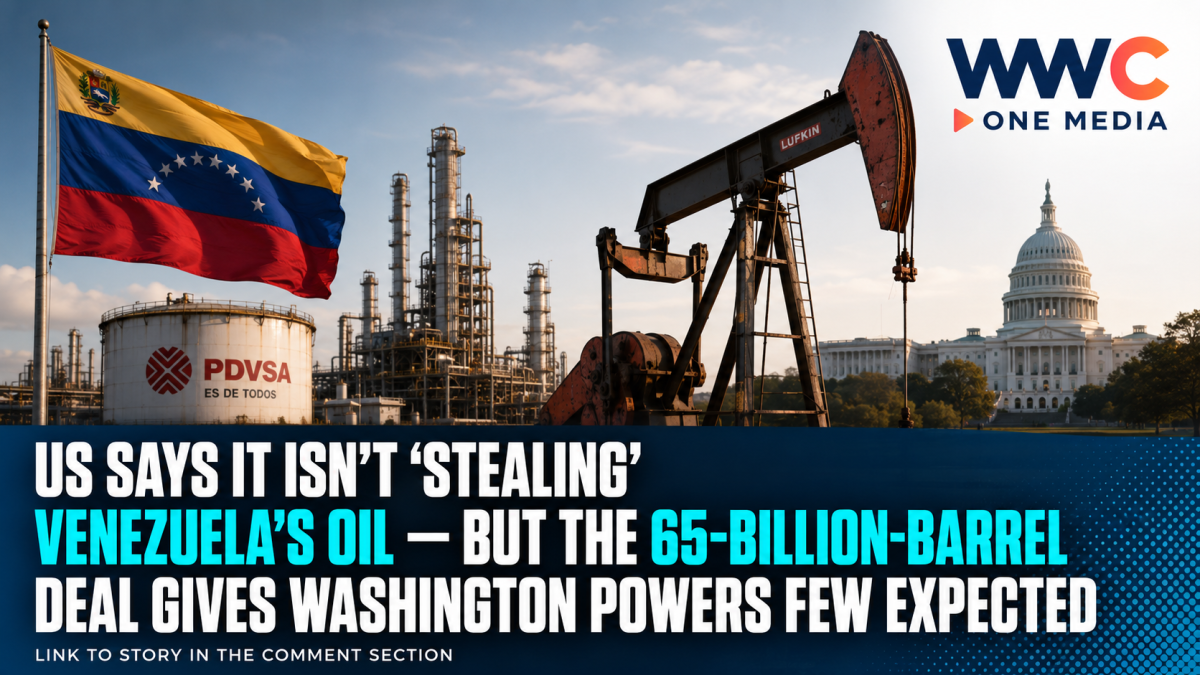
CARACAS, Venezuela — U.S. Energy Secretary Chris Wright has rejected accusations that Washington is effectively taking Venezuela’s oil, insisting that the South American country will remain the owner of its vast petroleum resources.
But newly disclosed details of the extraordinary U.S.-Venezuela energy arrangement show why the agreement is generating far more controversy than a conventional foreign oil investment.
The deal connects Washington to roughly 65 billion barrels of Venezuelan proven oil reserves, gives the U.S. government rights to a 35% equity stake in the corporate parent of private operator North American Blue Energy Partners (NABEP), guarantees access to part of the company’s future production at production cost and gives Washington significant influence over the company’s governance.
Those provisions have transformed what President Donald Trump calls the “biggest oil deal in world history” into a debate over sovereignty, energy security, foreign investment and the future political direction of Venezuela.
Wright: Venezuela Still Owns the Oil
Speaking in Caracas on September 2, Wright pushed back against headlines accusing the United States of taking Venezuelan resources.
He argued that private companies would supply the investment and technology needed to bring dormant oil fields back into production, while Venezuela would continue receiving royalties and taxes.
“The oil in Venezuela is indeed owned by the people of Venezuela,” Wright said, according to AFP.
His argument is straightforward: Washington is not physically confiscating Venezuela’s underground reserves or declaring them American property. Instead, private companies will develop the resources commercially while Venezuela receives government revenue.
Venezuelan interim President Delcy Rodríguez has made a similar case, saying the country retains “ownership of and sovereignty” over its natural resources. Caracas estimates that the broader arrangement could generate approximately $209 billion in government revenue over 25 years, depending on production and oil prices.
But that is only one side of the deal.
What Does the United States Actually Get?
The White House’s own description shows that Washington is receiving substantial rights.
Venezuelan interim authorities have granted NABEP 100-year concessions covering 17 oil fields containing approximately 65 billion barrels of proven reserves.
In connection with the arrangement, NABEP granted the U.S. Department of War’s Office of Strategic Capital rights to a 35% equity stake in its corporate parent.
The U.S. State Department will also have the right to buy 20% of production from NABEP-operated fields at production cost.
For the remaining 80%, Washington receives a right of first refusal, meaning it gets the first opportunity to buy that crude before other purchasers.
The U.S. government also receives veto power over appointments to NABEP’s board, while a majority of directors must be U.S. citizens, according to the White House.
That distinction is important.
Wright’s statement that Washington is not “taking” Venezuela’s oil can be accurate in the narrow sense that the crude remains Venezuelan property until commercially produced and sold.
But the agreement simultaneously gives the United States extensive influence over the company developing those resources and preferential access to the resulting oil.
25 Years or 100 Years? The Difference Matters
Another potentially confusing element is the agreement’s duration.
Rodríguez has described the bilateral energy project as lasting 25 years, with an initial target of raising production connected with the agreement to more than 1.5 million barrels per day.
The White House, however, says NABEP received 100-year concessions over the 17 fields.
Those figures are not necessarily contradictory: the 25-year period relates to the economic and production framework highlighted by Caracas, while the underlying concessions granted to NABEP extend much longer.
But the difference has contributed to demands for greater transparency about exactly how the arrangement will operate over several generations.
Legal Experts Are Asking Questions
Reuters reported that lawyers and energy experts have questioned both the legal foundation and transparency of the arrangement.
The agreement was negotiated without a competitive bidding process, according to Reuters, while Venezuela was simultaneously restructuring its hydrocarbons rules and migrating existing oil contracts into a new framework.
Legal experts told Reuters that elements of the agreement could eventually face challenges in court.
Analysts are also questioning whether granting extraordinary advantages to one operator could discourage other international companies from investing if they believe they will be competing against a company backed by the U.S. government.
That matters because Venezuela needs enormous amounts of outside capital—not just access to underground reserves—to restore pipelines, electricity generation, wells, refineries, export facilities and other infrastructure damaged or neglected over decades.
Venezuela Has Huge Reserves — But Production Remains Far Below Its Peak
Venezuela possesses the world’s largest proven crude-oil reserves, yet its actual production has fallen dramatically from historic levels.
Reuters estimates current output at roughly 1.25 million barrels per day, compared with approximately 3 million barrels per day during the 1990s.
Years of underinvestment, economic crisis, management problems, sanctions and deteriorating infrastructure have prevented Caracas from converting its enormous reserves into equally enormous production.
The new agreement is designed to change that.
NABEP says it plans to raise nearly $100 billion for investment and ultimately increase its Venezuelan production to more than 1 million barrels per day.
Chevron Is Betting Billions Too
The NABEP agreement is not the only major shift underway.
Chevron announced on September 2 that its Venezuelan joint ventures plan to invest more than $7 billion over five years, with the goal of roughly doubling the company’s production in Venezuela to about 600,000 barrels per day.
Italian energy giant Eni is also expanding its involvement.
Those agreements are separate from the U.S.-NABEP arrangement but illustrate how rapidly Venezuela’s energy landscape is changing following the removal of Nicolás Maduro from power by U.S. forces in January and the installation of Rodríguez as interim leader.
Chevron’s commitment is particularly important because the company has maintained a significant presence in Venezuela while several other Western oil majors previously withdrew or remained reluctant to return.
Washington Also Wants Venezuelan Crude for Strategic Reasons
The agreement goes beyond corporate profits.
The White House says preferential access to Venezuelan production could help replenish the U.S. Strategic Petroleum Reserve, while giving American refiners and government agencies access to a major source of crude in the Western Hemisphere.
Many U.S. Gulf Coast refineries are also technically well suited to processing Venezuela’s heavy crude.
That makes Venezuelan production strategically valuable to Washington, particularly during periods of disruption in global energy markets.
President Trump argues that expanding Venezuelan supply will ultimately contribute to lower American fuel prices.
However, analysts caution that rebuilding Venezuela’s petroleum infrastructure will take years, meaning consumers should not necessarily expect a sudden flood of cheap crude or an immediate collapse in gasoline prices.
Then There Is the Political Question
The oil agreement is unfolding alongside an unresolved debate over Venezuela’s democratic future.
Maduro was captured and removed during a U.S. military operation in January 2026, leaving Rodríguez to govern on an interim basis.
Trump said this week that Venezuela is not yet ready for elections, while Wright described elections as a process requiring institutional reforms and economic stabilization first.
That position is politically sensitive because Venezuela’s previous presidential election in 2024 was widely disputed. The Carter Center concluded that the vote did not meet international standards of electoral integrity and could not be considered democratic.
Critics therefore worry that an enormous long-term oil arrangement negotiated before a new national election could become vulnerable to challenges from a future Venezuelan government.
The Bigger Question Is No Longer Who Owns the Oil
Technically, Venezuela continues to own the petroleum beneath its territory.
But ownership alone does not tell the entire story.
The more consequential questions are who controls development, who finances production, who gets preferential access to the crude, who oversees the money and whether the agreement survives future political change.
Washington will have significant governance rights over NABEP, preferential purchasing rights over its oil, a potential 35% equity interest in the operator’s corporate parent and strict oversight of financial flows.
Venezuela, meanwhile, is betting that foreign capital and American technology can revive an industry sitting on hundreds of billions of barrels of underground wealth but producing only a fraction of its historic potential. U.S. officials say royalties and taxes will benefit Venezuelans; Reuters reports Wright also pledged strict U.S. controls over the flow of funds connected with the arrangement.
So the dispute over whether America is “stealing” Venezuelan oil may actually obscure the more important story.
The real test will be whether this unprecedented arrangement genuinely rebuilds Venezuela’s economy—or leaves future governments fighting over who was given control of one of the largest pools of petroleum wealth on Earth.
WWC ONE MEDIA MJE
Leave a Reply